Description
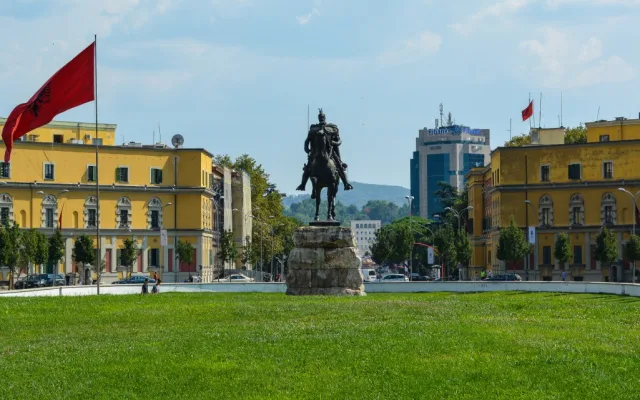
The capital of Albania: colourful facades, an arts scene housed in old bunkers, the legacy of the Hoxha years and a lively restaurant culture at Europe's lowest prices.
Wiki
Tirana is the capital and largest city of Albania, situated in the centre of the country on a fertile plain between the Adriatic Sea and a mountain range. It is one of Europe's youngest and fastest-changing capitals: once closed off and little known, today it draws travellers with its colourful architecture, affordable prices and vibrant urban atmosphere.
City at a glance
Tirana's population is around 420,000, with the greater metropolitan area considerably larger. For much of its history the settlement was a quiet backwater of the Ottoman Empire, receiving capital city status only in 1920 when Albania became an independent state. The defining mark on the city's character and fate was left by nearly half a century of communism: from 1944 until his death in 1985 the country was ruled single-handedly by Enver Hoxha, and the regime held on until 1991; Albania became one of the most isolated states on the planet. Severing ties even with former allies, a cult of concrete bunkers and a ban on travel abroad turned it into a blank spot on the map of Europe. Since the 2010s, Tirana has been opening up rapidly and reinventing itself, while remaining one of the most affordable capitals on the continent.
Main sights
- Skanderbeg Square — the spacious heart of the city, with an equestrian statue of national hero Gjergj Kastrioti Skanderbeg (1405–1468), who led resistance against the Ottomans. The main civic buildings are clustered around it.
- Tirana Pyramid — an unusual structure from 1988, originally built as a museum to Enver Hoxha. After years of neglect it was restored by 2023 and turned into a technology and education centre, with staircases running directly up its sloping sides.
- Et'hem Bey Mosque — an elegant 18th-century Ottoman mosque, remarkable in Islamic architecture for its frescoes depicting trees, waterfalls and cityscapes.
- Clock Tower — standing next to the mosque and dating from the same period, one of the oldest landmarks in the historic centre.
- Bunk'Art 1 and Bunk'Art 2 — underground bunkers converted into museums. The first was built for senior leadership in the event of nuclear war; the second, in the city centre, covers the work of the internal security apparatus and political repression.
- House of Leaves — a museum of surveillance and espionage in the former headquarters of the Sigurimi secret police; one of Europe's most powerful accounts of the machinery of totalitarian control.
- National History Museum — the country's largest collection, recognisable by the monumental mosaic "Albanians" on its façade.
- Mount Dajti — a popular viewpoint above the city: the Dajti Express, the longest cable car in the Balkans, climbs to a plateau at around a thousand metres, while the summit of Dajti itself reaches 1,613 metres.
- Grand Park of Tirana — a large green space with an artificial lake, a favourite spot for walking and relaxing among locals.
Neighbourhoods and atmosphere
The main hub of contemporary life is the Blloku district. During the communist era it was the sealed residential enclave of the party elite, off-limits to ordinary citizens. Today it is the liveliest neighbourhood, packed with cafés, bars, boutiques and nightlife venues. Tirana's streets are notable for their multi-coloured façades: repainting drab concrete-panel blocks in vivid hues became a symbol of urban renewal. A walk along Dëshmorët e Kombit Boulevard links the main squares and parks.
Food and prices
Albanian cuisine blends Balkan and Mediterranean traditions. Worth trying are byrek — a flaky pastry filled with cheese, meat or spinach; tavë kosi — baked lamb with a yoghurt-and-egg sauce; qofte (grilled meatballs); and a variety of grilled dishes. Among drinks, raki — a strong fruit distillate — is ubiquitous. Café and restaurant prices remain low by European standards, making the city an appealing destination for culinary exploration. Transactions are in Albanian lekë; cash is useful in smaller establishments and at markets.
A couple of days in the city
Two days are enough to cover the highlights. The first day is naturally devoted to the centre: Skanderbeg Square, the mosque, the National Museum, the Pyramid, and a deep dive into the Hoxha era at the House of Leaves and Bunk'Art. The second day can be given over to nature and the surroundings — riding the cable car up Dajti and strolling through the Grand Park.
The standout day trip is Krujë — a town around 30 km north of the city with Skanderbeg's castle, an old bazaar and a museum dedicated to the national hero. Tirana works well as a base: the city is compact, many sights are within walking distance, and the airport and neighbouring regions are easily reached by transport.