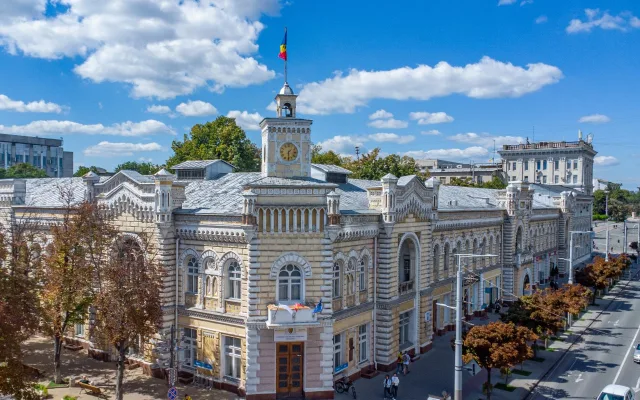
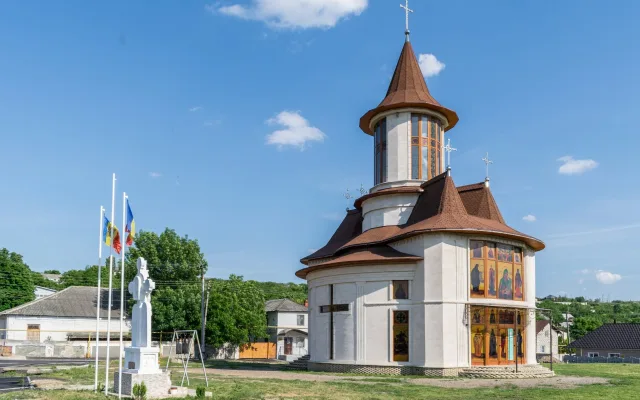
Description
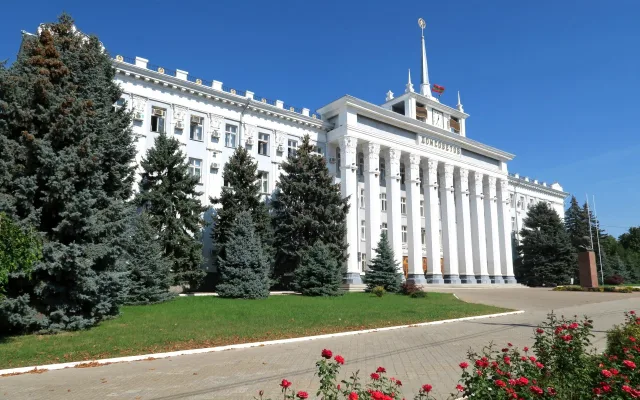
The capital of the Pridnestrovian Moldavian Republic — Soviet-era monuments and the Kvint distillery.
Wiki
Transnistria is a time machine back into the USSR, and you can reach it from Chisinau in a couple of hours. Tiraspol, its capital, is a small city on the left bank of the Dniester, where the hammer and sickle is still on the facades and border guards of an unrecognised state meet you on the way in. One full day is enough to see the essentials and get back.
Getting there and entry
The simplest route is from Chisinau. Minibuses and buses leave the bus station regularly and the journey takes about an hour and a half to two hours. Passenger rail services between Chisinau and Tiraspol are currently suspended. The crossings from the Ukrainian side have been closed since 2022, so entry is only possible from Moldova. The situation at the border changes, so check it immediately before travelling.
The key point is the Transnistrian migration control. A migration card is issued free of charge at the border: you will be asked for your address and how long you intend to stay. It is issued for up to 45 days and can be extended if needed. Keep the slip until you leave — it is checked on the way out. A passport is required; no visa is needed.
No stamp goes into your passport — as far as Moldova is concerned, you never left the country.
Money and connectivity
Transnistria has its own currency, the Transnistrian rouble, which is worthless anywhere else and cannot be converted outside the region. Moldovan lei, dollars and euros in cash can be exchanged at bureaux and banks. Visa and Mastercard mostly do not work here — the banking system is isolated. The conclusion is simple: bring cash and change only a small amount for specific spending, so you are not left holding local roubles you cannot use. Changing them back is difficult.
Roaming with foreign operators is unreliable; a local IDC SIM card is an option if you are staying.
What to see in a day
The centre is compact, and everything of note is walkable along 25 October Street, the city's main axis.
- 25 October Street — the central thoroughfare, lined with Soviet-era buildings, government offices and monuments. A good place to plan your route from.
- Suvorov Square — the heart of the city, with the equestrian statue of the general who founded Tiraspol in 1792. Beside it stand the House of Soviets, Soviet insignia intact, and a Lenin monument.
- The Memorial of Glory — dedicated to the fallen defenders of Transnistria in the 1992 conflict, with an eternal flame. A T-34 tank on a plinth stands nearby, one of the city's emblems.
- The Cathedral of the Nativity — a large neo-Byzantine church, still in use.
- The KVINT distillery — the city's calling card, producing brandy since 1897. Tours with tastings are available; book ahead. The factory shop is the best place to buy a bottle at local prices.
Bender and its fortress
Eleven kilometres away, on the right bank, lies Bender, and the reason to go is Bender Fortress — a formidable 16th-century Ottoman fort and one of the most substantial surviving fortifications in the region. It is now a museum, with exhibitions, towers and views over the Dniester. Getting there from Tiraspol is easy: minibuses run frequently and the bridge takes a few minutes. If time allows, the fortress is the most genuinely historic thing on the trip, as opposed to the Soviet monuments in the centre.
Food and prices
The cooking is Moldovan and Russian: mamaliga with brynza cheese, borscht, mititei (grilled sausages), placinte and plov. It feels cheap — Transnistria is noticeably more affordable than not only Europe but Chisinau itself. Cafés and canteens in the centre, and the Green Market with its home cooking, fruit and local colour, will feed you for very little. The local beer is cheap and decent too.
Practicalities and safety
- Allow one day. Tiraspol and Bender fit into daylight hours, leaving Chisinau in the morning and returning in the evening.
- Do not photograph military sites, checkpoints, border guards or security buildings — this is taken seriously. Ordinary streets and monuments are fine.
- Do not overstay the registration you were given without extending it, or there may be questions on the way out.
- Everyday crime is low and the city is calm. The risks here are bureaucratic rather than criminal.
- English is barely spoken; Russian is the working language of the region, so bring a translation app or a few phrases.
Common mistakes
- Changing too much money into local roubles — there is then nowhere to spend them.
- Counting on your card; without cash you cannot pay.
- Travelling without a passport, or losing the migration slip.
- Failing to declare an overnight stay when the migration card is issued — the period on the card must cover the whole trip.