Description
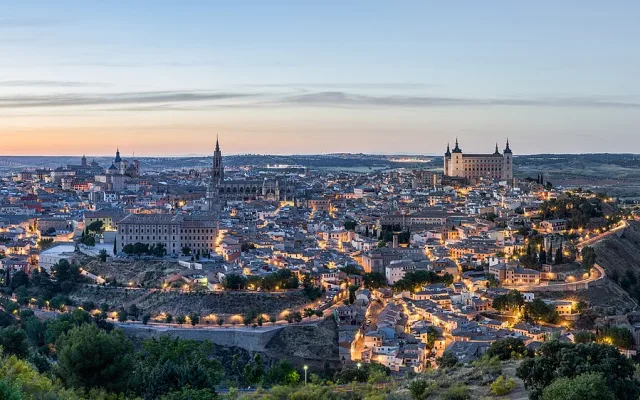
Toledo is a city on a rock above the River Tagus, where medieval cathedrals, synagogues and mosques survive within a single historic core — testament to the coexistence of three cultures.
Wiki
Toledo is a medieval city-museum on a rocky peninsula wrapped on three sides by the Tagus, and nearly everything worth seeing fits within the old walls. It is easy to visit as a day trip from Madrid, but a full day is a better plan: the narrow cobbled lanes, cathedrals and synagogues reward a leisurely pace, not a sprint.
Why go and what is genuinely worth your time
Toledo's greatest asset is density. A Gothic cathedral, former mosques, synagogues and monasteries all stand within a compact core, all within walking distance of each other. That shapes the natural order of priorities for a short visit:
- The Cathedral — unmissable. Gothic architecture from the 13th to 15th centuries, with an interior far richer than the façade: look out for the altarpiece, the sacristy with paintings by El Greco and Goya, and the Transparente — a baroque opening cut through the vault to admit natural light. Entry is paid; the full ticket including the bell tower is worth it for the view.
- "The Burial of the Count of Orgaz" in Santo Tomé — El Greco's most famous painting, still hanging where it was made. A brief but rewarding stop: allow 15–20 minutes for a single canvas.
- Two synagogues — Santa María la Blanca, with its white horseshoe-arched hall in Moorish style (a paradox: a synagogue built by Muslim craftsmen), and El Tránsito, which houses the Sephardic Museum. If time is short, pick one — they are quite different in character.
- Cristo de la Luz Mosque — tiny, tenth-century, one of the oldest surviving buildings in the city. Quick to visit, but atmospheric.
- San Juan de los Reyes — a monastery with an elegant two-storey cloister, far less crowded than the cathedral.
You can skip without regret the military museum inside the Alcázar if the subject does not interest you — the Alcázar reads best as an exterior landmark defining the city's skyline.
Getting there and getting around
From Madrid there are two straightforward options. The high-speed train (Atocha → Toledo) takes around half an hour, but seats on specific departures are limited — book online in advance. The bus (from Plaza Elíptica station) is cheaper and runs more frequently, though the journey takes longer. Both drop you at the foot of the city.
Toledo's railway station is an attraction in its own right, built in neo-Moorish style, but it sits at the bottom, by the river. The climb into the historic centre is steep. Options:
- a city bus to Plaza de Zocodover (the main square) — the most practical choice;
- the outdoor escalator system on the Puerta de Bisagra side — a free way up without tackling the stairs;
- a taxi — inexpensive and energy-saving if you are visiting for only a short time.
Once inside the city you do not need any transport: everything is walkable. The streets are narrow and often stepped; driving in is not advisable — use the park-and-ride car parks outside the walls. Wear shoes with proper soles: cobblestones and gradients are tiring.
How long to stay and when to visit
One full day is enough to cover the highlights. But the best move in Toledo is to stay overnight. During the day the city fills with coach groups from Madrid; by evening, once the buses have left, the lanes empty out, and the floodlit city seen from across the river — from the mirador on the Cigarrales side or from the parador — offers the finest view of the entire trip. Early morning, before the crowds arrive, is equally peaceful.
Season: spring and autumn are the most comfortable. Summers in Castilla-La Mancha are hot, the stone streets heat up intensely, and midday sightseeing becomes hard work — plan your visits for morning and evening. Winter is cool and quiet.
Where to stay
If you are spending the night, choose accommodation inside the walls, in the historic core. Yes, dragging a suitcase over cobblestones is awkward, but you gain the city to yourself in the evening. The area around Zocodover and the cathedral is central and convenient. An alternative for views is staying at one of the hotels or the parador on the opposite bank, though you will then need transport to reach the centre.
Food and prices
The local cuisine is Castilian — hearty and meat-focused. Things to try:
- cordero asado — roast suckling lamb, the regional classic;
- perdiz estofada — braised partridge, the traditional game dish of the area;
- carcamusas — a local pork and tomato stew, cheap and found everywhere;
- marzipan (mazapán) — Toledo is famous for it, sold in convent shops and pastry stores;
- Manchego cheese and wines from La Mancha.
On price: the tourist strip near the cathedral is more expensive and lower quality — avoid places with touts and menus in five languages. Walk two streets away from the main squares and you will find spots where locals eat at reasonable prices. The menú del día on weekdays is the best-value way to eat a proper meal.
Common mistakes
- Arriving for a 2–3 hour whirlwind and leaving before evening — you miss the best part of the day.
- Trying to cover every synagogue, mosque and monastery in one day — sightseeing fatigue sets in; choose according to your interests.
- Attempting to climb from the station on foot with luggage — there is a bus and there are escalators.
- Eating near the cathedral — you pay over the odds for tourist food.
- Arriving without a train booking in high season — tickets sell out, so keep the bus as a backup plan.