Description
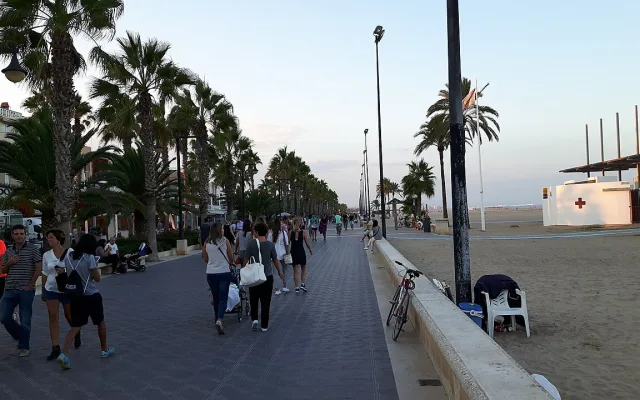
Valencia is the Spanish city known as the birthplace of paella and home to the futuristic City of Arts and Sciences. The Malvarrosa beaches are here too.
Wiki
Valencia is the third-largest city in Spain and the capital of the autonomous region of the same name on the Mediterranean coast. Paella was born here, and the former bed of the river has been turned into a green park, along which stands the futuristic City of Arts and Sciences.
General information
Valencia lies in the east of the Iberian peninsula, on the shore of the Mediterranean at the mouth of the river Turia. The city itself has a population of over 800,000, and the metropolitan area around 1.6 million. Founded by the Romans in 138 BC, the city lived through the Visigoths and the Moors and reached its peak in the 15th century, when it became one of the largest trading centres of the Mediterranean. Two languages are spoken here — Spanish (Castilian) and Valencian, which is close to Catalan. The climate is mild, with plenty of sunny days all year round, which makes a trip comfortable in almost any season.
Main sights
- The City of Arts and Sciences (Ciutat de les Arts i les Ciencies) — the emblem of modern Valencia, an ensemble of gleaming white futuristic buildings designed by Santiago Calatrava and Felix Candela. The complex includes the interactive Principe Felipe science museum, the Hemisferic planetarium and cinema, the Oceanografic, the largest aquarium in Europe, and the Palau de les Arts opera house.
- The Central Market (Mercat Central) — one of the most beautiful covered markets in Europe, built in modernista style with stained glass and domes, holding around a thousand stalls of local produce, spices and seafood.
- The Silk Exchange (Llotja de la Seda) — a masterpiece of late Gothic from the 15th century, inscribed on the UNESCO World Heritage list. The twisted columns of the main hall recall a grove of palm trees.
- The cathedral — the church where, by tradition, the Holy Grail is kept. Its Miguelete bell tower gives a panorama of the city.
- The El Carmen quarter — the historic heart of the old town, with narrow lanes, street art, bohemian bars and the surviving medieval gates of Torres de Serranos and Torres de Quart.
The Turia park
After the devastating flood of 1957 the river was diverted around the city, and the drained bed was turned into the Turia park — a green corridor some nine kilometres long that crosses the centre. It has cycle paths and running tracks, sports grounds, fountains and gardens. Walking the park is a convenient way to get from the old town to the City of Arts and Sciences on foot or by bicycle.
Food and paella
Valencia is considered the birthplace of paella, and the genuine local version is not made with seafood at all. Classic paella valenciana includes chicken, rabbit, green and white beans, sometimes snails, and is seasoned with saffron. The rice for the dish is grown in the nearby Albufera, a natural park with a lagoon south of the city. Among drinks, it is worth trying horchata (a drink made from tiger nuts) with fartons pastries, along with the local wines. Lunch in a simple place costs very little, which makes the city one of the most affordable in the country for travellers.
Las Fallas
Valencia's main festival takes place in March and ends on the night of the 19th. For a week the streets are filled with huge satirical papier-mache sculptures — the fallas — while fireworks and daytime pyrotechnic concerts called mascleta thunder overhead. On the final night, the Crema, almost all the figures are ceremonially burned. The festival is on the UNESCO list of intangible heritage and draws visitors from all over the world.
Beaches
The city beaches of Malvarrosa and Las Arenas are broad strips of golden sand with a gentle slope into the sea and a promenade lined with restaurants. They are 15–20 minutes from the centre by tram or bus. Further south are the quieter, wilder beaches around the Albufera.
Practicalities
- Getting there. The international airport connects Valencia with many European cities, and AVE high-speed trains reach Madrid in about an hour and a half.
- Transport. The metro, trams, buses and hire bicycles make it easy to get around; the historic centre is compact and well suited to walking.
- How long to allow. Three days are enough to see the old town and the cathedral, give a day to the City of Arts and Sciences with the aquarium, and still set aside time for the beach and the Turia park.