Description
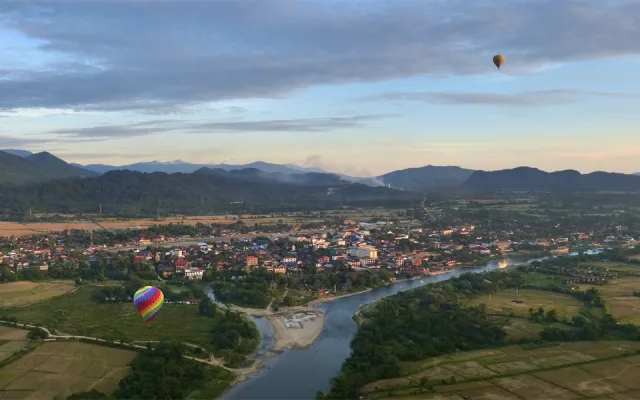
A valley of limestone karst in central Laos: tubing on the Nam Song, blue lagoons, caves, hot-air balloons at dawn and cycling among the peaks.
Wiki
Vang Vieng is a small town in central Laos, set in the scenic valley of the Nam Song river at the foot of steep limestone cliffs. It is roughly four hours' drive north of the capital, Vientiane, and has a population of about 25,000. The place combines water sport, caving and karst mountain views that have become a visual shorthand for Laos.
History and character
In the early 2010s Vang Vieng acquired a loud and grim reputation as a centre of unsupervised young-backpacker excess: dozens of bars serving alcohol and drugs lined the banks of the Nam Song, and floating down the river on an inner tube had turned into a dangerous fairground ride in which people drowned every year. After raids and the closure of the riverside bars in 2012, the authorities reoriented the destination. Today it is a calm outdoor resort aimed at active travel, families and landscape photographers. What remains from the wild years is a well-developed tourist infrastructure and a great many cheap guesthouses.
The main sights
- Tubing on the Nam Song — an unhurried drift downstream in an inflated inner tube, usually an hour or two. The town's signature activity, now without the parties and drink stations on the water.
- The Blue Lagoons (numbers 1, 3 and 5) — a chain of natural pools of clear turquoise water fed by underground springs. The first is closest to town and usually busy; the further ones are quieter and prettier, with rope swings and jumping platforms.
- Tham Chang cave — a made-up grotto with lighting and a viewing terrace looking out over the valley and the river. A stair reaches the entrance across a suspension bridge.
- The Tham Nam and Tham Phu Kham caves — a "water" cave that you float into on a tube along a fixed rope, and a dry cave with a reclining golden Buddha next to Blue Lagoon 1.
- Hot-air ballooning — a dawn or sunset ascent over the karst peaks, lasting 30 to 40 minutes. Powered paragliding is popular alongside the balloons.
- Paragliding and zip lines — cable descents and glides in the mountains around the valley, for anyone after the adrenaline.
- Kayaking on the Nam Song — paddling down the river with stops at the caves along the bank, a more active alternative to tubing.
- The Nam Xay and Pha Ngern viewpoints — trekking paths to the tops of the cliffs, with the whole valley laid out below. The climbs are steep, but the views repay them.
Getting active and getting out
Vang Vieng suits cycling and scooter trips along the dirt roads: the routes run through rice fields, Hmong villages and out to the more distant lagoons. Combined day tours of "caves plus kayaking plus tubing" are popular. In the dry season the river is easy to wade, which opens up footpaths to quiet grottoes on the west bank.
Food and prices
The food is Lao: laap (chopped meat with herbs and spices), tam mak hung (fiery green papaya salad), khao soi (noodles in a rich broth) and sticky rice. The French colonial legacy shows up in baguettes with pâté and good coffee. As a guide: lunch in a café runs $4–7, dinner in a restaurant $10–18 and a Beerlao about $1.50. A litre of petrol is roughly $1, a tuk-tuk across town $2–4 and a scooter $8–12 a day. Prices are as of 2026 and left in dollars, which is how travellers are usually quoted here.
Getting there
The town has no airport of its own. The quickest route is the China–Laos high-speed railway, opened in 2021: about an hour from Vientiane ($7–15) and roughly an hour from Luang Prabang too ($10–20). The station is outside town, with tuk-tuks running into the centre. Buses to both cities still operate. Within Vang Vieng itself, walking, cycling or a scooter are the way to go.
When to go
The best season is November to March: dry, a comfortable 18–28°C, and clear skies for ballooning and mountain walks. From May to September the monsoon rains fall, the river runs high and muddy, but the landscape is at its greenest. April is the hottest month; in mid-April the Lao new year, Pi Mai, is marked with water fights in the streets.
How long to allow
Three days covers the essentials: tubing and the nearer lagoons on the first, caves and a bike ride around the valley on the second, and a dawn balloon flight plus a climb to a viewpoint on the third.