Description
Namibia's tidy capital — German architecture, the Alte Feste and the starting point for the Namib desert.
Wiki
Windhoek greets you with an order unusual for Africa: wide clean streets, German signage, coffee houses and the smell of grilled meat from street braais. For the independent traveller it is first of all a base — this is where you pick up a car, stock up and head out into the desert — but a couple of days is enough to see the capital properly as well.
What kind of city, and why come
The capital of Namibia has around 430,000 people at an altitude of 1,660 m, and it is quiet, clean and unexpectedly German. Windhoek is a transit point rather than a destination in itself: trips to Sossusvlei, Etosha and the Skeleton Coast all start here. It is safer than many African capitals, but still avoid walking at night.
The city's practical purpose is logistics. Almost any route through Namibia means driving yourself over long distances, and Windhoek is the only place where it is genuinely convenient to hire a 4×4, buy the kit you are missing, draw cash and get a SIM card. Allow a day for the drive and the hire paperwork — it will save you trouble in the desert.
Main sights
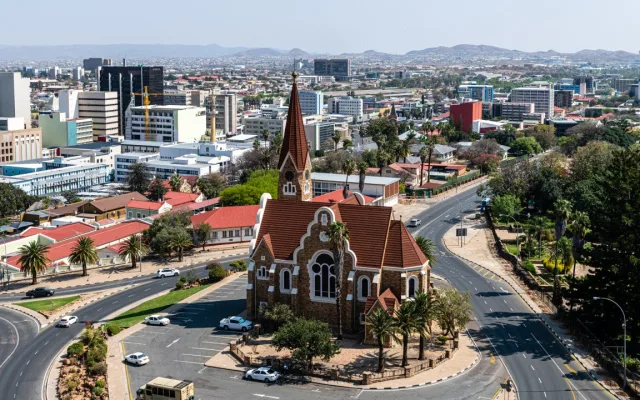
- The Christuskirche — a Lutheran church of 1907 in German neo-Gothic, the emblem of the city; it stands on a roundabout surrounded by the most recognisable buildings.
- The Tintenpalast ("ink palace") — the parliament building in its gardens, welcome shade on a hot day.
- The Independence Memorial Museum — a modern museum of the independence struggle; the viewing platform at the top is free and gives the best view over the centre.
- The Alte Feste — the oldest building in the city (1890) and the National Museum, next to the independence museum.
- Katutura township — with a guide only: this is modern Namibia as it really is, with markets and kapana grills. Do not go alone.
- Daan Viljoen Game Park — a mini-safari 24 km out: zebra, oryx, kudu. A good warm-up before the big parks.
The centre is compact: the church, parliament, both museums and the main shops can be walked in a few hours. Everything of interest sits around Independence Avenue and Post Street Mall.
How to plan two days
- Day 1. The centre on foot: the Christuskirche, the independence museum and its viewpoint, the Alte Feste, and a walk along Independence Avenue. Towards evening, dinner with local meat.
- Day 2. A morning tour of Katutura, or half a day at Daan Viljoen; the afternoon for food shopping, the car hire and preparing for the route.
If Windhoek is only a stop before Sossusvlei or Etosha, one night is realistic.
Food and prices
The cooking is mixed — German, African and South African: eisbein with sauerkraut, oryx steak, kapana (street grilled meat, bought straight from the braai men in Katutura). Lunch in a café is $8-15, dinner at Joe's Beerhouse — a city institution, heavy on game and atmosphere — $25-45. Namibian beer (Windhoek Lager, Tafel) costs $2-3. Prices are as of 2026.
The city feels inexpensive for food and meat but expensive for car hire, and it is the car that eats the budget. To save: buy food and water for the whole route at the supermarkets (Spar, Checkers) here — in the desert there is no choice and prices are higher. Draw cash in the capital in advance; ATMs are scarce further out.
Getting there and getting around
Hosea Kutako International Airport (WDH) is 45 km from the city, served by Lufthansa, Qatar, Eurowings, Ethiopian and South African. The shuttle into the centre costs $25-35 and a taxi $50-70; the drive takes 40-45 minutes, so allow for it. There is also the small Eros airport almost within the city, for domestic flights.
Around town, Bolt is the easiest option — a fixed price and no haggling. Ordinary taxis are by negotiation ($4-8 in the centre), so agree the sum before getting in. There is no public transport in the usual sense, and the combis are not for visitors.
On hire: a 4×4, for safari and gravel roads, costs $80-120 a day and a litre of petrol about $1. Take a car with two spare wheels and check the tyres — the gravel is hard on them. Book ahead in high season; there may be no 4×4 free on the day.
When to go, and what to watch for
The best time is the Namibian winter, May to October: dry, not too hot, and excellent visibility of animals at the waterholes. Bear in mind the altitude of 1,660 m — the nights can be genuinely cold even in summer, and warm clothing is useful.
Common mistakes: planning the city as a "sight" — its value is logistics, not museums; underestimating the distances to the parks (four to five hours to Sossusvlei, the same to Etosha, and each is a separate day); setting out on gravel without a reserve of fuel and water. And do not walk after dark — the centre is calm by day, but in the evening take a Bolt.