Description
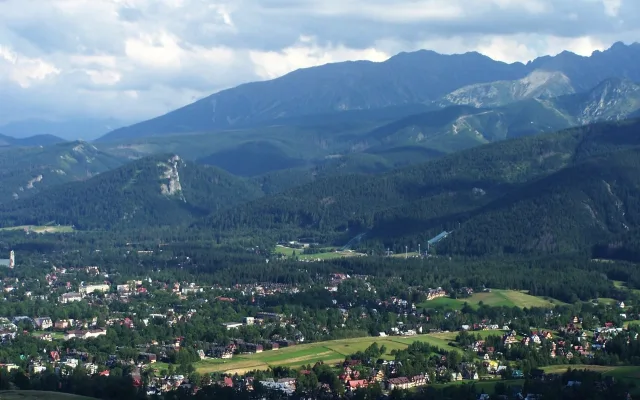
Poland's 'winter capital' at the foot of the Tatra Mountains, with ski slopes, thermal baths and distinctive Zakopane-style wooden architecture.
Wiki
Zakopane is Poland's southernmost town, spread across a valley at the northern foot of the Tatra Mountains — the only alpine-type range in the country. Long known as Poland's 'winter capital,' it combines the status of the country's leading ski resort with its role as the spiritual and cultural heart of the Gorals (górale) — indigenous highlanders who have preserved their own dialect, customs and crafts.
History and Culture
Until the 19th century, Zakopane was a small shepherding village living off sheep-farming and ore mining. Everything changed in the second half of that century when Warsaw and Kraków intellectuals began heading to the mountains in search of clean air and inspiration. The physician Tytus Chałubiński championed the local climate as therapeutic, while the artist and theorist Stanisław Witkiewicz developed the 'Zakopane Style' — an architectural movement that fused Goral folk-building traditions with ideas of national romanticism. Writers, composers and painters lived and worked here for extended periods; visitors included Karol Szymanowski, Henryk Sienkiewicz and, later, Lenin. Goral culture remains palpable everywhere today: in the music with its characteristic fiddles, in embroidery, wood carving, and in the local dialect, which residents clearly distinguish from standard Polish.
Main Sights
- Krupówki — the lively pedestrian promenade at the heart of town, lined with shops, cafés, Goral taverns and a market selling smoked sheep's cheese (oscypek) and woollen goods.
- Kasprowy Wierch (1,987 m) — a summit on the Slovak border reached in minutes by the historic cable car built in 1936; it offers panoramic views of the Tatra ridges and serves as the departure point for ski runs.
- Giewont (1,894 m) — the emblematic peak whose silhouette resembles a sleeping knight; a large metal cross stands at the summit, and the climb takes several hours.
- Morskie Oko — a scenic mountain lake in the Rybi Potok valley, one of the most visited natural attractions in Poland; reachable on foot along a paved road or by horse-drawn carriage.
- Gubałówka — a gently sloping ridge above town with a funicular, viewing platforms and a panorama across the entire Tatra range; a popular spot for families.
- Tatra National Park — a protected area with exceptionally rich flora and fauna, including chamois, marmot, lynx and brown bear, crossed by a network of marked hiking trails of varying difficulty.
- Wooden villas and churches — examples of the Zakopane Style, among them Villa Koliba with its museum, the historic cemetery of Pęksowy Brzyzek with its Goral gravestones, and an old wooden church.
Thermal Baths
Several large thermal complexes operate in the surrounding area, drawing on the geothermal springs of the Podhale plateau. The best known are the baths at Bukowina Tatrzańska and Chochołów — each with dozens of indoor and outdoor pools, hydromassage, saunas and waterslides. Bathing in the open air with a view of snow-capped peaks has become one of the region's signature winter experiences and a welcome alternative to skiing in bad weather.
Cuisine
Goral cooking is hearty and unpretentious, shaped by the mountain climate. The signature product is oscypek — salty sheep's-milk cheese served grilled with lingonberry jam. Also popular are kwaśnica (a sour cabbage soup made with smoked meats), pierogi, lamb prepared in various ways, potato dishes and warming grog. Goral taverns with their dark-wood interiors, animal skins and live music are an essential part of the local atmosphere.
Getting There and When to Go
The nearest major airport is in Kraków, about 100 km to the north; regular buses and trains from there reach Zakopane in roughly two to three hours. A direct road connects the town to the Kraków area, though traffic can build up at weekends and on public holidays. The high season comes in two waves: winter (December–March) draws visitors for skiing, sledging and the thermal baths, while summer (June–September) is peak season for hiking and mountain air. The shoulder seasons are quieter and cheaper, though mountain weather is always changeable.
Three Days in Zakopane
Three days are enough to get a feel for both the town and the mountains. The first day is best devoted to Zakopane itself — a walk along Krupówki, a ride up to Gubałówka and a look at the wooden architecture and museums. The second day belongs to the high Tatras: take the cable car to Kasprowy Wierch or hike out to Morskie Oko. Use the third day to balance activity with rest — a session at the thermal baths followed by a leisurely dinner in a Goral tavern.