Description
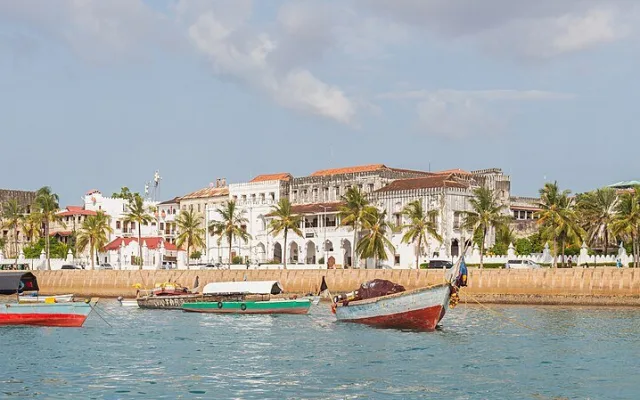
The spice island in the Indian Ocean — UNESCO-listed Stone Town, the white sands of Nungwi and Kendwa, and diving.
Wiki
Zanzibar is a tropical archipelago in the Indian Ocean off the east coast of Africa, a semi-autonomous part of the United Republic of Tanzania with its own president and parliament. Centuries of maritime trade mixed Arab, Persian, Indian and African cultures here, and nutmeg, cloves and cinnamon earned the islands the name of the Spice Island.
Geography and climate
The archipelago consists of two large islands — Unguja (Zanzibar proper) and Pemba — and a scattering of coral islets. Most of the roughly 1.9 million inhabitants live on Unguja. The land is flat, the shores fringed with coral reefs and turquoise lagoons. The climate is equatorial, hot and humid all year, holding around 26-32°C. The long rains fall in April and May, the short ones in November. The best times to visit are June to October and December to February, when it is dry and moderately breezy.
History
From the 9th and 10th centuries the islands were a trading node in the network of Swahili city-states. In the 17th to 19th centuries Zanzibar came under the Omani sultanate; in 1840 Sultan Said bin Sultan moved his capital here, making the island a centre for the export of cloves and of slaves. The East African slave market was one of the largest in the region and was closed in 1873 under British pressure, after which Britain established a protectorate. The short history of the independent sultanate ended with the revolution of 1964, after which Zanzibar united with Tanganyika to form Tanzania. That layered history is legible in the architecture, in the Swahili language and in daily life.
Stone Town and the UNESCO heritage
The historic centre of Stone Town is a single World Heritage site. The main sights are the House of Wonders, the Old Fort, the Anglican cathedral built on the site of the slave market, and the house associated with Farrokh Bulsara — Freddie Mercury. Beyond these, look into the Beit el-Sahel palace museum of the sultans, the Persian Hamamni baths, the Hindu temples and the old port. A particular mark of the town is its massive carved doors with brass spikes: the ornament indicated the wealth and origin of the owner. The lanes are so narrow and winding that getting lost is part of the experience; the minarets and the waterfront serve as landmarks.
Beaches and activities
The northern tip of the island — Nungwi and Kendwa — is known for deep water close inshore, so you can swim whatever the tide, and for its sunsets. The east coast (Paje, Jambiani, Bwejuu) exposes a broad sand flat and lagoon at low tide, ideal conditions for kitesurfing, especially in the windy months. The south-east and the Mnemba atoll are prized by divers and snorkellers: the reefs hold moray eels, turtles and rays, and dolphins pass through. Trips on traditional dhows and dolphin watching at Kizimkazi complete the picture.
Nature and excursions
- Jozani-Chwaka Bay Forest — the island's only national park, home to the endemic Zanzibar red colobus; boardwalks run through the mangroves.
- Spice tours — walks through the plantations, showing how cloves, vanilla, cardamom, pepper and tropical fruit grow.
- Changuu (Prison Island) — a refuge for the introduced Aldabra giant tortoises.
- The Nakupenda sandbank and the Blue Lagoon — sand spits for picnics on boat trips.
Food
Zanzibari cooking is the essence of the Swahili tradition, with Indian and Arab influence. The base is rice, coconut milk and generous spice. Try pilau, biryani, chapati and mandazi, along with urojo, the tangy "Zanzibar mix" soup, coconut curry of octopus or fish, sambusa, and the local "Zanzibar pizza", a stuffed flatbread from the evening market at Forodhani. To drink there is sweet masala tea, fresh sugarcane juice and coffee brewed in the street from brass pots.
Practical information
The currency is the Tanzanian shilling, and US dollars are accepted everywhere. Visas are issued on arrival or online; a yellow fever certificate is advisable if arriving from an endemic country, and malaria prophylaxis is recommended. Abeid Amani Karume International Airport is next to Stone Town, and ferries link the port with Dar es Salaam in about two hours. People get around by taxi, hired scooter and dala-dala minibus. Zanzibar is predominantly Muslim, so covered clothing is appropriate away from the beaches, and the rhythm of life changes during Ramadan. Five days is enough to combine Stone Town, a spice tour, a trip to the reefs and a few days on the northern or eastern beaches.