
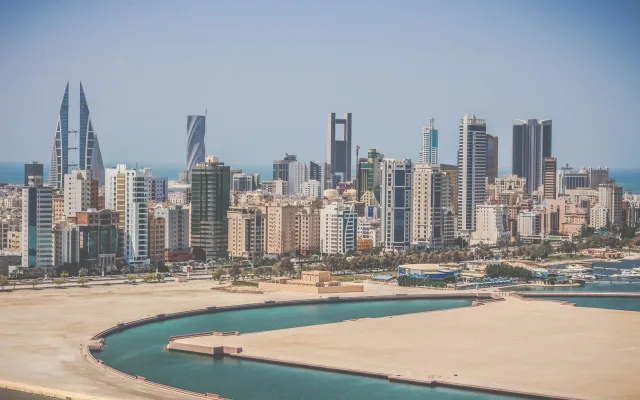
A tiny island kingdom in the Persian Gulf and the most liberal state in the region, where ancient Dilmun forts sit alongside skyscrapers and a Formula 1 circuit. Bahrain is the only Gulf country where alcohol is sold openly in hotels and restaurants, and the nightlife is lively. It makes an easy first step into the Arab world for anyone curious about the Middle East without the strictures. The Bahraini dinar is one of the world's strongest currencies, yet food and transport stay affordable.
Where to go
#
What to see
#Bahrain Fort: Qal'at al-Bahrain is the place to go for the ruins of ancient Dilmun. The walls look striking against the modern towers of Manama behind them, and access to the grounds is free.
National Museum: This huge white travertine building holds everything you need to understand the country. The collection covers six thousand years, from the stone age through to the oil era.
Al Fateh Mosque: An enormous structure carrying the largest fibreglass dome in the world, and it is open to everyone. The Italian marble and the Swarovski chandelier inside are genuinely impressive, and guided tours are free.
Tree of Life: A single acacia has grown in the middle of the desert for four hundred years with no visible water source. It is the country's natural emblem and an excellent spot for photographs.
Formula 1 circuit: Worth the drive out to Sakhir if you like speed. Outside the Grand Prix weekend you can drive karts there or book a tour of the track itself.
Bab Al Bahrain: The souq in the centre of the capital is the place for souvenirs and genuine Gulf atmosphere. Haggle here for perfume, spices and pearl jewellery.
Prices
#Currency: The Bahraini dinar (BHD) is pegged to the US dollar and is one of the strongest currencies in the world. The exchange rate surprises people, since one dinar is worth well over two dollars.
Cards: Visa and Mastercard are accepted almost everywhere, from malls to chain restaurants, and Amex at hotels and larger venues. Wise and Revolut both work well here and keep conversion costs low.
Cash: Keep small notes for older taxis that do not use an app and for the souq. The best rates come from the exchange counters before passport control rather than after.
Tourist levy: Since May 2024 a charge of around nine dollars per night applies. It is collected by the hotel at check-in or check-out and is not usually included in the online rate.
Tipping: Ten percent is welcome where service is not already added. Many restaurants add it automatically, so read the bill first.
| Item | Price (USD) |
|---|---|
| Lunch in a simple cafe | 7.00 |
| Dinner for two with wine | 50.00 |
| Fast food combo | 8.00 |
| Street shawarma | 3.00 |
| Cappuccino | 5.00 |
| Beer in a bar | 11.00 |
| Water 0.5 l | 0.50 |
| Bus ticket | 0.80 |
| Uber ride, 5 km | 6.00 |
| Taxi from the airport | 12.00 |
| Car hire per day | 35.00 |
| Litre of petrol | 0.55 |
| National Museum entry | 2.65 |
| F1 circuit tour | 19.00 |
| Kilo of dates | 5.00 |
Getting around
#Getting there: Bahrain is Gulf Air's hub, with direct flights from London, Paris, Frankfurt and much of Europe, plus dense connections through Dubai and Doha. From North America you connect through London or a Gulf hub, and the short hop from Dubai is frequent and cheap.
Buses: The Public Transport network reaches every significant district on the island. The vehicles are modern and air-conditioned, and you board through the front door only.
Paying the fare: Buses take no cash, so buy a rechargeable GO Card. They are sold from machines at the stops and a ride costs around eighty cents.
Taxis: Uber and the regional app Careem both work well and cost less than flagging a car down. Trips are tracked, so the fare is never in dispute.
Car hire: The roads are excellent and petrol costs almost nothing. It is the best way to reach outlying sights such as the Tree of Life or the camel farm.
Driving: Traffic gets chaotic at rush hour in central Manama. Stay alert, because local drivers do not always treat lane markings as binding.
Walking: Getting between districts on foot is genuinely impractical because of the heat and the absence of pavements along the highways. Use transport even for short distances.
Where to stay
#Juffair: The most popular district among independent travellers thanks to the number of apart-hotels. The nightlife, restaurants and shops are all concentrated here.
Seef: The business centre, worth choosing for proximity to the largest malls. The buildings are newer and taller, often with panoramic views over the gulf.
Muharraq: Pick this side if you want the atmosphere of the old town. There are small guesthouses in traditional Arabic buildings, which are far more characterful.
In transit: If you have a long layover, the airport has a hotel with sleeping pods. That saves you clearing immigration and heading into the city at night.
Booking: The usual international platforms work without any problems. During the Formula 1 weekend rates multiply several times over, so book six months ahead if your trip coincides.
Noise: If you stay in central Manama, bear in mind it can be loud under your window. Many bars are attached to the hotels themselves and run late into the night.
What to eat
#Machboos: The national dish, a spiced rice something like a pilaf with chicken or fish. Eat it in a family-run cafe, where the portions are enormous and genuinely filling.
Ghouzi: The celebration dish of roast lamb on a bed of rice and nuts. It is treated as a delicacy and normally ordered for a group of several people rather than one.
Street food: Shawarma and falafel are on every corner, especially around Adliya. It is the cheapest way to eat and the ingredients are invariably fresh.
Seafood: Look for hammour at the Manama fish market. You can buy it there and ask one of the neighbouring stalls to grill it for you on the spot.
Sweets: Bahraini halwa is nothing like the sesame kind, being jelly-like and scented with saffron. It is traditionally drunk down with strong cardamom coffee.
Alcohol: The kingdom is liberal by regional standards and alcohol is sold in hotel restaurants and dedicated shops. Drinking in the street or appearing drunk in public is prohibited.
Safety
#Overall: Bahrain is among the calmest countries in the region for visitors. Street crime is almost absent and walking around after dark is unremarkable.
Heat: The real threat here is the temperature, which reaches 50C in summer. Carry water at all times and plan to be indoors during the middle of the day.
Photography: Do not photograph military installations, government buildings or local women without permission. Any of these can land you in trouble with the police.
Ramadan: Rules tighten during the holy month, when eating, drinking and smoking in public before sunset are not permitted. Most cafes close during daylight and life restarts after iftar.
Demonstrations: Avoid the outlying villages in the south of the island, where political gatherings occasionally take place. They hold nothing for a visitor anyway. Check your own government's travel advisory before you book.
Health: Tap water quality is acceptable but bottled is better for drinking. Private hospitals are excellent, so contact your insurer and go to a clinic if anything goes wrong.
Etiquette and culture
#Dress: There is no outright ban on shorts, but covering shoulders and knees in public places is the courteous choice. Mosques provide women with an abaya and headscarf at the door.
Greetings: Men generally shake hands on meeting. With a local woman, greet verbally and wait for her to offer a hand first if she chooses to.
Coffee: Refusing the offered gahwa is close to an insult. Accept the small cup, and when you have had enough, wobble it gently in your hand to signal you are done.
Friday: This is the sacred day, and most shops and government offices are shut until the afternoon. Life pauses while people go to communal prayer.
Etiquette: Do not point at people, and do not sit with the soles of your feet aimed at whoever you are talking to. Both gestures read as insults.
Conversation: Bahrainis are notably friendly and will often volunteer help to visitors. Small talk about the weather or how good the country looks is always well received.
Connectivity
#Operators: Three companies compete here: Batelco, STC and Zain. There are sales points in the arrivals hall at the airport, and you need your passport to buy.
Tourist packages: Visitor SIMs come with generous data and cost around 10 to 15 dollars. The 5G footprint covers nearly the whole island.
eSIM: If your phone supports it, this is the best option here, since coverage is dense and the global providers all have partners. You can activate before boarding and skip the counter entirely.
Calling home: Unlike some neighbouring countries, Bahrain does not block voice calls over WhatsApp or FaceTime. You do not need a VPN or any workaround to call home, which is worth knowing if you are used to the restrictions in the UAE or Qatar.
Public wifi: Free internet is available in every mall, on the modern buses and in chain cafes, and the speed is generally high and stable.
Language and apps: English is spoken essentially universally, all signage is bilingual and menus are in English by default. Download Uber or Careem for transport and Talabat for food delivery, and Google Maps routes the island accurately.
Phrasebook
#| English | Arabic | Pronunciation |
|---|---|---|
| Peace be upon you (greeting) | السلام عليكم | as-sa-LAA-mu a-LAY-kum |
| Thank you | شكراً | SHUK-ran |
| Please | من فضلك | min FAD-lik |
| How are you? | كيف الحال؟ | kayf al-HAAL |
| Good (Gulf dialect) | زين | zayn |
| How much? | بكم؟ | bi-KAM |
| That's expensive | غالي | GHAA-lee |
| Where is the toilet? | وين الحمام؟ | wayn al-ham-MAAM |
| Yes | نعم | NA-am |
| No | لا | laa |
| Help me | ساعدني | SAA-id-nee |
| Excuse me | عفواً | AF-wan |
| Hotel | فندق | FUN-duq |
| Water | ماء | maa |
| Delicious | لذيذ | la-THEETH |
| Come on, let's go | يلا | YAL-la |
| Enough, that's it | خلاص | kha-LAAS |
| Straight ahead | سيدا | SEE-da |
| Right | يمين | ya-MEEN |
| Left | يسار | ya-SAAR |
| Goodbye | مع السلامة | maa as-sa-LAA-ma |
| No problem | مافي مشكلة | MAA-fee MUSH-ki-la |
Good to know
#Consular help: Most countries with a mission keep it in Manama, though some cover Bahrain from Riyadh or Kuwait City. Look yours up and save the address and number before you fly.
Medical care: For anything health-related, call your insurer first. Doctors in the private hospitals speak English and the standard of care is genuinely high.
Websites: The official btea.bh portal lists festivals and events. For race and event tickets use bahraingp.com rather than resellers.
Shopping: The best prices on dates and spices are in the airport duty free on the way out, which also carries decent craft goods.
Sockets: Bahrain uses the British standard, type G with three flat pins. Bring an adapter or ask at your hotel reception, where they usually have spares.
Parking: Finding a space in the centre of the capital is difficult, so use the paid garages. They cost very little and keep the car out of the sun.
Frequently asked questions
#Many nationalities can get a visa on arrival at Manama airport for around 5 dinars for a two-week stay, and an e-visa is available in advance through the official portal. You need a passport valid for six months, a return ticket and a confirmed booking, so check your own passport's rules.
A budget independent traveller should allow 600 to 800 dollars excluding flights. That covers an apart-hotel, eating in local cafes and getting around by bus and ride-hailing.
Yes, alcohol is legal and sold in hotel bars, clubs and licensed shops. Drinking in public or being visibly drunk in the street carries fines, so keep it indoors.
Uber and Careem both cover the whole island and are the easiest option. There is also a modern bus network, for which you need a prepaid GO Card, as drivers take no cash.
November to March is the window, when the heat drops to a comfortable 25C or so. Summer brings extreme temperatures combined with high humidity.
It is regarded as one of the safest countries in the Arab world and solo travellers rarely encounter problems. Dress with reasonable modesty and avoid the quieter outlying areas.
Juffair is the most convenient district, with a large choice of apartments and infrastructure geared to foreigners. Seef is the other popular option, sitting next to the biggest malls.
Only if you already hold a Saudi visa, which many nationalities can now obtain as an e-visa in advance. Without one you will be turned back at the King Fahd Causeway, and a short flight is simpler.
Yes, but with restrictions. Registration is mandatory for a drone of any weight. Registration is mandatory for any drone and flights require prior permission. Rules for other countries are in the drone ranking by country.
Updated
The data on this page goes out of date. Visa rules and permitted stays, border requirements, prices and budgets, transport and local conditions all change fast, and we do not re-check every page every day. We show the date of our last check where we have one, but before you travel, verify with official sources: the country’s consulate, its immigration service, its e-visa portal and your carrier.