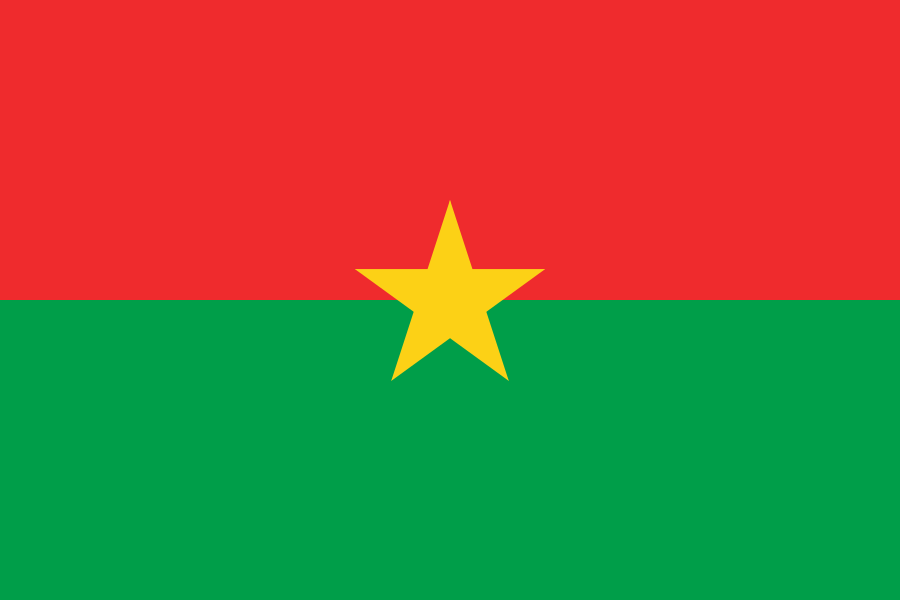
Burkina Faso
BF**WARNING: GOVERNMENTS WORLDWIDE ADVISE AGAINST ALL TRAVEL TO BURKINA FASO** because of terrorism, kidnapping and the instability that followed the 2022 coup. The Land of Upright People — the literal meaning of the name — was once among the most welcoming places in West Africa. Ouagadougou hosted FESPACO, the biggest film festival on the continent, and the Mossi were famous for their warmth. Today armed groups control much of the territory and travel outside the capital is extremely dangerous.
Where to go #
Ouagadougou
The capital hits you with a chaos of mopeds and the permanent smell of frying fish. It is worth a trip for the loud markets and for the feel of a place that has been West Africa's main political stage for decades.
Bobo-Dioulasso
The country's cultural capital is also its greenest and most pleasant city. You can do the old quarters in a day and still have the evening free for live balafon in the music bars.
Banfora
This small town in the southwest is the base for trips out to the natural sights. People come for the sugarcane plantations and for the strangely shaped rock formations nearby.
Tiebele
A tiny village on the Ghanaian border, famous for its painted fortress houses. If you want genuine Kassena art with its ancient geometric patterns, this is where to go.
Dedougou
The town wakes up every two years for the huge international mask festival. The rest of the time it is a calm provincial centre where life moves at its own unhurried pace.
What to see #
What to see in the capital: The FESPACO festival turns Ouagadougou into the world capital of African cinema every two years. Even if you are not much of a film buff, walk over to the Place des Cineastes to feel the scale of the thing.
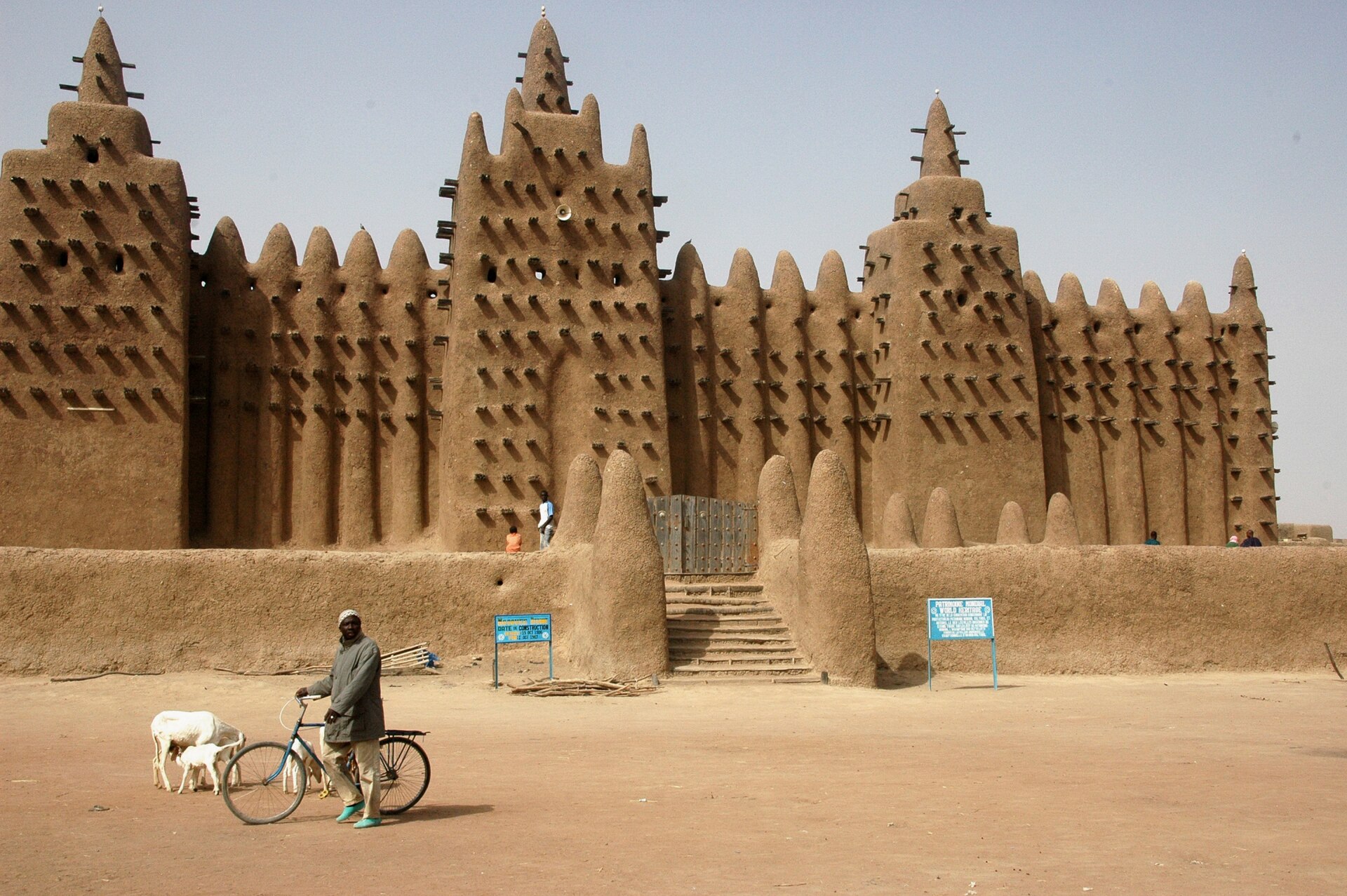
The old Kibidwe quarter: In Bobo-Dioulasso, do not skip the mud-brick Grand Mosque built in Sudanese style. It is a national symbol, and a local guide can take you up onto the roof for the panoramic views.
The Sindou Peaks: These sandstone spires are worth the long haul southwest. If you want landscapes that look like another planet, head for these natural castles carved out by hot wind and time.
Karfiguela Falls: Come in the rainy season, when the cascades are at their fullest. It is the perfect escape from the dusty heat, with cool, clean natural pools to swim in.
The sacred crocodiles: In the village of Bazoule the animals live side by side with people and are treated as tame. Feeding one a chicken and getting the photo is the standard dare for anyone brave enough.
The ruins of Loropeni: A UNESCO-listed site of massive stone walls left from an eleventh-century fortress. They are barely studied, but the scale of the old fortifications impresses even a jaded wanderer.
Prices #
Local currency: The West African CFA franc is pegged hard to the euro, which makes the mental maths easy. Coins and notes are both in circulation, and the notes are usually worn thin and dusty from the climate.
Cash and exchange: Bring euros in cash, since any bank will change them at the fixed rate. Dollars are taken reluctantly and the rate you get for them can be noticeably worse than at the official desks.
Cards and ATMs: Visa works at machines in the bigger cities, but plenty of them refuse Mastercard outright. Paying by card in a shop or a cafe is rare enough that you should never build a day around it.
Mobile wallets: Orange Money is what locals use to settle almost anything from their phones. For a visitor it turns into a bureaucratic quest, so it is simpler to keep a stack of small notes on you at all times.
Keeping fees down: Cash machines are effectively a Ouagadougou and Bobo-Dioulasso thing, so withdraw a decent amount whenever one cooperates. A Wise or Revolut card at least spares you your home bank's conversion markup.
| Item | Price (USD) |
|---|---|
| Street riz gras | 1.50 |
| Brakina beer 0.6l | 1.20 |
| Taxi across town | 3.00 |
| Lunch at a maquis | 5.00 |
| Bottled water 1.5l | 0.50 |
| Night in a guesthouse | 25.00 |
| Intercity bus ticket | 10.00 |
| Mosquito net | 8.00 |
| Litre of petrol | 1.40 |
| Kola nuts, 1kg | 4.00 |
| Museum entry | 2.50 |
| Bar of shea soap | 1.00 |
| Bogolan cloth, 1m | 6.00 |
| SIM card | 1.00 |
| Hour of internet | 0.50 |
Getting around #
Getting in: Ouagadougou is the only realistic international gateway, and almost everyone arrives on one connection from Europe through Paris, Brussels or Casablanca, or through Addis Ababa and Istanbul from further afield. Regional hops from Abidjan, Lome and Accra are frequent and usually the cheapest way in.
City taxis: In the capital look for the yellow cars with official markings, and agree the price before you get in. Meters are a rarity here, so a bit of haggling skill will save you a serious number of francs.
Green taxis: These battered old cars work as shared minibuses, picking up passengers along the route. It is the cheapest way to move around, but expect to be squeezed in, hot and entirely without comfort.
Intercity buses: Companies like TCV and Rahimo run regular services between the main centres. Buy tickets in advance at the terminal counters, because demand on the popular routes is always high.
Domestic flights: Hopping from Ouagadougou to Bobo-Dioulasso with Air Burkina saves you a full day on the road. Given the state of the highways and the risks of overland travel, it is money well spent.
Renting a moped: The motorbike is close to a religion here, and rental places are easy to find in the centre. That said, the chaos on the roads and the clouds of dust turn any ride into a test of your nerves and lungs.
The railway: The legendary train down to Abidjan runs rarely and unpredictably. If you are lucky enough to catch it, it will be one of the most colourful and exhausting adventures of your life.
Where to stay #
What to look for: Instead of expensive chain properties, hunt down the auberges, small guesthouses tucked into residential blocks. The furnishings are basic, but there is almost always a fan and, crucially, a mosquito net.
Safer districts: The Ouaga 2000 quarter in the south of the capital is considered the calmest place to sleep. Government buildings and modern hotels sit here, and professional security is usually on duty at the gate.
Provincial comfort: In Bobo-Dioulasso and Banfora the hotels often hide in shady gardens full of mango trees. It is a fine way to recover from the city, listening to the cicadas going full volume in the evening.
Booking ahead: The big booking sites list only a small slice of what actually exists, so calling directly works better. A confirmation over a messaging app is often more reliable than an unpaid reservation on an international platform.
Everyday realities: Power cuts out at the peak of the heat, and the shower frequently runs at room temperature only. A working air conditioner instantly doubles the price of a room, so decide what matters to you.
Looking after your bags: Always bring your own padlock for the doors in cheap guesthouses. Staff are generally honest, but in a compound with people coming and going, a little extra caution never hurt anyone.
What to eat #
The staple: The national dish is to, a thick paste of sorghum or maize eaten with your hands. It comes with sauces made from okra or baobab leaves, and the taste can feel genuinely unfamiliar at first.
Rice and fish: Riz gras is the local take on a rice pilaf, simple and filling, sold on practically every corner. For fish, order the grilled capitaine pulled out of the rivers and served under a mound of fried onion.
Eating safely: Stick to places where the food is cooked in front of you over a fierce flame, and skip ice entirely. Tap water is hard on the stomach, so buy only properly sealed bottles from shops.
Meat off the grill: Street braziers turn out excellent brochettes of beef or goat. The meat is often tough, but the spices and the smoke make up for the amount of chewing involved.
Tropical fruit: In the rainy season the markets are buried under mangoes that cost almost nothing and taste extraordinary. Papaya and avocado are around all year and make an excellent traveller's breakfast.
What to drink: Try bissap made from hibiscus, or ginger juice, both of which deal well with forty-degree heat. For alcohol, the local Brakina beer is everywhere, alongside traditional millet beer called dolo.
Safety #
The overall picture: The security situation remains highly unstable because of armed group activity. Only the centre of the capital is treated as relatively safe, while travel to the north and the east carries serious risk.
Never move at night: Do not travel between towns after dark, and treat that as a rule with no exceptions. The risk of attack multiplies after sunset, and roads are often closed off by army checkpoints anyway.
Papers and checks: Carry your original passport and vaccination certificate at all times, because either can be asked for without warning. Frequent roadside checks are simply a routine part of life across the Sahel.
Photography: Photographing government buildings, military sites and anyone in uniform is strictly forbidden. Always ask ordinary people first, otherwise you risk a very sharp reaction.
Petty theft: In crowds and markets keep a hand on your pockets and do not flash expensive electronics. A money belt worn under your clothes is the sensible place for cash and documents.
Before you go: Read your own government's travel advisory before booking anything, since the guidance shifts quickly. Leave your route with someone at home, keep trusted contacts in your phone and always travel with a charged power bank.
Etiquette and culture #
Masks and spirits: Traditional belief here is tightly woven into the world religions. For Burkinabe a mask is not a souvenir but a living embodiment of an ancestral spirit, used in the most important rituals and dances.
The art of greeting: Walking up and asking a question straight out is considered the height of rudeness. The custom is to ask at length about a person's health and family before you get anywhere near your actual point.
Upright people: The country's name translates as exactly that, and locals are proud of the reputation. Mutual help and hospitality run deep despite everything the population has been through.
Use the right hand: Food is accepted and money handed over with the right hand only. The left is considered unclean, and using it in that situation reads as a direct insult to the person in front of you.
Dress modestly: In Muslim districts, keep shoulders covered and leave the short shorts at home. Dressing modestly earns respect and makes it far quicker to build a rapport with conservative neighbours.
The rhythm code: The djembe and the balafon are a language you can hear in every quarter. Music accompanies every event in community life and gives your trip a soundtrack you will not find anywhere else.
Connectivity #
French runs everything: French is the one reliable way to communicate, and without a little of it the trip turns into a puzzle. English is understood only rarely, so learn a basic set of phrases before you fly.
English in practice: Outside the big hotels in Ouagadougou and a handful of tour operators, almost nobody speaks English. Menus, road signs and bus timetables are in French only, so a translation app that works offline earns its place.
The Moore language: Moore is spoken by the Mossi, who make up most of the population in the centre of the country. A couple of words in Moore instantly turns you from a tourist into a guest and buys you real goodwill.
Dioula and trade: In the west, Dioula dominates and works as a bridge between different ethnic groups. Every region has its own dialects, but French plus sign language covers everyday needs perfectly well.
SIM cards and data: Buy a local SIM the moment you land, since it costs almost nothing and only needs a passport. An eSIM from Airalo or a similar provider works as a backup, though mobile data is patchy on the highways and can vanish for hours.
Restrictions and VPNs: The military authorities have been known to throttle popular messaging apps without notice. Install a reliable VPN before you arrive so you can still reach people if that happens.
WhatsApp etiquette: Burkinabe love voice notes, and WhatsApp is where business gets done. It is by far the fastest way to arrange things with a guide or a hotel owner, since calls and email often go unanswered.
Phrasebook #
| English | French | Pronunciation |
|---|---|---|
| Hello | Bonjour | bon-ZHOOR |
| Good evening | Bonsoir | bon-SWAR |
| How are you? | Ca va? | sah VAH |
| I'm fine | Ca va bien | sah vah BYEN |
| Thank you | Merci | mair-SEE |
| You're welcome | C'est rien | say RYEN |
| Yes / No | Oui / Non | wee / non |
| Please | S'il vous plait | seel voo PLAY |
| How much is it? | C'est combien? | say kom-BYEN |
| That's expensive! | C'est cher! | say SHAIR |
| Bring the price down | Diminue un peu | dee-mee-NEW an PUH |
| I'm walking | Je marche | zhuh MARSH |
| Water | Eau | oh |
| Beer | Biere | BYAIR |
| Help! | Aidez-moi! | ay-day MWAH |
| I don't understand | Je ne comprends pas | zhuh nuh kom-PRON pah |
| Where is the toilet? | Ou sont les toilettes? | oo son lay twa-LET |
| Foreigner, white person (slang) | Toubabou | too-bah-BOO |
| Food, to eat (slang) | Dabali | dah-bah-LEE |
| Mate, brother (slang) | Mon type | mon TEEP |
| It's all good (slang) | C'est doux | say DOO |
| Goodbye | Au revoir | oh ruh-VWAR |
Good to know #
Consular cover: Only a handful of countries keep a full embassy in Ouagadougou, and many others handle Burkina Faso from Abidjan or Accra through an honorary consul on the ground. Find out which mission covers your passport and save the number before you leave home.
Health and medicines: Take out a policy that covers serious cases, because local medicine is thinly resourced. Pharmacies exist in the cities, but anything specific to you should travel in your own kit.
Electricity: Sockets are the European type, so most travellers need no adapter at all. The supply is often unstable, which is another argument for charging your gadgets from a decent power bank.
Climate and clothing: November to February is the comfortable window, when the heat drops to something bearable. The rest of the year the air bakes and the dusty harmattan wind gets into every crack, including your lungs.
Photographs: Always ask before you take the camera out in a village. A small payment or a modest gift for a good shot is often expected and is completely normal practice here.
Drinking water: Bottled water is sold everywhere, as are very cheap sealed sachets. The sachets cost next to nothing but are awkward to drink while walking, so take the bottle with a cap for longer days out.