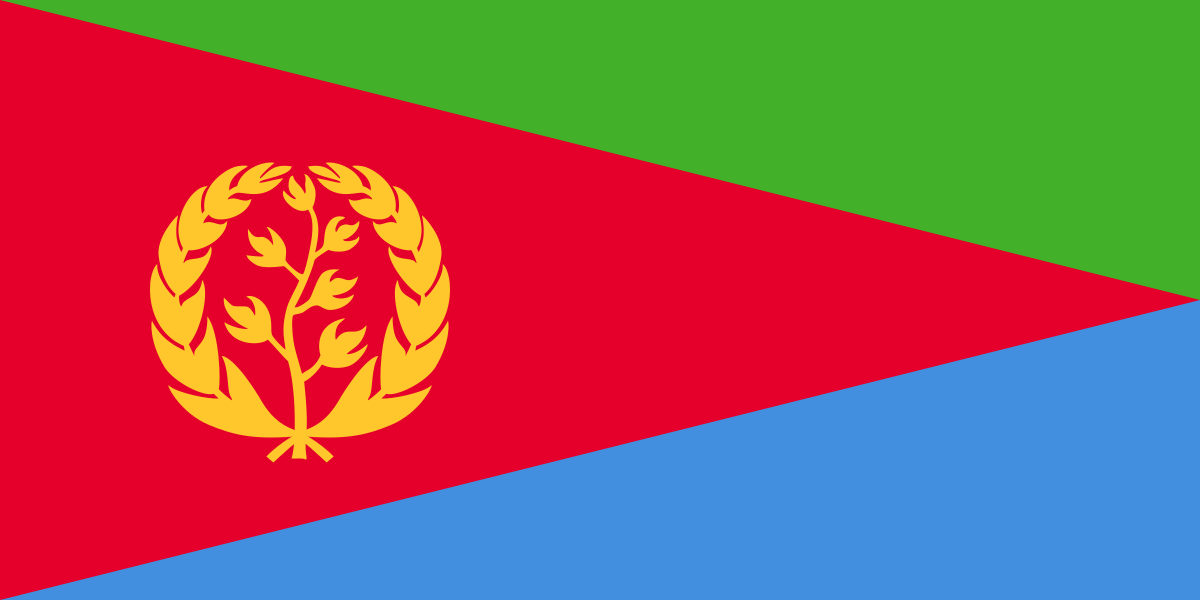
Eritrea
EROne of the least visited countries in the world, with a remarkable capital: Asmara, a UNESCO-listed jewel of Italian Art Deco. This former Italian colony on the Horn of Africa has broad boulevards, cafés serving macchiato and old Fiats — the effect is of travelling back in time. There is also the Red Sea coast at Massawa, mountain scenery, the camel market at Keren and the Dahlak islands. The state is authoritarian and closed, but safe and welcoming to anyone who gets a visa.
Where to go #
Asmara
The capital sits on a plateau at 2,300 metres, which means cool air and clear light, and its 1930s architecture has survived almost untouched. Come for the experience of old Italy in the middle of Africa and for slow walks along Harnet Avenue. Two days on foot, or in one of the old Fiat taxis, covers it.
Massawa
The Red Sea port, memorable for its ruined Ottoman quarter and for heat that has to be experienced to be believed. This is where to go for fresh seafood and for boat trips out to the islands. War damage left the architecture strange and heavily textured.
Keren
A mountain town visited for its famous camel market, held on Mondays. Islamic influence is much stronger here and the streets carry bright murals. A day covers the war cemeteries and the shrine built inside the trunk of a baobab.
Dekemhare
Once the industrial centre of the Italian colony, now closer to a quiet village with dirt roads. Half a day is enough to see the remains of the colonial villas and walk through the market. It sits on the road south and makes an easy stop.
Mendefera
A traditional Tigrinya town where Sunday brings large bicycle races straight down the main street. In the evening church singing carries over the rooftops. A pleasant place to sleep and see daily life without any tourist gloss.
Adi Keyh
A highland town near the Qohaito ruins and a practical base if you want to see the ancient sites without doing the whole run from the capital in one day.
What to see #
Fiat Tagliero: the petrol station shaped like an aircraft is the country's emblem for a reason. Built in 1938, its concrete wings still cantilever out unsupported, and it looks futuristic almost a century later.
Cinema Impero: worth entering not only for a film but for the art deco interior. The original ticket booths still work and the fittings survive from the Mussolini era, largely unaltered.
The tank graveyard: on the edge of Asmara, hills of rusting armour left from the thirty-year independence war. Nothing else conveys the scale of that struggle so directly.
The Dahlak archipelago: for untouched coral and clear water. Visiting needs a separate permit, best arranged through a tour operator in Massawa before you go down to the coast.
Qohaito: ruins at 2,600 metres with pre-Aksumite columns and cave paintings, plus a staggering view over the canyon and into the Rift Valley.
Mariam Dearit: at Keren, a shrine inside an enormous baobab tree. Local belief holds that prayers here help women hoping for a child, and it remains a working place of pilgrimage.
The railway: the Italian-era steam line still runs for chartered groups only, climbing through tunnels and switchbacks with tremendous mountain views. Worth arranging if you can join a group.
Prices #
Currency: the Eritrean nakfa, pegged to the US dollar at 15 to 1. The black market offers roughly double, and using it is illegal; people have been arrested for it, so don't.
Cash only: bring your entire budget in US dollar or euro notes. No foreign card works anywhere in the country and there are no international ATMs, so running short is a genuine problem with no solution.
Changing money: use Himbol bank branches or the large state hotels. Keep every exchange receipt, because you can be asked to account for your spending when leaving.
Cards: Visa and Mastercard simply do not function here. In an emergency a Western Union transfer is theoretically possible and takes hours.
Prices: Eritrea costs more than neighbouring Ethiopia, because so much is imported, including drinking water. Lunch runs 7 to 12 dollars and a bottle of water is oddly expensive.
| Item | Price (USD) |
|---|---|
| Macchiato in a cafe | 0.70 |
| Lunch (injera and meat) | 8.00 |
| Restaurant dinner | 15.00 |
| Bottle of Asmara Beer | 1.50 |
| Water, 1.5 l | 1.80 |
| Travel permit | 3.50 |
| Taxi in the capital | 5.00 |
| Intercity bus | 2.50 |
| Cheap room | 20.00 |
| Good hotel | 80.00 |
| Tourist SIM card | 5.00 |
| An hour in an internet cafe | 1.30 |
| Visa on arrival | 70.00 |
| Car with driver, per day | 150.00 |
Getting around #
Travel permits: you can move freely only within Asmara. Any trip out of the city requires a paper permit from the Ministry of Tourism, issued for a couple of dollars, naming your exact dates, destinations and even the vehicle. Hotels check that the dates match, so plan the route before you plan anything else.
Intercity buses: the cheapest way to travel and always overloaded. Fares are trivial, but you need to be at the station by six in the morning to get a seat at all.
Minivans: more frequent and faster than the buses, leaving when full. The better option for Asmara to Massawa or Keren, at around five or six dollars.
Around the capital: Asmara is compact and the centre is best walked, which is the whole point of the architecture. For longer trips, flag a yellow taxi and agree the fare first, since there are no meters.
Car hire: renting without a driver is close to impossible, since it requires a locally issued licence. Most visitors hire a car with a driver from 150 dollars a day, which also solves the permit paperwork.
Roads: mountain surfaces are often poor and potholes appear without warning. Drivers are calm and yield readily to pedestrians and cyclists, who have absolute priority in practice.
Where to stay #
Finding a room: the usual booking sites do not operate here. You either telephone hotels internationally in advance or simply turn up and ask, which is what most travellers end up doing.
Budget: in Asmara, the African Village, a colonial-era building with shared facilities, is the dependable cheap option and where you will meet the handful of other travellers in the country.
Comfortable: a few hotels in the capital, such as the Crystal or the Sunshine, offer familiar service and breakfast from around 60 to 80 dollars, which buys you reliable water and clean linen.
What to expect: something in the room will not work, from a socket to a tap. In provincial towns like Keren, conditions are spartan, so ask to see two or three rooms before choosing.
Water: in Massawa there is essentially no hot water, which given the heat is no hardship. In Asmara it runs to a schedule tied to the neighbourhood's electricity supply.
Registration: hotels will ask for your passport and a copy of your travel permit for that town. If the dates do not match, they are entitled to turn you away, and they will.
What to eat #
Injera: the sour, spongy flatbread that serves as both plate and cutlery. Stewed meat, zigni, or spiced chickpea shiro goes on top, and you eat with your right hand.
The Italian legacy: the colonists left behind genuinely good pasta and lasagne, cooked in city restaurants. Wood-fired pizza in Asmara is entirely normal and frequently as good as the original.
Street food: look for sambusa, fried triangles filled with lentils or meat, at the markets. Be careful with the chilli, which is fierce here; ask how hot something is before committing.
Breakfast: order ful, a thick bean puree with oil and vegetables served with fresh bread. It costs almost nothing and carries you through a day of walking.
Fish: in Massawa, eat the day's catch baked in a wood oven with spices and served with a mound of injera. It is the single best meal on the coast.
Fasting days: Orthodox Eritreans fast on Wednesdays and Fridays, so menus fill with vegetable dishes. Ask for "nay tsom", a full vegan plate of different lentils and greens.
Safety #
Street crime: extremely low, and Asmara is one of the calmest cities on the continent. Walking after dark is normal and robbery is close to unheard of.
Politics: never discuss the government or criticise the system with anyone. This is a tightly controlled state, and conversations can create serious problems for the local person as much as for you.
Restricted zones: stay at least 25 kilometres from the Ethiopian and Djiboutian borders, which are militarised. Permits for those areas are not issued and attempting to travel there ends in detention.
Photography: never point a camera at military installations, government buildings, bridges or anyone in uniform. Police watch for this and will confiscate equipment or make you delete everything.
Begging: you will be approached, though rarely aggressively. Ignoring it, or asking a passer-by for help, resolves the situation.
Health: medical facilities are weak and effectively nonexistent outside the capital. Carry your own medicines, antiseptics and mosquito protection, and take insurance that covers evacuation to a neighbouring country. Read your own government's travel advisory before booking.
Etiquette and culture #
The coffee ceremony: the heart of social life, run in three rounds of roasting and brewing. Refusing an invitation is poor manners if you have half an hour to spare, and you should not have anywhere more important to be.
Religion: the population is split roughly evenly between Christians and Muslims who have coexisted for centuries. Cover your shoulders in churches and remove your shoes in mosques.
Dress: Eritreans dress conservatively but without severity, and in the capital you will see shorts and short skirts. In the provinces, modest clothing keeps you from standing out.
Pride: people are deeply patriotic about an independence won over thirty years of war. Do not make jokes about the country's poverty or its infrastructure; it lands badly and it is not funny to them.
Greetings: always greet someone before you ask them anything. Giving up a seat to an older person is expected rather than remarked upon.
The afternoon: cities empty out for a few hours in the heat, with most shops shut between one and four. Do anything important in the morning or the evening.
Connectivity #
Almost nothing works: EriTel is the only operator, running on old technology, with no international roaming and no mobile data. SIM cards are not officially sold to foreigners, so plan on being unreachable.
Internet: among the slowest in the world. Wi-Fi exists in a few capital hotels and internet cafes and drops constantly. Loading a photograph can take minutes.
Prepare offline: download city maps, phrasebooks and any reading you want before you fly. You will spend the trip without cloud services or messaging apps, which many travellers end up enjoying.
Censorship: many sites are blocked and a VPN, installed before departure, sometimes helps. Even then, the connection rarely carries more than text.
Phone calls: international calls are very expensive and there are no public phones. In an emergency, the reception desk of a large hotel will place a call for a substantial fee.
Language: Tigrinya is the official language, English is widely understood in the cities, and older people often remember Italian, which is genuinely useful in the old cafes.
Phrasebook #
| English | Tigrinya | Pronunciation |
|---|---|---|
| Hello | Selam | seh-LAHM |
| How are you? (to a man) | Kemey aleka? | keh-MAY ah-LEH-kah |
| How are you? (to a woman) | Kemey aleki? | keh-MAY ah-LEH-kee |
| I'm well | Tsibuq | tsih-BOOK |
| Thank you | Yekenyeley | yeh-ken-yeh-LAY |
| Please | Bejaka | beh-JAH-kah |
| Yes / No | Iwe / Ayfalen | EE-weh / eye-FAH-len |
| How much is it? | Kindeyu? | kin-DEH-yoo |
| Expensive | Kibur | kih-BOOR |
| Water | May | my |
| Tea / Coffee | Shahi / Bun | SHAH-hee / boon |
| Bread | Bani | BAH-nee |
| Meat | Siga | see-GAH |
| Beautiful! | Tsibuq! | tsih-BOOK |
| Where is...? | ... abeyu? | ah-BAY-yoo |
| Left / Right | Tsegam / Yeman | tseh-GAHM / yeh-MAHN |
| Help! | Hagzuni! | hag-ZOO-nee |
| Hotel | Hotel | hoh-TEL |
| Goodbye | Dehan kun | deh-HAHN koon |
| It's great (slang) | Tiimti | teem-TEE |
| My friend (slang) | Arkey | ar-KAY |
Good to know #
Getting there: all land borders are closed, so you fly. Asmara is reached through Cairo with EgyptAir, Dubai with flydubai, Istanbul with Turkish Airlines, or Addis Ababa, and schedules are thin, so build in slack.
Permits first: collect your travel permits at the Ministry of Tourism in central Asmara on your first working morning. Regions can be closed without explanation, so check the current status before fixing a route.
Consular cover: only a handful of countries maintain a mission in Asmara, and many cover Eritrea from elsewhere in the region. Find out who handles your passport before you leave home.
Electricity: 220 volts with a mixture of socket types, so bring a universal adapter. Power cuts are constant, so keep a charged power bank on you.
Medical kit: local pharmacies stock very little. Bring rehydration salts, anti-diarrhoeals, plasters and a broad-spectrum antibiotic, and anything you take regularly, in original packaging.
Shop hours: most places open from eight in the morning to nine at night with a long closure from one to four. Don't leave buying water until the middle of the day.
Maps and books: the Awghet bookshop on Bahti Meskerem square sells good paper maps and histories, which matter in a country with no working internet.