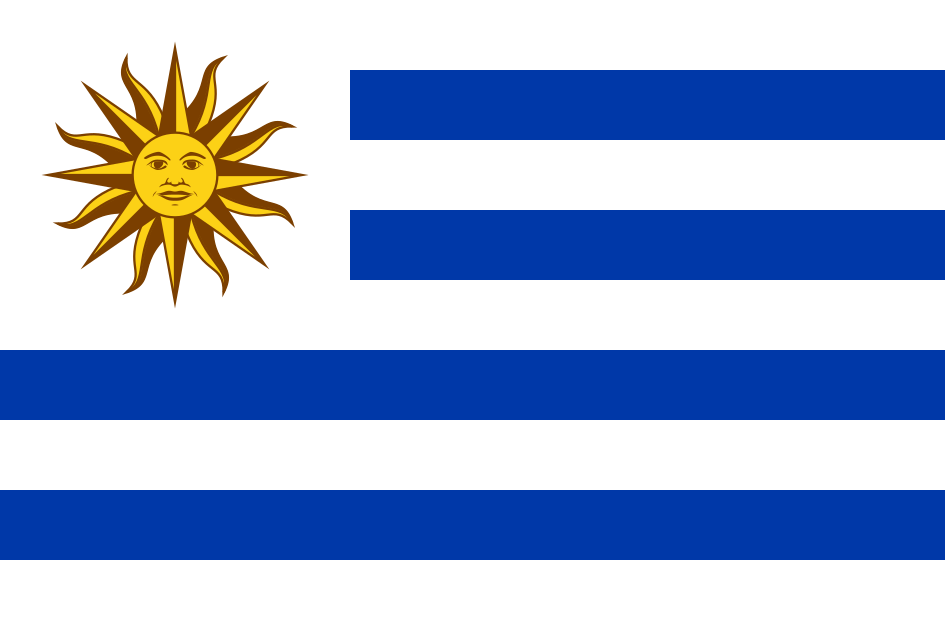
Uruguay
UYA small, progressive country between Brazil and Argentina, and the safest and most democratic in South America. Endless Atlantic beaches, the legendary Punta del Este, grilled meat and mate on every corner. Uruguay costs more than its neighbours but repays it with European levels of comfort and a relaxed atmosphere. Cannabis is legal here, and the carnival runs longer than the one in Rio.
Where to go #
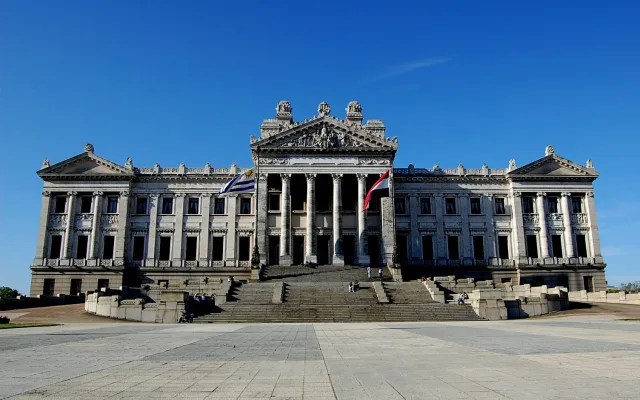
Montevideo
South America's safest and happiest capital: a coastal rambla, Art Deco in Ciudad Vieja, mate, and sizzling asado.
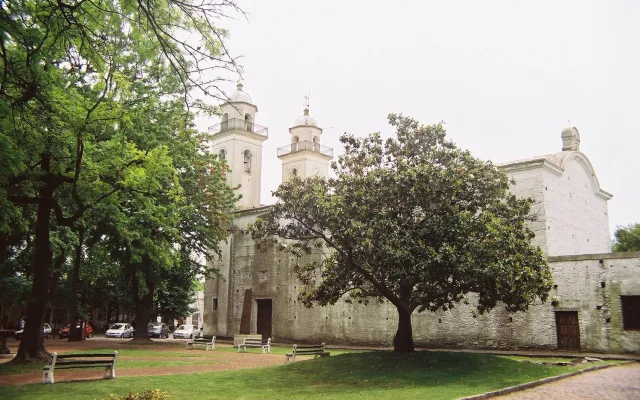
Colonia del Sacramento
Uruguay's oldest city, with the cobblestone streets of the Barrio Histórico and a lighthouse facing Buenos Aires — the perfect day trip across the estuary.
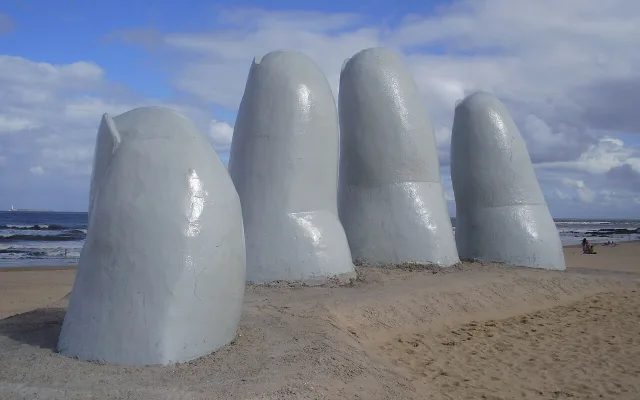
Punta del Este
South America's premium resort — the Brava and Mansa beaches, the Los Dedos sculpture and Casapueblo.
What to see #
What to see in the capital: The 22-kilometre Rambla is the headline attraction, where locals gather at sunset with their flasks. You can walk it for hours or hire a bike, watching the fishermen and the runners go by.
A day in Colonia: The seventeenth-century historic quarter is on the world heritage list and is made for walking. Climb the old lighthouse to see the Argentine shore on the far side of the estuary.
Worth a trip to the ocean: The giant concrete hand on Brava beach in Punta del Este is the country's most recognisable image. A photograph with the Fingers is a fixed point in almost every traveller's itinerary.
Where to find sunsets: Casapueblo, the whitewashed hotel-sculpture at Punta Ballena, recalls Gaudi or Santorini. Every evening there is a farewell-to-the-sun ceremony read over the creator's own poetry.
Where to go for something wilder: Cabo Polonio is reached by four-wheel-drive trucks across the sand dunes. There is no comfort to speak of, but the stars are brighter and the sea lions lie right at the foot of the lighthouse.
Carnival: In February and March Montevideo fills with murga performances and candombe drum parades. Seek out the tablados, the open-air stages in different neighbourhoods, where the satirical musical shows happen.
The theatre: Teatro Solis is the oldest in South America, with an astonishing interior and acoustics to match. You can go for a performance or take a detailed backstage tour.
Prices #
Currency: The Uruguayan peso is written with a dollar sign and a stroke through it. Notes and coins are both in use, and in 2026 the rate sits around 40 pesos to one US dollar.
Tax refund: Foreign visitors get an excellent break when paying by a card issued abroad in restaurants: the 22% VAT is deducted automatically at the till, which makes the bill noticeably kinder.
Prices: This is one of the more expensive countries in South America, with costs closer to Spain than to its neighbours. Budget travel is harder to pull off here than in Argentina or Bolivia.
Cards and cash: Visa and Mastercard are accepted almost everywhere, Amex much less so. Change cash at a proper Cambio office in the city centre rather than at the airport, where rates are traditionally poor, and note that shops paying in dollars use a deliberately low rate. A Wise or Revolut card avoids most of the mark-up.
Tipping: Ten percent for the waiter is the norm in restaurants. Sometimes it is already on the bill as cubierto or servicio, so read the total carefully before adding more.
| Item | Price (USD) |
|---|---|
| Lunch in a local cafe | 14 |
| Dinner for two with wine | 70 |
| Chivito sandwich | 11 |
| Large empanada | 3 |
| Night in a city hotel | 85 |
| Dorm bed | 22 |
| Taxi across town | 9 |
| Ferry ticket to Colonia | 58 |
| Bus, capital to Punta | 13 |
| Cappuccino | 4 |
| Litre of petrol | 2.1 |
| Bottle of wine in a shop | 12 |
| Litre of milk | 1.2 |
| Kilo of beef | 15 |
| Museum entry | 6 |
Getting around #
Getting there: Montevideo's Carrasco airport takes flights from Madrid, Sao Paulo, Panama City and Santiago, so most travellers from Europe or North America connect through one of those. The other classic approach is to fly into Buenos Aires and cross the river.
Ferries from Argentina: Fast boats run between Buenos Aires and the Uruguayan ports with Buquebus and Colonia Express. The Colonia crossing is cheaper and takes only an hour, and passport control for both countries happens in one place.
Long-distance buses: These link every town worth reaching and are how most people move around. COT and COPSA run comfortable coaches with reclining seats and a working toilet.
City transport: Montevideo has a dense bus network, and buying an STM card is worth it because it gives you free transfers within the hour and a lower fare per ride.
Taxis and apps: Uber and Cabify both work properly and are usually safer and cheaper than flagging a car down. Yellow city taxis always run the meter, and drivers are not tipped.
Car hire: A car makes sense for the wineries and the wild beaches of Rocha. Local firms such as Marino Sport often offer more flexible terms and insurance than the international chains.
Airport transfer: From Carrasco into central Montevideo a taxi costs 30 to 40 dollars, while the COT bus costs almost nothing and stops directly outside the terminal.
Where to stay #
Montevideo districts: Pocitos and Punta Carretas are the best bases, safe and full of cafes. The historic Ciudad Vieja is lovely by day but empties out unnervingly in the evening.
Staying in Colonia: The old town has plenty of small hotels in restored nineteenth-century houses. It is the most immersive way to experience the place, though rates run above average.
Seasonal pressure: From late December to mid-February the coast is at full stretch. Decent places sell out months ahead and prices can triple, so plan that stretch early or avoid it.
Apartments and guesthouses: Booking through the usual rental platforms works well and is often better value than a hotel, particularly if you intend to cook and take advantage of the beef.
Boutique hotels: The eastern coast has a lot of design-led places with ocean views, aimed at wealthier visitors from Brazil and Europe, and the service reflects that.
Cabo Polonio: Accommodation here is a different proposition, usually small cabins with a gas ring and candles. If you want any comfort, book something with solar panels so you can at least charge a phone.
What to eat #
The beef: Asado is not merely dinner, it is a point of national pride. The grilled beef is superb, and the best steaks are at Mercado del Puerto in Montevideo on a Saturday afternoon.
Chivito: A vast sandwich of thin steak, cheese, bacon and egg. Portions are often so large that one order comfortably feeds two adults.
Mate: Everyone drinks it, everywhere, and it is the single most visible cultural marker. Do not be surprised to see people carrying a flask under one arm into a business meeting or onto a bus.
Wine: Uruguay is known for Tannat, a dense red with serious tannins. Many bodegas sit close to the capital and are open for tastings and tours, which makes an easy half-day out of the city.
Drink driving: There is zero tolerance here. One glass of wine and you cannot legally drive; fines are enormous and police regularly patrol the roads around the resorts.
Sweet breakfasts: The day starts with medialunas and coffee. Try anything made with dulce de leche, the local caramelised milk that ends up in most of the baking.
Safety #
Overall: This is one of the calmest countries in the region, though that is not a reason to switch off. Apply the same habits you would in any big city and petty theft will not find you.
At night: In Montevideo, avoid the empty central streets after dark. The coastal districts and the Rambla are well lit and patrolled, and walking there in the evening is genuinely fine.
Basic precautions: Do not carry your original passport or large amounts of cash. A photocopy is enough for identification and the hotel safe handles the rest.
Things in the car: With a hire car, never leave bags or jackets on the seats. Even an empty carrier bag can be enough to get a window broken, especially in unattended beach car parks.
Locals will help: Uruguayans are friendly and often approach a visitor who looks lost. They will tell you if you have wandered into a rough block and point you towards a better route.
Withdrawing cash: Use ATMs inside bank branches during the day, and skip the street machines in quiet places. It is also worth reading your own government's travel advisory before the trip.
Etiquette and culture #
Carnival rhythms: The festival runs for forty days and is nothing like Brazil's. The centrepiece is the Llamadas parade, where dozens of drummers beat out hypnotic candombe rhythms through the streets.
Murga: A genre unique to the country, blending music, theatre and sharp political satire. Performers in vivid make-up and costume play the open-air stages, and it is worth going out of your way for.
A liberal streak: This is the most socially liberal state on the continent, and the laws actually function. A lot that is banned next door is legal here, yet people behave with great restraint about it.
Football: Uruguayans are fanatically devoted to their clubs and their national side. A match at the Estadio Centenario is the fastest way to understand the national character with the politeness stripped away.
Mate etiquette: Being offered mate from the shared gourd is a mark of real welcome. Do not stir the bombilla straw, and do not say thank you until you have finished for good, or you will not be offered another.
Secular by design: Equality and mutual respect are taken seriously and religion is fully separated from the state. Even the public holidays have been renamed, so Christmas is officially Family Day.
Connectivity #
Operators: Antel, Movistar and Claro all sell tourist packages. Antel is the state network with the best coverage in remote areas, and you can buy a SIM at the airport with your passport.
eSIM: If your phone supports it, Yesim or Airalo save you finding a shop and get you online the moment you land. Worth arranging before you fly.
Coverage: LTE data is available along essentially the whole coast and in the towns. The gaps are in genuinely wild places such as Cabo Polonio and in the deep interior.
Topping up: You can add credit at any pharmacy or kiosk through the Abitab and Redpagos systems. Just give your phone number and the amount you want to load.
Apps: Download Uber for getting around and PedidosYa for food delivery. For navigating the capital's buses, the official Como Ir app is the one that actually works.
On the road: Most long-distance coaches have free wifi, fast enough for messaging and checking maps while you travel.
Phrasebook #
| English | Spanish | Pronunciation |
|---|---|---|
| Hello / Hi there | ¡Hola! / ¡Buenas! | OH-la / BWEH-nas |
| How's it going? | ¿Todo bien? | TOH-do byen |
| How are you? (local) | ¿Cómo andás? | KOH-mo an-DAHS |
| Please | Por favor | por fa-VOR |
| Thank you | Gracias | GRAH-syas |
| Yes / No | Sí / No | see / no |
| Slang: mate, hey! | Bo | boh |
| Slang: brilliant | Bárbaro | BAR-ba-ro |
| How much is it? | ¿Cuánto sale? | KWAN-to SA-le |
| Too expensive | Muy caro | mwee KA-ro |
| The bill, please | La cuenta, por favor | la KWEN-ta por fa-VOR |
| Steak / meat | Carne | KAR-ne |
| Beer | Cerveza | ser-VE-sa |
| Where's the toilet? | ¿Dónde está el baño? | DON-de es-TA el BA-nyo |
| Help! | ¡Ayuda! | a-YOO-da |
| I don't understand | No entiendo | no en-TYEN-do |
| Where is...? | ¿Dónde queda...? | DON-de KE-da |
| Sorry | Disculpá | dis-kool-PA |
| Bye! | ¡Chau! | chow |
| Delicious! | ¡Qué rico! | ke REE-ko |
Good to know #
Your embassy: Most foreign missions sit in Montevideo, many of them in the Pocitos district. Note the duty number before you travel in case you lose your documents or need consular help.
Bus tickets: Timetables for every coach out of the capital are collected on the Tres Cruces terminal website, where you can check fares and journey times, though the actual booking often has to be done on the operator's own site.
Finding a room: Booking.com covers the city hotels well. For apartments in Pocitos or a cabin by the ocean, Airbnb is the better tool and frequently has discounts outside the peak weeks.
Maps: Google Maps knows the public transport routes here, but download the offline maps anyway. The historic centres are a tangle of small streets and easy to lose your bearings in.
Calling for help: Dial 911 for police or rescue services. The capital also runs dedicated tourist patrols whose officers speak English.
Holiday shutdowns: At Christmas and during Semana de Turismo, which is Easter week, the country stops. Shops close and transport thins out, so buy tickets and food ahead of time.