 Города и дороги
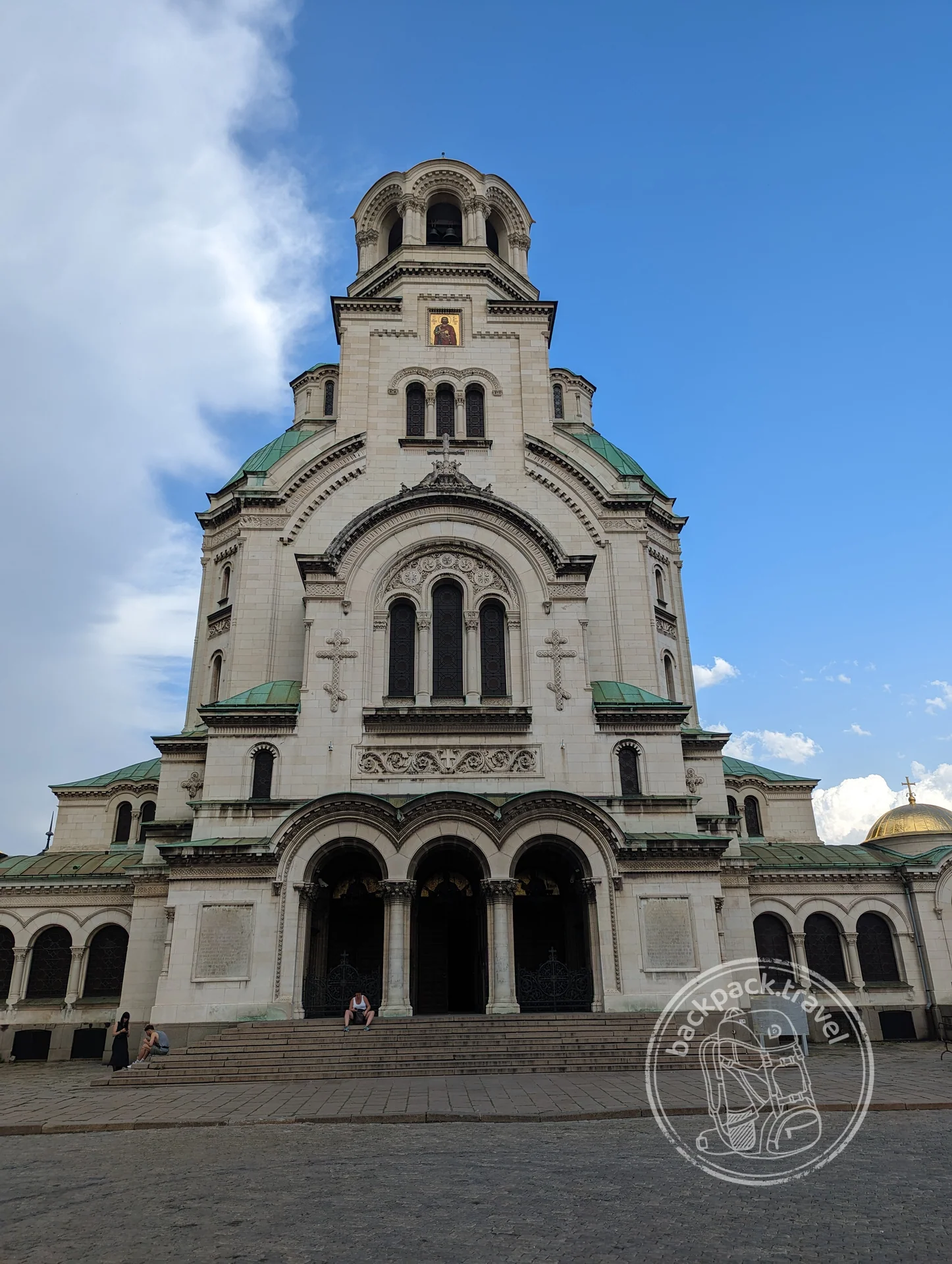
The principal church of Bulgaria and one of the largest Orthodox cathedrals in the Balkans: it holds around five thousand people. The decision to build it was taken in 1880, soon after liberation from Ottoman rule, in memory of the Russian soldiers who died in the war of 1877-1878. Construction, to a design by the Saint Petersburg architect Alexander Pomerantsev, ran from 1904 to 1912.
How it is built
The composition is neo-Byzantine: a central gilded dome on a high drum, half-domes around it, and a free-standing bell tower forty-five metres high with twelve bells. The finishing materials were brought from across Europe: Italian marble, Brazilian onyx, German stained glass, Venetian mosaic.
Inside
Inside it stays dim, and after the bright square the eyes take a while to adjust. The walls were painted by Bulgarian and Russian artists. The crypt holds an icon museum, the finest collection of Bulgarian icon painting from the ninth century to the nineteenth. It has its own entrance, its own ticket and its own hours, closed on Mondays.
The name
The cathedral changed its dedication twice for political reasons: in years when relations with Russia soured it was renamed for Saints Cyril and Methodius. The present name was restored in 1920.
The cathedral is in use and entry is free. It stands on its own square in the centre of Sofia, and the gilded domes are visible from most of the surrounding streets.
- Address
- Alexander Nevsky Square, Sofia
- Opening hours
- Cathedral 7:00–19:00, crypt Tue–Sun 10:00–18:00
- Prices
- Cathedral free, crypt about 10 BGN
On the map
Reviews (0)
No reviews yet. Be the first!
Updated