Sofia
Description
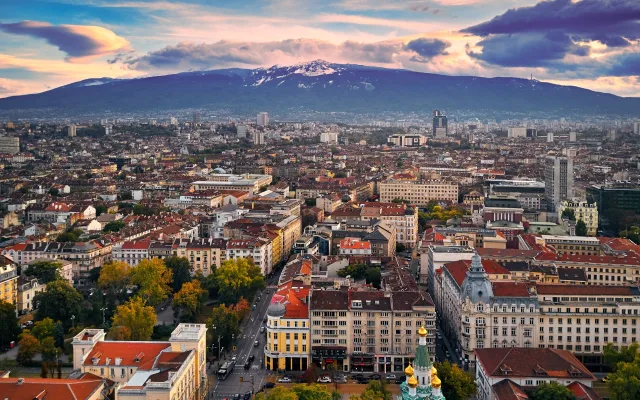
Sofia is one of Europe's oldest capital cities, set at the foot of Mount Vitosha. Home to the Alexander Nevsky Cathedral and an authentically Balkan atmosphere.
Wiki
Bulgaria's capital — around 1.3 million inhabitants. One of Europe's oldest cities (over 7,000 years of history; Roman name Serdica, Thracian Srednets, Ottoman Triaditsa). The city has a remarkable density of layers within a single square kilometre: Roman ruins, Byzantine churches, Ottoman mosques, Bulgarian National Revival architecture, Soviet-era buildings and contemporary European design. Directly to the south rises Mount Vitosha (2,290 m), home to one of Europe's oldest national parks (established 1934).
Top sights
- Alexander Nevsky Cathedral — Bulgaria's principal Orthodox cathedral, Neo-Byzantine in style, built 1882–1912, with a 45-metre dome and 12 bells.
- Sveti Georgi Rotunda — Sofia's oldest surviving building (4th century, Roman era), tucked inside the courtyard of the Presidential Palace.
- Sveta Sofia Square — site of the 6th-century Church of Sveta Sofia (from which the city takes its name) and part of the ancient Roman forum.
- Vitosha Boulevard (Vitosha) — the main pedestrianised street, lined with shops and cafés.
- National Historical Museum — the largest in Bulgaria, housed in the former residence of Communist-era leader Todor Zhivkov.
- Museum of Socialist Art — the only place in Bulgaria where Soviet-era monuments have been preserved and displayed.
- Archaeological Museum — occupying the former Buyuk Djamia mosque; Thracian and Roman art, including the gold Valchitran Treasure mask.
- Boyana Church — a UNESCO World Heritage Site 8 km from the centre, with 13th-century frescoes considered around 200 years ahead of the Italian Renaissance.
- Mount Vitosha — rising immediately south of the city to 2,290 m; chairlifts reach the Aleko plateau (1,800 m); ski resort in winter.
- Rila Monastery — Bulgaria's most important monastery and a UNESCO World Heritage Site, 110 km from Sofia.
- Plovdiv — 150 km away, reachable by train in 2–3 hours.
Food and prices
Bulgarian cuisine dominates: shopska salad, banitsa (cheese-filled pastry), kavarma (slow-cooked meat stew), moussaka, kashkaval-pane (fried cheese), kebapche (grilled minced-meat rolls). The wine scene is strong. Lunch at a mehana (traditional tavern) runs 6–12 EUR ($7–14), dinner at a restaurant 15–30 EUR ($17–35). A glass of Mavrud or Bulgarian Cabernet Sauvignon costs 3–5 EUR ($3.50–6). A litre of petrol is around 1.40 EUR ($1.60); the metro (4 lines) costs 1.60 EUR ($1.90); a ride with Yellow Taxi or TaxiMe runs 3–10 EUR ($3.50–12). Prices are as of 2026.
Getting there and around
Sofia International Airport (SOF) is served by Wizz Air, Ryanair, Lufthansa and flydubai, among others. The metro into the centre takes about 20 minutes and costs 1.60 EUR ($1.90); a taxi or Bolt ride runs 8–12 EUR ($9–14). From Skopje: bus, 5–6 hours (15–25 EUR / $17–29). From Bucharest: bus or train, around 9 hours. Around the city: metro, buses, trolleybuses and trams.
When to go
April through October, temperatures range from 12–28 °C. May and June are ideal — mild and with spring blooms. The Vitosha ski season typically opens in November. Winter (December–March) is cold (−3 to +5 °C), often snowy, and good for skiing. Key events: Sofia Music Weeks (spring) and Sofia Pride (June).
Updated