Description
The capital of Algeria — the UNESCO-listed Casbah, French boulevards and the great white mosque above the Mediterranean.
Wiki
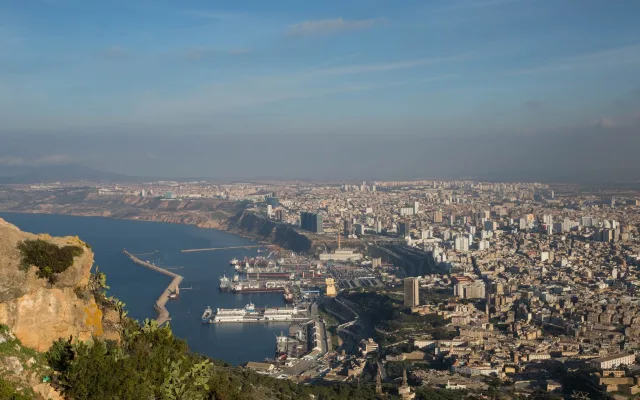
Algiers (Arabic al-Jaza'ir, "the islands") is the capital of Algeria and the largest city of the Maghreb, spread like an amphitheatre along the western shore of a deep Mediterranean bay. The seaward view is formed by a cascade of whitewashed houses climbing the hills from the harbour front, which is why the city has long been called Alger la Blanche, "Algiers the White". Around three million people live in the metropolitan area, and its character combines three eras: the Ottoman medina, the formal French colonial centre and the monumental building of the socialist 1970s.
The historic core and the Casbah
The heart of the old city is the Casbah, inscribed on the UNESCO World Heritage list. It is a dense maze of narrow paved lanes, steep stairways and blank walls concealing the courtyards of traditional houses. The Phoenicians founded a settlement here under the name Icosium, but the present shape of the medina took form under the Ottomans, when Algiers was the capital of a semi-independent regency and a corsair base. Among the surviving monuments are the 11th-century Great Mosque (Djamaa el-Kebir) with its later minaret, the baroque New Mosque (Djamaa el-Djedid), and the palaces of the deys, now occupied by museums of crafts and calligraphy. Walking the Casbah calls for comfortable shoes and attention: the changes in level are considerable, and it is easier to find your way with a local guide.
The colonial and modern city
Below the medina lies the French centre, with boulevards, arcades and facades in the Haussmann spirit — the Place des Martyrs, the Grande Poste in neo-Moorish style, and the waterfront with its long galleries.
- Notre-Dame d'Afrique — the 19th-century Catholic basilica on the heights of Bouzareah; the terrace gives the best view of the bay and the port.
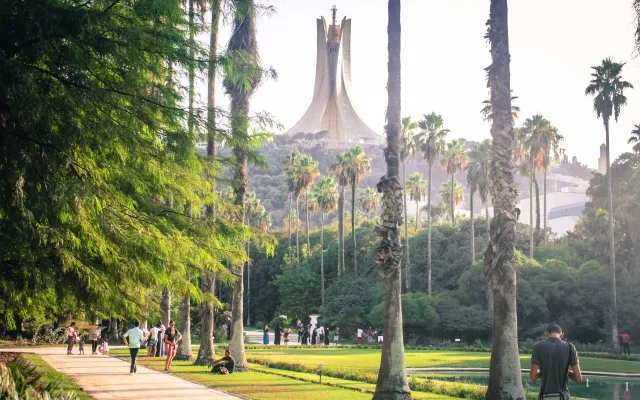
- Maqam Echahid (the Martyrs' Memorial) — a concrete stele about 92 metres high formed of three converging "palm fronds", dedicated to the fallen of the war of independence; at its foot are the Army Museum and the Riadh El Feth shopping centre.
- The Bardo Palace — an ethnographic and prehistoric museum in an elegant Ottoman villa with a garden.
- The National Museum of Fine Arts completes the picture; and in the seafront district stands the modern Djamaa el-Djazair (Great Mosque of Algiers), with one of the tallest minarets in the world.
Around the city
Within an hour or two lie sites that deserve a day of their own. Tipaza is a coastal archaeological site on the UNESCO list, with the ruins of a Roman and early Christian town above turquoise water. Nearby is the Royal Mausoleum of Mauretania, known as the Tomb of the Christian Woman, a monumental royal burial place. East of the capital the foothills of Kabylia and the beaches of the coast are worth exploring.
Food
The Algerian table combines Berber, Arab, Ottoman and Mediterranean traditions. The staples are couscous with vegetables and meat, the rich cracked-wheat soup chorba frik, mechoui (a whole roast lamb), mhadjeb (flatbread stuffed with vegetables), along with honey-and-almond pastries and strong mint tea. A modest lunch in a café runs to roughly $5-8 and dinner in a restaurant to about $15-25. Note that alcohol is sold only in limited places, and during Ramadan daytime life pauses and establishments open mainly in the evening.
Transport and practicalities
The gateway is Houari Boumediene international airport (ALG), served by Air Algérie along with several European and Turkish carriers; a taxi into the centre costs roughly $15-20. Within the city there is a single metro line, a tram and an extensive bus network, with fares of a token amount, while a taxi across the centre runs to $2-5. Fuel is among the cheapest in the world, at about $0.30 a litre. Most foreign nationals need a visa, arranged in advance; bring cash dinars, as cards are far from universally accepted.
When to go
The most comfortable times are the shoulder seasons, April to June and September to November, when the temperature holds at 18-25°C. Summer is hot (28-35°C) but the coast makes up for it with swimming. Winter is mild (10-16°C) and wet. Three days is enough to see the Casbah and the colonial centre, climb to Notre-Dame d'Afrique and the memorial, and give the remaining day to the ruins at Tipaza.