Description
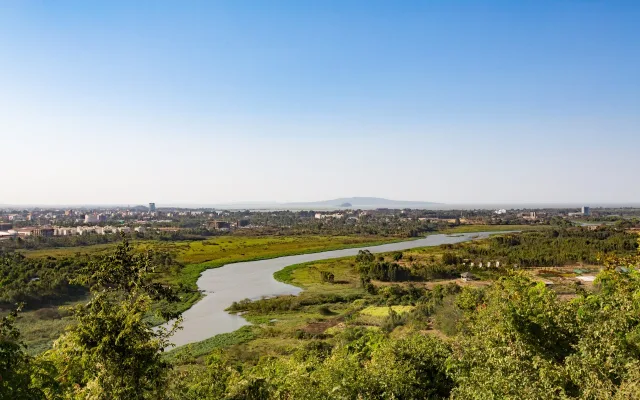
A town on the shore of Lake Tana — the outflow of the Blue Nile, the island monasteries and the Tis Issat falls.
Wiki
One of the few Ethiopian towns where you simply want to slow down: wide palm-lined streets, warm air and Lake Tana at your feet. Boats leave from here to the island monasteries, the Blue Nile flows out of the lake, and for two days the town makes a convenient base for the monasteries, the waterfall and, if you like, a run out to Gondar.
Why come, and what is actually worth seeing
The main reason to come is Lake Tana and its monasteries. These are not an open-air museum but working churches, where monks come every day. Inside are vivid 16th- and 17th-century wall paintings in the characteristic Ethiopian style, often well preserved. Ura Kidane Mihret on the Zege peninsula is the most accessible and the most picturesque: the crossing is short and the church sits among coffee and lemon groves. Daga Estifanos is further out, but it holds the mummified remains of medieval emperors and offers a view over the lake. One important point for planning: women are not admitted to a number of islands, Daga Estifanos among them — this is a strict rule rather than a formality, so check your route in advance.
The Tis Issat falls ("smoking water"), 30 km from town, are the second essential. In the dry season they are noticeably thinner than in the photographs, as a hydroelectric scheme upstream takes part of the flow. The trip is still worth it for the walk: from the car park you go on foot through a village, cross the Blue Nile on an old Portuguese stone bridge, and there are viewpoints from several sides. Allow two to three hours on site plus the drive.
The rest is secondary. Bezawit Hill, with the former residence of Haile Selassie, is a good spot for sunset over the lake. The town market is interesting for shamma cloth, baskets and spices, but it is background rather than a destination.
Planning two days
- Day 1 — the boat tour of the monasteries. Set out early: calmer water and softer light. A circuit of Zege plus one or two islands takes half a day, and can be combined with watching pelicans at the mouth where the Nile leaves the lake.
- Day 2 — Tis Issat falls in the morning, and the evening for the waterfront, a coffee ceremony and sunset on Bezawit.
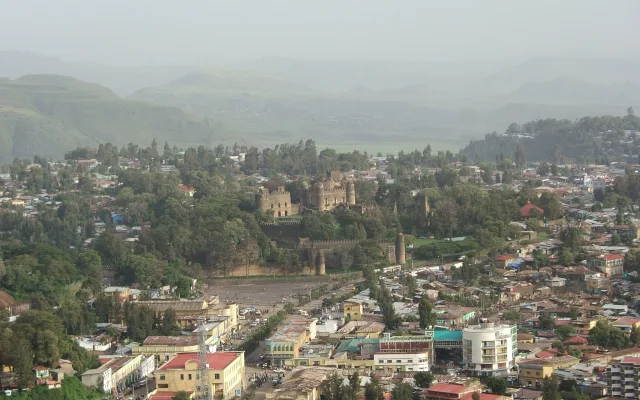
If you want Gondar and the castles of Fasil Ghebbi, that is a full day of its own or a night there; do not try to squeeze it into two days alongside Bahir Dar.
Getting there and getting around
The simplest option is an Ethiopian Airlines flight from Addis Ababa, about an hour. The airline usually offers domestic discounts to those who arrived in the country on its own international service — ask about them when buying, as the saving is significant. The airport (BJR) is close to town and the ride into the centre is cheap.
Around town everything is handled by bajaj three-wheelers and your own feet: the waterfront and the centre are compact and walkable. Agree the fare before getting in — there are no meters. For the waterfall and Gondar, people take a car with a driver or a bus; buses are cheap but slow and leave early in the morning.
The boat tour is easier and cheaper taken as a group — alone it costs noticeably more. Look for others at the guest houses or the jetty, and haggling is fair.
Where to stay
Stay along the lake or near the waterfront — that gives you both the views and walking distance to the jetty where the boats leave. The range is wide, from simple guest houses to a few resort hotels on the shore. Budget options are slightly back from the water, closer to the centre and the market.
Food, prices and money
The cooking is standard Ethiopian and good: injera with various wats (shiro, tibs), and here also fresh fish from Tana, a rarity in a landlocked country. The coffee ceremony is offered everywhere; it is a ritual rather than simply a cup, so accept at least once.
Bahir Dar feels inexpensive: lunch at a local café costs a few dollars, and dinner in a restaurant with fish noticeably more but still budget by a traveller's standards. The main expenses are not food but the boat and the transfer to the falls.
On money: carry enough cash in birr, as ATMs are temperamental and cards are barely accepted outside the larger hotels. Change currency in advance in Addis Ababa or at a major bank.
When to go, and what to watch for
October to March is dry and comfortable, roughly 18-26°C, and the best time. In the rainy season (June to September) the falls are more powerful and the country greener, but the dirt roads to them and to Gondar wash out and journeys become unpredictable.
A separate reason to come in January is Timkat (Epiphany, around 19 January). Bahir Dar is one of the best places to see it: processions, pilgrims and the rite at the water. Accommodation is taken early, so book well ahead.
Two practical points: at the monasteries it is customary to dress modestly and remove your shoes, and a small payment is often expected for photographs and as a donation — keep small notes. And do not chase the number of islands: two or three monasteries without hurrying give more than a marathon around the lake.