Description
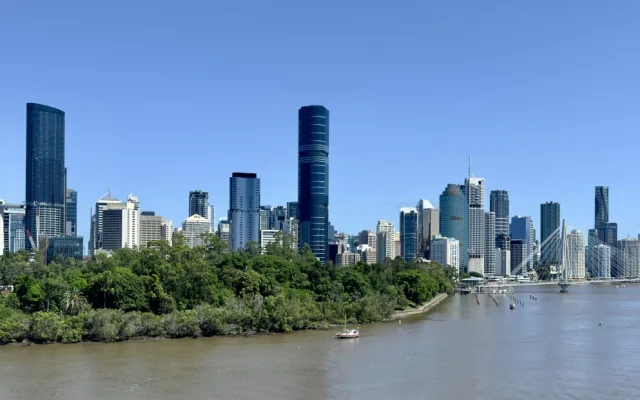
Brisbane is the capital of Queensland, known for cultural landmarks such as South Bank and GOMA, and for its closeness to the Moreton Bay islands and to koala country.
Wiki
Brisbane is the capital of Queensland and Australia's third-largest city, spread along the bends of the river of the same name 30 kilometres from where it meets Moreton Bay. Around 2.6 million people live here, and a mild subtropical climate gives almost 280 sunny days a year, which makes the city a convenient base for travel across all of south-east Queensland.
First impressions
For a long time Brisbane stood in the shadow of Sydney and Melbourne, taken for a large provincial centre. Over recent decades, though, the city has changed markedly: modern towers have risen in the business district, cultural life has come alive, and the riverbanks have turned into busy public spaces. Its selection as host of the 2032 Summer Olympics confirmed the new status. The city stretches along both banks: the historic and business centre (the CBD) on the north side, and the South Bank cultural cluster on the south.
Main sights
- South Bank Parklands — the heart of the south bank, a park on the site of the old Expo 88. Here is Streets Beach, the city's only artificial beach with a lagoon in the middle of the metropolis, along with the Wheel of Brisbane and the bougainvillea-covered Grand Arbour.
- GOMA and the Queensland Cultural Centre — the Gallery of Modern Art is considered one of the largest contemporary art venues in Australia. Beside it are the Queensland Art Gallery, the state museum and the state library — all free to enter.
- Story Bridge — the steel cantilever bridge of 1940 that has become the city's emblem. Organised bridge climbs run across its spans, with panoramic views.
- Eagle Street Pier and the Goodwill Bridge — riverside promenades with restaurants and bars, looking across to the bend at Kangaroo Point with its climbing cliffs.
- Mount Coot-tha — the main lookout above the city. A botanic garden lies at its foot, along with the Sir Thomas Brisbane Planetarium.
- Lone Pine Koala Sanctuary — the oldest koala sanctuary in the world, founded in 1927. You can not only see a koala but hold one, and feed the kangaroos.
- The City Botanic Gardens — an old garden in the river bend beside the business district, a favourite spot for picnics.
Islands and day trips
Brisbane is an ideal base for days out. An hour to the south lies the Gold Coast with its famous Surfers Paradise beach and theme parks; to the north, the Sunshine Coast and the resort town of Noosa. Moreton Bay and its islands deserve particular attention: North Stradbroke Island (Minjerribah), with wild beaches and dolphin colonies, and sandy Moreton Island (Mulgumpin), where the sunken Tangalooma Wrecks lie just offshore, a popular snorkelling site.
History and culture
The land traditionally belongs to the Jagera and Turrbal peoples. European settlement began in 1824 as a penal colony, and the city took its name from Thomas Brisbane, governor of New South Wales. It became capital of the newly created Queensland in 1859. Today it is a multinational centre with strong Asian and Pacific communities, evident both in the streets and in the food.
Food and prices
Local cooking combines modern Australian with Asian influence: barbecue and grills, fresh seafood, Sunday brunches and a developed coffee culture. Lunch in a café runs about A$18-28 ($13-20), dinner in a restaurant A$40-70 ($28-49), and a flat white around A$5 ($4). A litre of petrol costs about A$1.30 ($0.90). Prices are as of 2026 and are averages that shift over time.
Getting there and getting around
Brisbane International Airport (BNE) is served by Qantas and Virgin Australia along with foreign carriers including Singapore Airlines and Emirates. The Airtrain runs into the centre (about A$21 / $15); a taxi costs more. Within the city there is an integrated network of trains, buses and ferries, and Brisbane's signature is the CityCat river catamaran, running up and down the river. Fares are paid with a go card. The Gold Coast is easily reached by suburban train in about an hour and a half.
When to go
The best season is the Australian winter and the shoulder months, April to October: a comfortable 18-26°C, dry and sunny. Summer (December to February) is hot and humid at 25-32°C, with likely thunderstorms. Allow around three days for the city and a trip to the coast or the islands.