Description
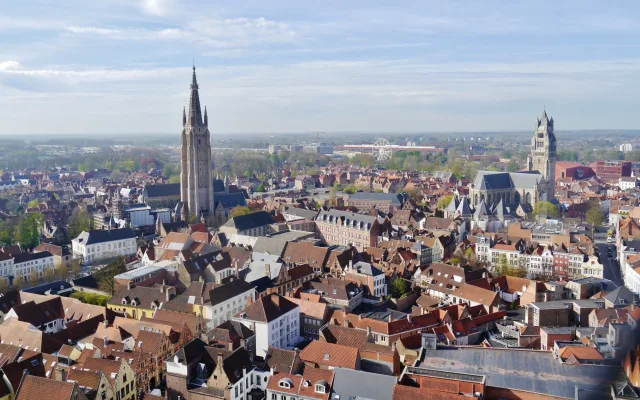
Bruges is a medieval UNESCO-listed city where you can explore canals, visit the De Halve Maan brewery, and wander its remarkably preserved historic core.
Wiki
Wet cobblestones, mist over the canal and the smell of waffles on every corner — Bruges looks like a film set, but it is a real city that has somehow survived the centuries almost unchanged. Compact, entirely walkable and perfectly sized for two unhurried days.
Why go and how long to stay
Bruges froze in the 15th century, when it was one of the richest trading centres in Europe — then its harbour silted up, the money moved to Antwerp, and the medieval core was left intact. That accidental preservation is why the entire historic centre is a UNESCO World Heritage Site.
Many visitors come from Brussels for the day — a mistake. Daytime Bruges is swamped with coach groups, and what makes it special is the early morning and evening, when the crowds leave and the city is yours. Allow 2 days with an overnight stay: day one for the main square, canals and museums; day two for the quieter edges of the centre, the Beguinage, the brewery, and an unplanned wander.
What is actually worth seeing
- Markt and the Belfort. The main square and the famous belfry. 366 narrow steps to the top — queues can be long, so arrive at opening time. The views are worth the effort, but the square is rewarding even from ground level.
- Burg. The adjacent square with the Town Hall and the Basilica of the Holy Blood — inside are a relic, a steady stream of pilgrims and tourists, and usually free entry.
- The canals (Reien). A half-hour boat trip gives the best perspectives on the city; avoid the midday slot. Jetties are scattered around the centre, prices are roughly the same everywhere, and boats take cash only.
- Groeninge Museum. A compact collection of Flemish Primitives — Van Eyck, Memling. If you can only visit one art venue in the city, make it this one.
- Begijnhof and Minnewater. A quiet white courtyard complex and the "Lake of Love" next to it — best visited in the morning or late afternoon, as it gets crowded by day.
Don't chase a checklist. Half the pleasure is simply getting lost in the lanes north and east of the Markt, where tourist numbers drop sharply but the canals and bridges are just as good.
Beer, chocolate and food
The local beer is Brugse Zot, brewed right in the city centre at the De Halve Maan ("Half Moon") brewery. The tour is popular and fills up — book ahead; a tasting is included at the end. The nearby Bruges Beer Experience explains what sets Belgian beer apart from everything else.
For food, go for Flemish classics: waterzooi (a creamy stew), mussels and fries, carbonade flamande (beef braised in beer). Fries are street food — look for frituur stalls rather than restaurants. Waffles and chocolate are everywhere; for chocolate, seek out small independent workshops rather than the chain shops around the main square.
Bruges is not cheap and is geared toward tourists. The simple saving: walk a couple of blocks away from the Markt and Burg — the same dishes cost noticeably less. Eat a substantial lunch at a brasserie and save the evening for beer and waffles.
Getting there and getting around
Bruges has no airport of its own. Fly into Brussels (BRU) or Charleroi, then continue by train. From Brussels the journey takes about an hour; from Ghent it is roughly half that, with frequent services. Bruges station is about 15–20 minutes on foot from the centre, or a couple of stops by city bus.
Once there, you barely need transport: the entire centre is walkable, with distances measured in hundreds of metres. The cobblestones matter: comfortable shoes are more important than they seem, and wheeled luggage on the old paving is genuinely painful. A rental bike from near the station is useful for venturing beyond the centre — to the windmills on the ramparts, for instance, or along the canal toward Damme. Horse-drawn carriages and hop-on tourist buses are novelties and overpriced.
When to visit and what to budget for
- April–October — mild, green, but busy.
- July–August — peak crowds; the remedy is early mornings and late evenings.
- December — Christmas market and an ice rink on the square; atmospheric, but cold and damp.
- Shoulder season (November, March) — fewer people, lower accommodation prices, but unpredictable weather.
Where to stay and common mistakes
Stay inside the historic centre — the evening and morning city without the crowds is the main reason to spend a night here. Hotels near the station are cheaper, but you lose exactly what you came for.
Frequent mistakes: coming for a single day and seeing only the crowds; storming the belfry at noon; eating right on the Markt; dragging wheeled luggage across the cobblestones when a taxi from the station costs little. Keep some cash — boat trips and small vendors do not always accept cards.