Description
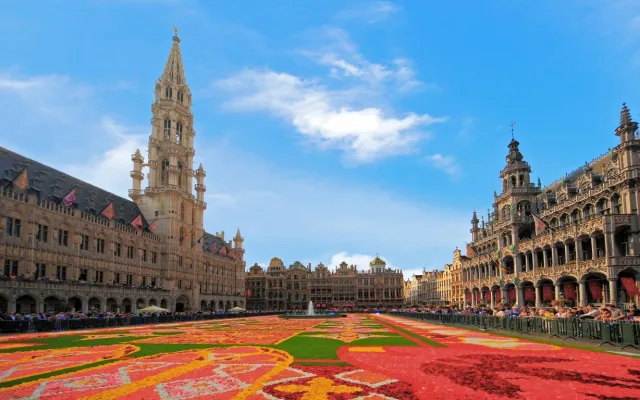
Brussels is Europe's de facto capital, home to the UNESCO-listed Grand Place and the iconic Atomium. The city is also celebrated for what many consider the world's finest waffles and chocolate.
Wiki
Brussels is the capital of Belgium and the administrative heart of the European Union, seat of the bloc's key institutions. A compact but layered city: around 1.2 million people live in the capital region, speaking two official languages — French and Dutch — while its streets combine Flemish Gothic, Art Nouveau and the world-famous traditions of Belgian chocolate, beer and comics.
History and character
A settlement on the marshy banks of the River Senne emerged around the 10th century and gradually grew into a trading hub on the route between Bruges and Cologne. During the Middle Ages the city prospered through textile production and sumptuous tapestry-making, with craft guilds shaping its character. Brussels subsequently passed through the hands of the Burgundians, the Spanish and Austrian Habsburgs, the French and the Dutch — each era leaving its architectural mark. In 1830 it became the capital of independent Belgium, and in the second half of the 20th century it evolved into the unofficial "capital of Europe." This multinational character is felt everywhere: official signage appears in both languages, and the streets carry the voices of diplomats, officials and immigrants from across the globe.
Main sights
- Grand Place — the central square and a UNESCO World Heritage Site, framed by the Gothic Town Hall with its ornate tower, gilded Baroque guild houses and the Maison du Roi. Every two years the square is carpeted with a famous display of begonias.
- Manneken Pis — a tiny bronze fountain just off the Grand Place that has become the city's unofficial symbol. It is regularly dressed in costumes; the wardrobe numbers more than a thousand outfits and is kept in a dedicated museum.
- Atomium — a 102-metre structure in the shape of an enlarged unit cell of an iron crystal, built for the 1958 World's Fair (Expo 58). The spheres today house exhibition halls and a viewing platform overlooking the north of the city.
- European Quarter — the EU's business centre, with the buildings of the European Parliament, the Council, and the Berlaymont — headquarters of the European Commission. Also here are the House of European History museum and the Parlamentarium, both dedicated to explaining how the union works.
- Galeries Royales Saint-Hubert — an elegant covered arcade dating from 1847, one of the oldest in Europe, with a glass roof, coffee houses and chocolatiers.
- Magritte Museum and the Belgian Comic Strip Center — the city's two essential cultural addresses. The former is devoted to Surrealist René Magritte; the latter celebrates the "ninth art" through Tintin, the Smurfs and dozens of other characters.
Also worth visiting: the Mont des Arts terraces with their panoramic views, the Cathedral of Saints Michael and Gudula, and — for Art Nouveau enthusiasts — the mansions designed by architect Victor Horta.
Neighbourhoods
The historic Lower Town around the Grand Place is a labyrinth of narrow cobbled streets, chocolate boutiques and brasseries. The Upper Town, with the Royal Palace, fine arts museums and parks, has traditionally held an aristocratic character. Fashionable Ixelles and the Place Châtelain are known for cafés and bars, while multicultural Saint-Gilles is prized for its Art Nouveau architecture. The Marolles quarter is famous for its flea market on the Place du Jeu de Balle.
Food, chocolate and beer
Local cuisine is hearty and distinctive: mussels in white wine with fries (moules-frites), thick waterzooi stew, and meat braised in dark beer. Frites are considered a national invention and are served in a paper cone with sauce. Waffles come in two varieties: the light, airy Brussels waffle and the denser, caramelised Liège waffle. A particular point of pride is the praline and ganache produced by long-established chocolatiers. Beer culture is vast, ranging from Trappist ales to sour lambics and spontaneously fermented gueuzes, produced — among other places — at the family-run Cantillon brewery.
Planning your visit
Brussels Airport (BRU) at Zaventem is connected to the city centre by a fast train (about 17 minutes). Budget flights often arrive at Charleroi Airport (CRL), around an hour's drive to the south, served by shuttle buses. Within the city the STIB network — metro, trams and buses — operates on a unified ticketing system. Brussels is a major rail hub: Eurostar trains run to London, and high-speed services connect to Paris, Amsterdam and Cologne.
Three days is a sensible allocation: day one for the historic core — Grand Place, the galleries and museums; day two for the European Quarter, the Atomium and parkland; day three for strolling through Ixelles, taking in Art Nouveau architecture and sampling local flavours. The city is compact, the climate mild and rainy, so an umbrella and comfortable shoes are advisable in any season.