Busan
South KoreaDescription
Korea's seaside city — Haeundae beach, the Haedong Yonggungsa temple and the Jagalchi market.
Wiki
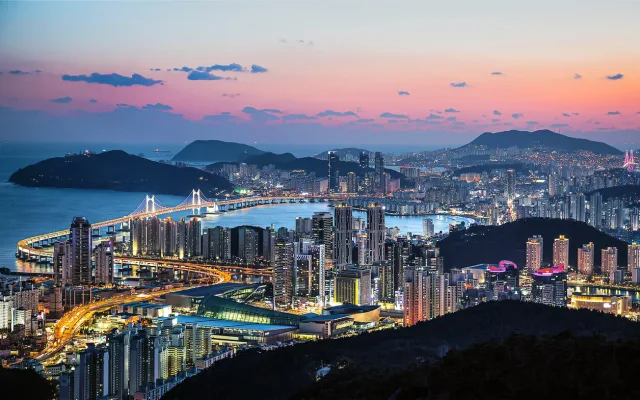
Busan is the second-largest city in South Korea and its main maritime gateway, spread across the south-eastern tip of the peninsula on the shores of the Korea Strait. Unlike buttoned-up, businesslike Seoul, a relaxed seaside atmosphere reigns here: hills come down right to the water, narrow streets climb the slopes, and the fresh catch is served in harbour eating houses from morning until night.
History and general character
From a small fishing settlement Busan grew into the country's largest port and one of the busiest container hubs in the world. During the Korean War the city became the temporary capital and a refuge for hundreds of thousands of displaced people — it was then that dense quarters of self-built houses rose on the mountain slopes, giving Busan its unmistakable stepped silhouette. Today it is a metropolitan area of around 3.4 million people, where the skyscrapers of the Haeundae business district stand alongside old lanes and Buddhist monasteries.
Main sights
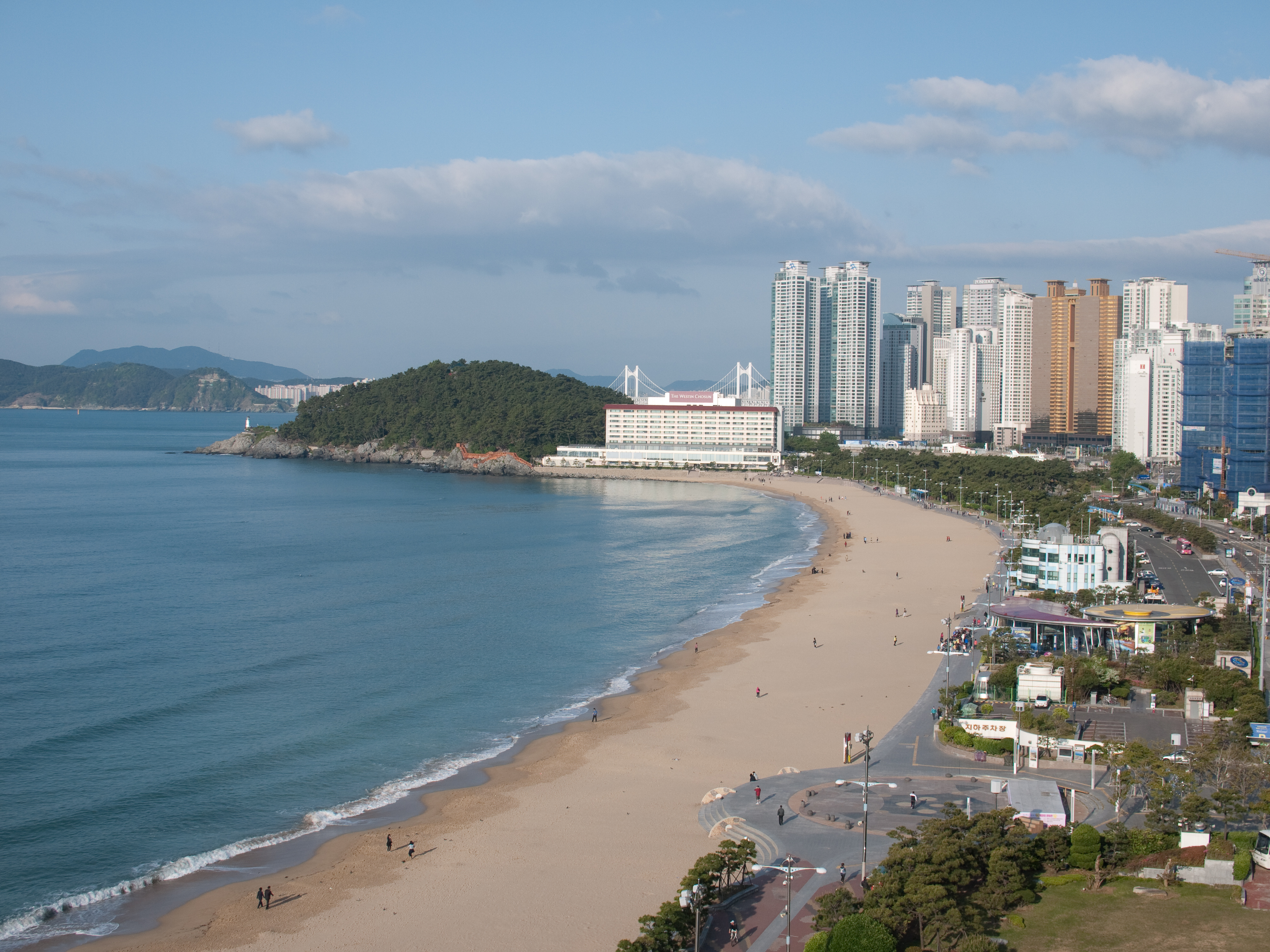
- Haeundae beach — the symbol of the Korean seaside holiday: about 1.8 km of pale sand framed by hotels and parks. At the height of summer there can be up to 100,000 people a day here. The SEA LIFE aquarium is nearby (a ticket is around 24,000 won).
- Haedong Yonggungsa temple — an exceptionally rare coastal Buddhist monastery, built right on the rocks above the waves. Entry is free; it is at its most beautiful at dawn and during the cherry blossom.
- Jagalchi market — the largest fish market in Korea and the true heart of harbour life. The crab, oysters or sea urchin you pick out will be cooked on the spot, or served raw on the upper floors.
- Gamcheon Culture Village — a former refugee quarter turned into a vivid art object: brightly coloured cubes of houses on the hillside, murals and installations, often compared to Santorini in Greece. A nominal ticket costs around 1,000 won.
- Gwangalli beach — famous for the evening panorama of the illuminated Gwangan cable-stayed bridge; a string of cafes and bars runs along the promenade.
- The Igidae trail and Taejongdae park — coastal routes over rocky headlands with viewpoints, pine trees and views of the open sea.
Food
Busan's cooking is inseparable from the sea and from the city's history. This is the birthplace of milmyeon, cold wheat noodles in an iced broth, invented as an affordable substitute for the North Korean naengmyeon, and of the tteokbokki served with local fish cakes (eomuk), for which the street stalls are famous. At Jagalchi and the neighbouring markets they serve hoe (Korean-style raw fish), boiled crab and seafood soup. It is also worth trying dwaeji gukbap, a rich soup of pork and rice, another signature dish that spread from the refugee camps. A portion of fresh seafood at the market costs roughly 10–20 dollars; an inexpensive lunch from 6 dollars, dinner in a restaurant about 25, and a cup of coffee around 4.
Districts
Haeundae is the resort and business core, with the beach, the high-rises and the BEXCO exhibition centre. Seomyeon counts as the main shopping and entertainment hub, with a dense network of shops and night-time venues. Nampo-dong, around Jagalchi and the Gukje market, keeps the atmosphere of the old port, and the Busan Tower rises nearby in Yongdusan park. The residential and university quarters of Kyungsung and Busan National University draw a young crowd and inexpensive cafes.
Transport
The city metro (four lines) together with the buses covers almost every point of interest; a single journey costs around 1,400 won, and a transport card is convenient. From Seoul the KTX high-speed train takes 2 hours 15 minutes (about 50 dollars). Gimhae International Airport is connected to the centre by a light metro line and is half an hour away. Around the city itself, taxis and ferries come in useful, and the scenic coastal stretches are best explored on foot.
Practical advice
Peak season falls in July and August, when the beaches are at their fullest and the heat and humidity are high. The most comfortable time to come is September and October: warm, the sea still fit for swimming, and noticeably fewer visitors. October brings the Busan International Film Festival (BIFF), one of the biggest events in Asian cinema. Accommodation ranges from budget guest houses (from 15 dollars) to mid-range hotels (around 70). Three days are enough to combine the beach, the temples, the fish markets and walks through the colourful quarters on the slopes.
Photos