Description
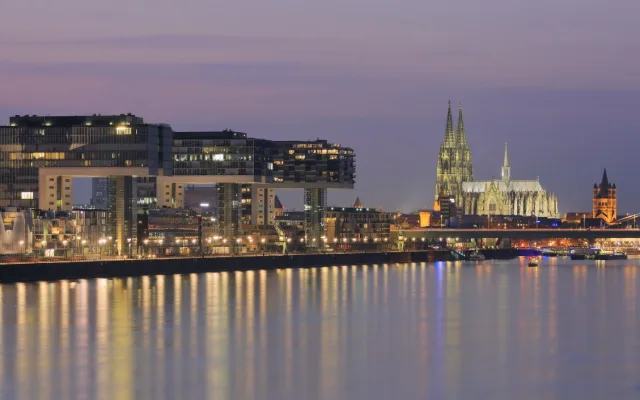
Cologne is a city famous for its Gothic cathedral, its carnival, and for being the birthplace of eau de cologne — all set on the banks of the Rhine.
Wiki
Cologne is a city defined by one enormous cathedral, visible from everywhere and setting the rhythm of the whole trip: step out of the station and it is already towering above you. For the independent traveller it is a practical base: a compact centre, straightforward logistics, cheap connections to half of Germany, and a beer style drunk almost nowhere else on earth.
Why go and how long to stay
Two days is plenty. Cologne is not about a long list of museums — it is about a couple of powerful focal points (the cathedral, the Rhine riverfront, the brewpubs) and the overall feel of the city. A realistic plan: day one — the cathedral, the Old Town, the riverfront, and the Hohenzollern Bridge; day two — museums (Ludwig or the Romano-Germanic), Belgisches Viertel, and a kölsch crawl through the kneipen. If you are coming for carnival, plan separately and book accommodation well in advance.
Getting there and getting around
- The airport (Köln/Bonn, CGN) is connected to the centre by the S-Bahn suburban rail — around 15 minutes to the main station. This is the quickest and cheapest option; taxis are noticeably more expensive.
- Train is one of Cologne's strong suits. The Hauptbahnhof sits right next to the cathedral, with fast ICE services to Düsseldorf, Bonn, and Frankfurt, plus international routes. Many visitors fly into nearby Frankfurt or Düsseldorf and continue by train.
- Within the city the centre is walkable: from the station to the Old Town and riverfront takes just minutes. For outlying areas there is a metro (U-Bahn) and trams. One ticket covers all modes of transport; if you are planning museums and day trips, look at the KölnCard — it includes transport plus discounts.
- Cycling works well along the Rhine: the riverside paths are flat, with cycle lanes and hire stations.
Where to stay
- Altstadt / near the cathedral — maximum convenience for a two-day visit: everything is within walking distance, but it is noisy and pricier, especially around events.
- Belgisches Viertel and Ehrenfeld — neighbourhoods for those who want a local feel, cafés and bars without the tourist premium; a couple of stops from the centre or walkable.
- Deutz (right bank) — across the river from the cathedral, often cheaper, and offering that postcard view of the Dom from the waterfront. The downside is that you will be crossing the bridge frequently.
Budget travellers should look at hostels near the station and in Deutz.
What is genuinely worth seeing
Entry to the cathedral itself is free — go in without fail. The separate paid climb to the tower (533 steps) is worthwhile for the panorama of the city and the Rhine, but it is a narrow spiral staircase with no lift, so it is not for everyone. Inside, look for the Shrine of the Three Kings and the stained glass.
The Museum Ludwig is the strongest stop for lovers of 20th-century art (Picasso, pop art) and stands right beside the cathedral. The Romano-Germanic Museum covers the city's Roman past — mosaics and glassware; check whether it is open in its main building or a temporary location, as it periodically moves out for renovation. The Chocolate Museum on the riverbank is a family option, though queues can be considerable.
Walk across the Hohenzollern Bridge: the love locks on the railings and the best angle of the cathedral from the water. An evening stroll along the Rhine riverfront costs nothing and is arguably the finest thing the city offers.
Food, beer and prices
The essential local ritual is kölsch: a light beer served in narrow 200 ml glasses called Stange. In the brewpubs (Päffgen, Früh, Sünner) the waiter — a köbes — replaces an empty glass with a full one automatically and marks a tally on your beer mat; to stop, simply place the mat on top of your glass. It is not only about the drink but also the cheapest way to eat and spend an evening like a local.
On the food side, do not expect refinement: Halve Hahn is a rye roll with cheese, despite the name having nothing to do with chicken; Himmel un Ääd is mashed potato with black pudding and apple. Lunch at a Brauhaus with a kölsch runs around 14–22 EUR (about $16–25); dinner at a restaurant 30–55 EUR ($34–63). The easiest ways to save are the brewpubs themselves, street food near the station, and the Turkish eateries in Ehrenfeld. Prices are as of 2026.
Practicalities and common mistakes
- Do not treat Cologne as just a stopover. The cathedral is impressive, but the city reveals itself through the kneipen and the riverfront — allow at least an evening.
- Carnival is not a normal visit. On peak days (Rosenmontag) the centre is paralysed, prices and crowds spike, and much is closed. Coming specifically for it — prepare accordingly; coming for other reasons — avoid those dates.
- Do not mix up kölsch and alt — that is the beer of neighbouring Düsseldorf. Locals treat the distinction with humour, but they mean it.
- Sunday — shops are closed; museums, cafés and the station operate normally.
- Safety is typical for a large German city: watch your pockets in crowds near the station and on the riverfront during festivals; otherwise it is relaxed.