Description
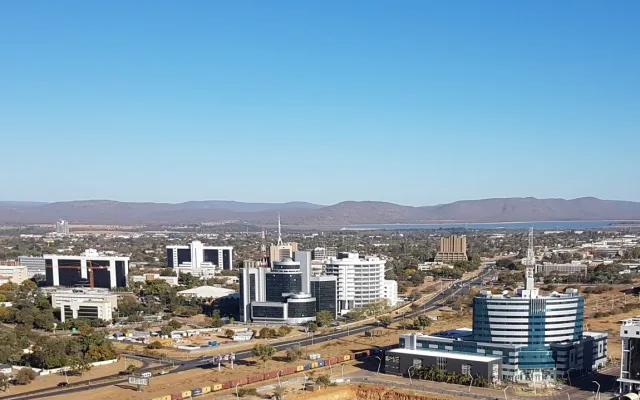
Gaborone is the capital of Botswana, home to the National Museum and the Three Dikgosi Monument. It is also the starting point for journeys to the Okavango Delta.
Wiki
Gaborone is rarely the point of a trip — people fly in to head north afterwards, to the Okavango Delta or to Chobe. But if your flight connects here, if a visa is being processed, or if you simply want a couple of days to acclimatise, the city gives you a calm, safe and straightforward start in Botswana.
Is it worth staying, and for how long
Two days is ample. A realistic plan: one day for the city (museum, monument, reserve) and one for Mokolodi or for shopping and logistics before heading north. If Gaborone is only a connection, half a day will do. Do not arrive expecting a capital with a historic core: the city sprawls low around boulevards and shopping centres, and there is no single heart of walkable streets. Gaborone's value is not itself but its usefulness as a base.
What is actually worth seeing
- The Three Dikgosi Monument — the object that matters most. In 1885 three Tswana chiefs secured a British protectorate and so saved the land from seizure by the Boers and by Cecil Rhodes's Rhodesians. Seeing it takes minutes, but the context matters if you want to understand why Botswana is Botswana.
- The National Museum and Art Gallery — the best way to get to grips with Tswana culture and colonial history in an hour or so. Entry is usually cheap or free.
- Gaborone Game Reserve — a compact reserve almost within the city: zebras, impala, wildebeest, birds. No substitute for a real safari, but a pleasant warm-up if the north is still ahead of you.
- Mokolodi Nature Reserve (about 12 km out) — more interesting: rhinos, cheetahs, and the possibility of night drives and walks with a ranger. A good option for a second day.
- Gaborone Dam — a reservoir for a walk at sunset, with little in the way of facilities.
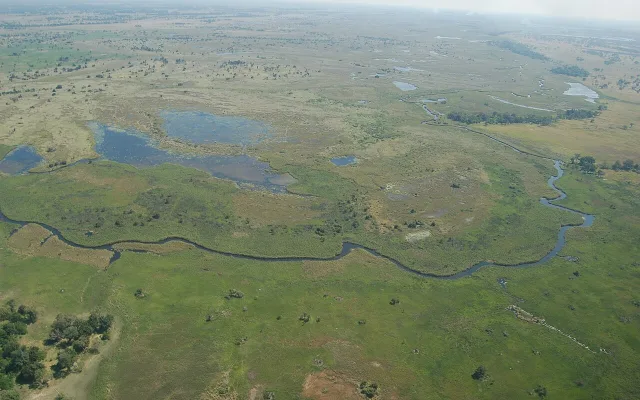
Tsodilo and the delta are not Gaborone. The Tsodilo Hills with their rock paintings, and the Okavango itself, lie in the north, ten to twelve hours away. Planning them as a day trip from the capital makes no sense — you go on a separate route, or fly domestically to Maun.
Getting there and getting around
Sir Seretse Khama Airport (GBE) is 15 km from the centre. International flights are few — Air Botswana, South African, Ethiopian, Kenya Airways — so most people come via Johannesburg, Addis Ababa or Nairobi. There is no express public transport; people take taxis from the airport, and you should agree the fare in advance, as there are no meters.
Getting around without a car is awkward: the distances are long, pavements are patchy and you will not walk far. The options:
- Taxis — book through your hotel or with drivers you know, and agree the price before setting off.
- Combis (minibuses) — cheap, but without knowing the routes and the language it is easy for a visitor to get lost; not the best choice for a first-timer.
- Car hire — the most sensible option, especially if you are driving north yourself. Traffic drives on the left, city roads are decent, but animals on the highway make driving outside town dangerous, so nobody drives at night.
Where to stay
Stay near the CBD and the large malls such as Game City or Riverwalk: the hotels, ATMs, supermarkets and cafés are concentrated there, which is convenient for stocking up before heading north. These are also the safest and most predictable districts. Hostels in the Western sense are few; it is mostly guest houses and chain hotels.
Food and money
The cooking is simple and filling: pap, seswaa (slow-cooked beef), morogo (stewed wild greens), and ostrich turns up as well. For local character, go to ordinary cafés rather than hotel restaurants. On prices: lunch is cheap, dinner in a restaurant noticeably dearer, and the local St. Louis beer inexpensive. The currency is the Botswana pula; cards work in the malls and hotels, but carry cash for the road north. A tip of around 10% is appropriate.
Safety and common mistakes
Botswana is one of the calmest and most stable countries in Africa, and Gaborone feels it: serious street crime is rare. Ordinary urban caution in the evening is enough. What to avoid:
- Underestimating the distance north. The Okavango and Chobe are a separate expedition, not a day trip.
- Counting on walking around the centre — the city is not built for it.
- Driving the highway after dark — animals on the road are a genuine hazard.
- Leaving your shopping until later — outside the capital the choice of goods and the number of ATMs drop sharply, so buy your kit, cash and supplies here.
In short: treat Gaborone as a working base — settle your business, get the country's context in the museum, see your first zebras and set off north prepared.