Ghent
Description
Ghent is a city where you can see medieval landmarks such as Gravensteen and the Van Eyck Ghent Altarpiece, along with canals to stroll along — all without the crushing tourist crowds.
Wiki
Ghent is a rare case in Belgium where the medieval centre has not become a tourist stage set but remains a living city full of students, bars and ordinary life. If Bruges is a postcard, Ghent is the working version of the same Flanders — without the feeling that you have wandered into a theme park.
Why go and how long to allow
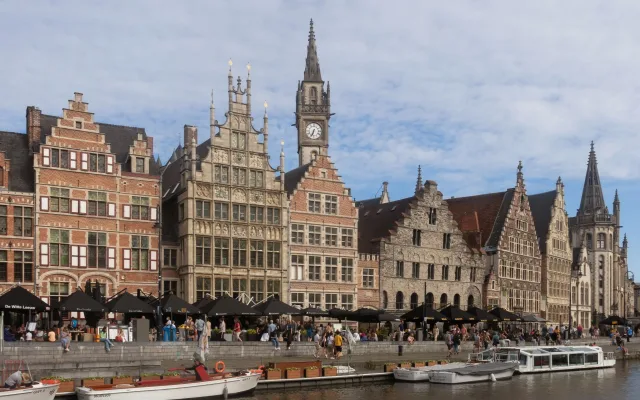
Two days is more than enough. Day one covers the historic centre (castle, cathedral, belfry, waterfront); day two is for museums, street art and simply wandering along the water with no plan. If you are coming from Brussels or Bruges, Ghent can fit into one packed day, but you will only see the surface. Staying overnight changes the city completely: during the day the centre is full of tour groups, but in the evening, once the coaches have left, the Graslei and Korenlei quays fill up with locals drinking beer — and that is the real Ghent.
What is genuinely worth seeing
- The Ghent Altarpiece in St Bavo's Cathedral — the main reason to come. The Van Eyck brothers' polyptych (1432), shown after years of restoration with multimedia support including AR glasses. Buy a ticket — this is not "just another painting in a church" but something on a par with the world's great museums, and the effect in person is nothing like a reproduction.
- Gravensteen — a compact fortress right in the centre, not a castle sprawled across a hill but a dense stone box with towers. Inside there is a collection of weapons and instruments of torture; from the top you get a view over the tiled rooftops. An hour to an hour and a half is plenty.
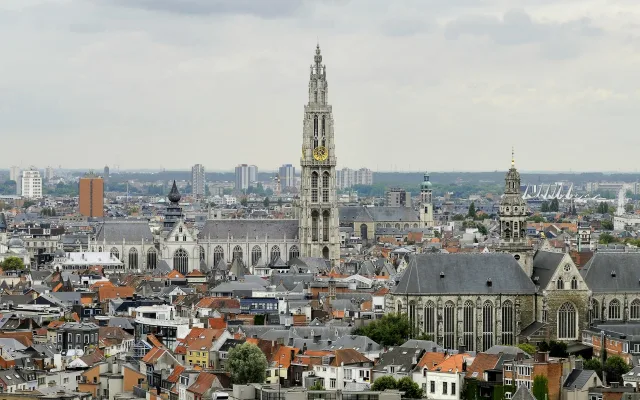
- The Belfry (Belfort) — there is a lift, so the climb is effortless; from the top you get the best view of Ghent's "three towers" lined up in a row (the cathedral, the belfry, and St Nicholas' Church).
- Graslei and Korenlei — best photographed from St Michael's Bridge (Sint-Michielsbrug) and in evening light when the facades are illuminated.
- Werregarenstraat — a legal graffiti alley where the artwork changes constantly; free to enter and conveniently located between the centre and the cathedral.
For museums: STAM if you want to understand how the city grew (very visual, with a huge aerial map on the floor beneath you). SMAK covers contemporary art; MSK next door handles the classics — both are in Citadelpark and easy to combine.
Getting there and getting around
Ghent has no significant airport of its own, so the main gateway is Brussels Airport (BRU): a direct train takes about an hour. Brussels South Charleroi (CRL) is used by low-cost carriers but requires a longer journey with a change.
One important detail: trains arrive at Gent-Sint-Pieters, which is not in the centre but to the south. It is a 25–30 minute walk to the historic core, or you can take a tram (De Lijn) to stops near the centre. It is cheaper to buy your ticket in the app in advance — buying on board costs more.
The centre itself is compact and entirely walkable; much of it is pedestrianised. Renting a bike (Donkey Republic and others) makes sense if you want to reach the more distant museums or parks along the canals, but for seeing the core it is more of a hindrance than a help.
Where to stay
The best base is the historic centre itself — the Patershol district, around the castle and the quays: everything is within walking distance and the evening atmosphere is right outside your door. The downside is price and possible noise from the bars. A budget alternative is the area closer to Sint-Pieters station: cheaper, with the centre a tram ride or a pleasant walk away. Being a university city, Ghent has a decent range of hostels and affordable guesthouses — by Belgian standards it is noticeably cheaper than Bruges or Brussels.
Food, prices and where to save money
The cuisine is hearty and meat-forward: waterzooi (a creamy stew, classically made with chicken), stoverij (beef braised in dark beer) and mussels with fries. Among local sweet souvenirs, look out for cuberdon — the purple cone-shaped sweets sold from carts on the squares; they are an acquired taste, but trying one is worth it.
A rough guide to costs: lunch in a cafe €16-25 (about $18-29), dinner with beer €35-50 ($40-58), a cone of chips from a frituur €4-5 ($5-6), a glass of local beer €4-6 ($5-7). Belgium is not cheap in general. The savings strategy here is:
- eat a proper lunch and limit yourself to a bar in the evening — the lunch menu is noticeably better value than dinner;
- fries from a street frituur in a paper cone are a real meal, not just a snack, and cost very little;
- drink beer in regular bars rather than at tourist spots by the water; the choice of Belgian beer is enormous, and the local Gulden Draak is strong — pace yourself.
Prices are as of 2026.
Practicalities and common mistakes
- Do not treat Ghent as a quick stop between Bruges and Brussels — you lose the city's main appeal, its evening atmosphere.
- Many churches and museums close early, and some are shut at the start of the week — plan the altarpiece and the castle for the first half of the day.
- The best time to visit is late spring and summer, when the quays come alive, though tourist numbers are higher; May and June offer a comfortable balance. Winter is beautiful and quiet, but daylight hours are short.
- Safety is standard for a western European city: calm overall, with the usual sensible awareness of pickpockets in crowds around the station and on the main squares.
Updated