Description
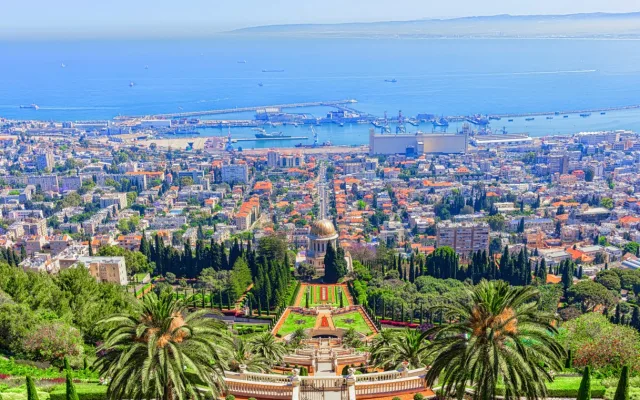
Haifa is a port city on the slopes of Mount Carmel: the UNESCO-listed Bahai Gardens, the German Colony, the underground Carmelit funicular and a mixed Arab-Jewish daily life.
Wiki
Haifa is Israel's third-largest city and its main seaport: some 290,000 people live on the slopes of Mount Carmel as they drop towards Haifa Bay. The city is built in tiers — from the port districts at the water, through the middle level of Hadar, up to well-heeled Carmel at the top — and the change in altitude is felt at every turn. It is the most mixed of the country's large cities: Jews, Muslim Arabs, Christian Arabs, Druze and Bahais all live side by side.
Background and history
A settlement at the foot of Carmel has been known since antiquity, but modern Haifa grew out of a small fishing town refounded in 1761 by Daher el-Omar, the ruler of Galilee. Real growth began in the nineteenth century: in 1868 German Templers arrived — a Protestant movement from Württemberg, unconnected with the medieval Knights Templar — and built a tidy colony by the sea with a straight street running towards the mountain. In 1905 a branch of the Hejaz Railway reached the city, and under the British Mandate a deep-water port was built that turned Haifa into an industrial and transport hub. Today it is home to the Technion and the University of Haifa, an oil refinery complex and a good share of the country's heavy industry.
Security conditions in the region can change, so it is worth checking them before travelling.
The Bahai Gardens
Haifa's defining sight is the Bahai Gardens, inscribed on the UNESCO World Heritage list together with the Bahai holy places in Acre. Nineteen terraces run almost a kilometre up the slope of Carmel, and halfway along that staircase stands the gold-domed Shrine of the Báb, the tomb of the herald of the Bahai faith. Haifa serves as the spiritual and administrative world centre of a religion with roughly eight million followers, generally reckoned the second most geographically widespread on earth, with communities in more than two hundred countries and territories. Entry is free, but opening hours are limited and change from season to season, and the walk down the terraces themselves is only possible on a guided tour — check the schedule in advance. The upper viewpoint on Yefe Nof Street looks out over the gardens, the port and the bay as far as Acre.
What to see in the city
- The German Colony — the restored Templer settlement of 1868: single-storey stone houses with inscriptions carved above the lintels, now the city's main pedestrian and restaurant street, aligned exactly on the axis of the Bahai Gardens.
- Wadi Nisnas — a lively Arab quarter with a market, bakeries and the outdoor artworks of the Museum Without Walls project.
- Wadi Salib — the old Ottoman quarters near the port, partly derelict, partly under restoration.
- Stella Maris Monastery — a Carmelite house on the headland; the Carmelite order itself began on Mount Carmel in the twelfth century. Beside it is the Cave of Elijah, revered by Jews, Christians and Muslims alike.
- The Bat Galim cable car — spherical cabins linking the seafront with the terrace by Stella Maris, and the most spectacular way up the mountain.
- The Carmelit — an underground funicular running since 1959 that serves Haifa as a metro: six stations and six minutes from the lower town to the top of Carmel.
- The Tikotin Museum of Japanese Art — the only collection of its kind in the Middle East.
- The Mane-Katz Museum — the house museum of the École de Paris painter, up on Carmel.
- The Haifa City Museum in the German Colony, and MadaTech, the national museum of science and technology, in the historic Technion building.
- The beaches — Bat Galim, HaShaket, Dado and Carmel form a long sandy strip south of the port.
Day trips
- Acre (about 25 km) — a UNESCO site: the underground Crusader city of the twelfth and thirteenth centuries, Ottoman walls, caravanserais and a market.
- Caesarea (about 45 km) — Herod the Great's seaside city, with a Roman theatre, a hippodrome and an aqueduct along the beach.
- Nazareth (about 35 km) — the country's principal Christian pilgrimage centre, with the Basilica of the Annunciation.
- The Druze villages of Daliyat al-Karmel and Isfiya (about 20 km) — a market, home cooking and views along the Carmel ridge.
- The Nahal Me'arot caves (about 20 km) — another UNESCO site, with prehistoric human occupation layers in rock shelters.
Food and prices
Haifa's cooking is Israeli and Levantine at once: hummus (the local hummus houses open early and close when the pot runs out), shawarma, falafel, labneh, sabich, tabbouleh and knafeh for dessert. The choice is widest in the Arab quarters and the German Colony, while the fish restaurants cluster in Bat Galim.
Lunch in a café runs to about 50–75 shekels ($16–25), dinner in a restaurant 105–195 shekels ($35–65). A bottle of Israeli beer is 12–18 shekels ($4–6), a ride across town on a Rav-Kav travel card about 6 shekels ($2), and a taxi within the city 25–75 shekels ($8–25). A litre of petrol costs around 7 shekels (about $2). Prices are as of 2026.
Getting there and when to go
The main airport is Ben Gurion, roughly 110 km away; the train from there takes about an hour and a half (around 30 shekels, $10). Haifa's own airport handles only a few short-haul routes. Trains to Tel Aviv run along the sea in about an hour and call at three stops in the city; locally there are buses, the Metronit bus rapid transit on its own lane, and the Carmelit.
The best months are March to May and September to November, when temperatures hold at 18–28°C. Summer is hot and humid (28–32°C), winter mild (10–15°C) and rainy. Two events stand out: the Holiday of Holidays in December, when Hanukkah, Christmas and Ramadan are marked together in one neighbourhood, and the Haifa International Film Festival in September and October.