Description
A mountain spa town within reach of Tokyo, with views of Fuji, hot springs and traditional ryokan inns.
Wiki
Hakone is the place near Tokyo people come to for three things at once: a view of Fuji, an onsen, and a night in a real ryokan. Two days is genuinely enough, and two days is what you should allow: in one you will either exhaust yourself running between ropeways and ferries, or miss the whole point — a slow evening in a hot bath.
What is actually worth seeing
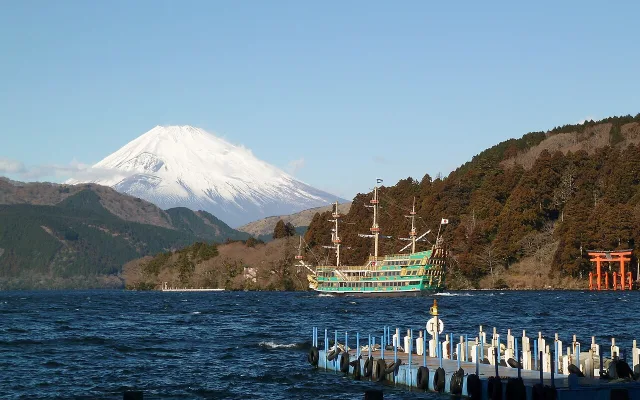
- Lake Ashi — the postcard view of Fuji from the water. Honestly, though: the mountain is often hidden, more often than not in cloud. Your best chance is early morning in the cold season. The cruise on the mock pirate ship is included in the Hakone Free Pass, so there is nothing extra to pay.
- The ropeway and Owakudani — the most spectacular part of the route. The cabin runs over a volcanic valley, sulphurous steam pours out of the ground and it smells of rotten eggs (that is normal). At the top they boil the famous black eggs in the hot spring water — the shells darken from the sulphur. The legend about "seven extra years of life" is marketing, but the egg is worth eating just to say you did.
- The Open-Air Museum — sculpture among the mountains, Picasso, Rodin, and works children can climb on. Even if you are indifferent to art, the place works as a pleasant walk. Bonus: a free foot onsen on the grounds.
- Hakone Shrine — red torii standing right in the lake water. That photograph. Come in the morning, before the crowds: the queue for the shot can be long.
Onsen: how it works
Hakone is the ideal place for a first Japanese onsen. The basic rules, so you do not embarrass yourself:
- You wash before the bath, sitting on a stool in the shower area. You enter the shared water already clean.
- You bathe naked; swimwear is not allowed. The small towel is for covering yourself on the way — it does not go into the water.
- Tattoos are banned in many public baths. If you have them, look for a ryokan with a private bath (kashikiri) or places marked "tattoo friendly".
Options by budget: public sento are cheap and good for an hour or so. A ryokan with a private bath is expensive, but that is the central Hakone experience.
The ryokan — what you came for
A night in a traditional inn: a futon on tatami, a yukata instead of pyjamas, a kaiseki dinner of a dozen small dishes served in your room or in the dining hall. It is expensive and it is worth it — count it not as "a hotel" but as an experience. Points to note:
- Book well ahead, one or two months, especially for weekends and the maple season.
- Check whether dinner and breakfast are included — usually they are, and they are part of the price.
- Many ryokan run a free shuttle from the nearest station; ask when you book.
Getting there and getting around
From Tokyo it is about an hour and a half. Two ways: the shinkansen to Odawara (fast, and this is where a JR Pass earns its keep), or the direct Romancecar from Shinjuku to Hakone-Yumoto (comfortable, no changes, good views).
The Hakone Free Pass — buy it without thinking. It is a two-day ticket for all local transport: the mountain railway, the funicular, the ropeway, the boat across the lake and the buses. It pays for itself almost immediately and removes all the ticket headaches.
The classic "loop" route is designed around the pass: the switchback mountain train → funicular → ropeway over Owakudani → ferry across Lake Ashi → bus back. Do it in one direction rather than retracing your steps.
Money, food, seasons
- Prices. Hakone is more expensive than the Japanese average — it is a resort. The two-day Hakone Free Pass costs about 6,100 yen (around $39) from Shinjuku and 5,000 yen ($32) from Odawara. A night in a ryokan with dinner and breakfast runs 20,000-45,000 yen ($125-285) per person, entry to a public bath 1,000-2,000 yen ($6-13), and a bowl of noodles by the station 800-1,200 yen ($5-8). Prices are as of 2026. You save on accommodation (a business hotel, or a sento visit instead of a ryokan) and on food: an ordinary noodle bar by the station costs a pittance against the hotel restaurant.
- Food. Besides the black eggs, there are local noodles, tofu and river fish. By Hakone-Yumoto station there are rows of street food and sweets, handy between transfers.
- When to go. Autumn (the maples) and winter give the best views of Fuji thanks to the clear air, though autumn also brings the biggest crowds. Summer is humid and often overcast — you may not see the mountain at all.
Common mistakes
- Coming "as a day trip from Tokyo" — you will manage the journey and half the route, and without an onsen in the evening the point is lost.
- Assuming Fuji is guaranteed to be visible. It is not; treat it as a bonus.
- Failing to book a ryokan in advance and ending up in an ordinary hotel that was not worth the trip.
- Dragging a suitcase onto mountain trains and ropeways. Leave the big luggage in Tokyo and bring a small bag for two nights.