Description
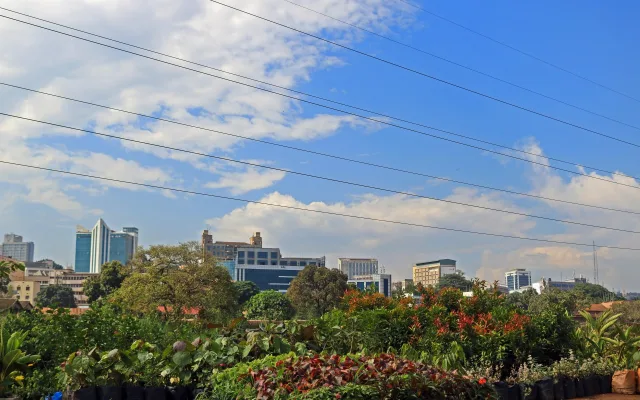
Uganda's capital on seven hills — the UNESCO-listed Kasubi Tombs, the national mosque and a base for gorilla trekking.
Wiki
Kampala greets you with chaos and friendliness at once: traffic, red dust, the roar of boda-bodas and markets spilling across seven hills. For most travellers it is not the destination but a staging post before the gorillas of Bwindi or a safari in the north — but a couple of days is enough to catch the rhythm of the Ugandan capital and stock up for the road.
How long to allow
Two days is enough. The first for the hills and their landmarks (the national mosque, Kasubi, the cathedrals), the second for the markets, the museum and preparing for a trek or safari. If Kampala is only a logistics point before the national parks, one full day will do — and transit is easier straight from Entebbe, without going into the city at all.
Getting there and getting around
Entebbe airport (EBB) is 40 km away, and that comes with an important caveat: traffic easily turns the drive into an hour and a half or two, not the "40 minutes" the map suggests. Allow a buffer, especially for the flight home. From the airport, take a pre-booked taxi or an Uber or Bolt; haggling with drivers at the exit gains little, and the app is more predictable.
Within the city:
- Boda-bodas — fastest through the traffic, but dangerous. Use SafeBoda (the app): fixed price, a helmet and trained riders. Flagging a boda in the street at night without a helmet is the classic beginner's mistake.
- Uber and Bolt — they work, and they are cheap (a couple of dollars across the centre); the best option in heat and rain.
- Matatus (minibuses) — pennies, but without experience and the language it is easy to get lost; the Old and New Taxi Parks are attractions in themselves, thousands of minibuses packed together.
- On foot the centre is walkable, but hilly and dusty; between hills it is better to ride.
What is actually worth seeing
- The Uganda National Mosque on Old Kampala — the city's great viewpoint. People come for the climb up the minaret and the full circle of all seven hills. Women are given a headscarf and skirt at the entrance; admission is paid and includes a guide.
- The Kasubi Tombs — a UNESCO site and the spiritual centre of the Buganda kingdom. Bear in mind that the main building was badly damaged by fire in 2010 and has been under restoration for years — much of what you see is reconstruction rather than the original. Go for the context and the guide's account of the Buganda monarchy rather than for architectural spectacle.
- The Uganda Museum — compact, but the best in the country for ethnography and musical instruments; useful as an introduction before travelling the regions.
- Rubaga (Catholic) and Namirembe (Anglican) cathedrals stand on neighbouring hills — the classic shot of two faiths facing each other.
- The Baháʼí House of Worship on Kikaaya Hill — a quiet garden on the edge of town, a contrast to the city noise.
- Namugongo is of interest mainly on 3 June, Martyrs' Day, when hundreds of thousands of pilgrims converge here.
The markets are an experience of their own: Owino (St Balikuddembe) for clothes and everything else, and the craft markets on Buganda Road and at Exposure Africa for souvenirs before your flight.
Where to stay
- Kololo and Nakasero — quiet green hills with embassies and cafés, safe; more expensive, but convenient.
- Bugolobi — a calm residential district with restaurants, popular with expatriates.
- The backpacker area around Lungujja and the hostels west of the centre — budget, with a garden and other travellers to compare routes with, handy for linking up trips to the parks.
- Staying in the commercial chaos of downtown is not advisable — noisy, and to no purpose.
Food and money
Try the local dishes: the rolex (an omelette in chapati), the great street snack for pennies; matoke; posho. Lunch at a local "hotel", as the eating houses are called here, is $2-5, a full dinner in a restaurant $15-30, and local Nile Special beer around $2. Prices are as of 2026.
On money in practice:
- The currency is the Ugandan shilling; cash is king, and cards are taken only at hotels and larger establishments.
- Mobile Money (MTN, Airtel) is how locals pay for everything; worth setting up for a longer trip.
- Withdraw cash at Stanbic or Absa ATMs inside shopping centres, not in dark corners.
- Get a SIM with data straight away — without it SafeBoda, Bolt and the maps will not work.
Safety and common mistakes
Kampala is relatively calm for East Africa, but the basic rules apply: pickpockets in the markets and taxi parks, so do not flash a phone or a bag, and in the evening travel by taxi or Bolt. The real risk is on the road: a boda without a helmet. Change money only at banks and licensed bureaux, never in the street.
A frequent mistake is underestimating the traffic and missing a connection to the parks: the reserves are far away (Bwindi is eight to nine hours' drive), and it is best to set off early in the morning. Travel in the rainy seasons (March to May, October to November) is possible, but the dirt roads to the gorillas turn to mud — for trekking, the dry months of June to September and December to February are more comfortable.