Description
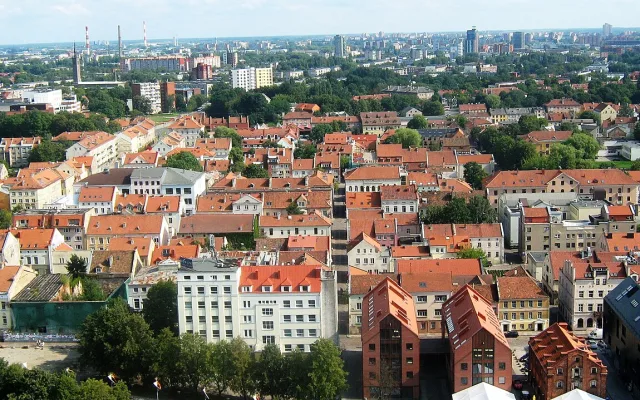
Lithuania's main Baltic Sea port and gateway to the Curonian Spit.
Wiki
Klaipėda is Lithuania's third-largest city and its only seaport, situated on the Baltic coast at the mouth of the Danė River, beside the strait that separates the mainland from the Curonian Spit. This maritime hub blends the German heritage of the former Memel with a working port character and serves as the departure point for trips to the celebrated sandy spit.
History
The city grew up around a castle founded in 1252 by knights of the Livonian Order, and for many centuries was known by its German name, Memel. It long formed part of the Teutonic Order state, then of Prussia and the German Empire, remaining the northernmost city of the German lands. After the First World War the territory passed to Allied administration, and in 1923 it was incorporated into Lithuania. In 1939 the region was returned to Germany, and it finally became part of Lithuania again after the Second World War. This chequered past is written into the city's fabric: half-timbered houses, a German street plan and Baltic culture sit closely side by side.
What to See
The historic core is concentrated in the Old Town on the southern bank of the Danė, where a medieval street grid of modest half-timbered buildings survives.
- Theatre Square — the Old Town's main square, in front of the drama theatre. It features a fountain with a sculpture of Ännchen von Tharau, dedicated to the poet Simon Dach.
- Sculpture Park — an unusual open-air collection laid out on the site of a former city cemetery.
- Castle Museum — an exhibition on the history of Memel Castle, whose bastions have been partially uncovered by archaeologists.
- Sea Museum and Dolphinarium — housed in a former fort on the Curonian Spit; visitors can see Baltic marine life, seals, and dolphin shows.
- Clock Museum — a collection tracing the history of timekeeping.
- The banks of the Danė, with moored sailing vessels and bascule bridges, give the city a distinctive port atmosphere.
Small bronze "ghost" sculptures and genre figures are scattered through the streets of the Old Town, making an entertaining trail to follow on foot.
The Curonian Spit
The standout natural attraction in the area is the Curonian Spit, a narrow sand strip roughly 98 kilometres long that separates the Curonian Lagoon from the open sea. Its Lithuanian portion is a UNESCO World Heritage Site. Ferries run there directly from the centre of Klaipėda. On the spit lies the resort village of Nida, with its fishermen's cottages, museums and sweeping dune panoramas. Vast shifting sands, pine forests, quiet fishing villages and bird colonies make this one of Europe's most distinctive landscapes. The symbol of the spit is the painted wooden weathervane, once used to identify individual fishing boats.
Food and Drink
The city's gastronomy draws on the Baltic catch and the traditions of Lithuanian and Baltic-German cooking. Worth trying are smoked and dried fish — especially Baltic herring and eel from the Curonian Lagoon. Widely available Lithuanian staples include cepelinai (potato dumplings stuffed with meat), šaltibarščiai (cold beetroot soup), kibinai, and rye bread. The port setting and proximity to the sea mean an abundance of fish restaurants and cosy cafés along the waterfront.
Practical Information
Klaipėda lies in western Lithuania, roughly 300 kilometres from Vilnius and about 215 kilometres from Kaunas, linked to both by bus and rail. The popular coastal resorts of Palanga and Šventoji are nearby; the closest airport is at Palanga. The seaport handles cargo ships, ferries to Germany and Sweden, and cruise liners.
The compact centre is easy to explore on foot, and regular ferries connect the city to the Curonian Spit. Two days are enough to take in the Old Town at a relaxed pace and devote a full day to a trip to the spit with a walk among the Nida dunes. The best time to visit is from late spring to early autumn, when resort facilities are open and ferry services run at full schedule. Highlights of the summer calendar include a jazz festival and a sea festival that draws thousands of visitors to the waterfront each year.