Description
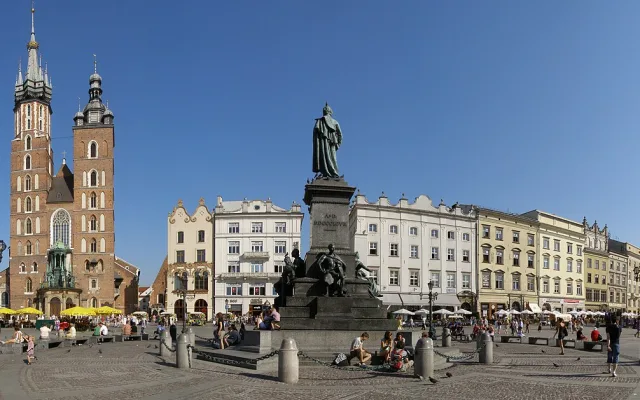
The historic capital — Wawel, the Main Market Square, Kazimierz and Auschwitz nearby.
Wiki
Krakow is the second-largest city in Poland and its former royal capital, spread along the banks of the Vistula in the south of the country, in the historic region of Lesser Poland. It is one of the few large European cities whose medieval fabric survived the fires of the Second World War, and so the Old Town here is genuinely authentic rather than rebuilt from rubble.
History and general character
From the 11th century until the end of the 16th, Krakow was the capital of the Kingdom of Poland and the place where monarchs were crowned and buried. In 1596 the royal court moved to Warsaw, but Krakow kept its status as the spiritual and cultural core of the country. In 1978 the historic centre was among the first sites inscribed on the UNESCO World Heritage list. The city is also known for the Jagiellonian University, one of the oldest in Europe (founded in 1364), whose graduates include Nicolaus Copernicus. The layout of the Old Town goes back to the medieval charter of 1257: a regular grid of streets surrounds an enormous square, and the green Planty boulevard rings the centre where the demolished city walls once stood. Of those old fortifications, the Florian Gate and the round Barbican survive.
Main sights
- Wawel Castle and cathedral — the complex on the limestone hill above the Vistula, combining the functions of royal residence and the country's chief shrine. Polish kings were married and buried in the cathedral, and national heroes and poets lie here too. The interior displays — the royal apartments, the treasury and the armoury — are covered by separate tickets.
- The Main Market Square (Rynek Główny) — one of the largest medieval squares in Europe. At its centre stands the Cloth Hall (Sukiennice), a long Renaissance trading building where souvenirs and amber are still sold today. Beside it rises the Gothic St Mary's Basilica with its wooden altarpiece by Veit Stoss; every hour a trumpeter plays the hejnal from its tower, the melody breaking off mid-note.
- Kazimierz — a formerly independent town that became the historic Jewish quarter. Several synagogues, the old cemetery and Plac Nowy with its round market hall survive here. Today the district has turned into a bohemian centre with galleries, cafes and street art; nearby, in Podgórze, a museum operates on the site of Oskar Schindler's former factory.
- The Wieliczka Salt Mine — a UNESCO-listed underground labyrinth 14 km south-east of the city, where chapels, sculptures and underground lakes have been carved out of rock salt more than a hundred metres down.
- The Wawel Dragon — a bronze figure at the foot of the castle rock, referring to the city legend of the monster; the statue periodically "breathes" fire.
Auschwitz nearby
About 70 km west of Krakow lies the Auschwitz-Birkenau memorial, the former Nazi concentration camp that became a symbol of the Holocaust. Today it is a state museum and a place of remembrance. Visits are possible independently or with a guide; in high season entry is organised in timed slots, which are worth booking in advance. The journey from Krakow takes about an hour and a half by bus or train.
Food
Krakow counts as one of the gastronomic capitals of Poland. The calling card of the local kitchen is pierogi with the widest range of fillings, from potato and curd cheese to meat and wild mushrooms. It is worth trying żurek, the sour rye soup, bigos made of stewed cabbage, and the obwarzanek, a ring-shaped bread sold from street stalls all over the centre. Kazimierz has developed a particularly rich restaurant and bar scene, and Polish craft beer and infused spirits round out the local table.
Practicalities
Three days are enough to see the Old Town and Wawel, walk through Kazimierz and set aside a day each for Auschwitz and Wieliczka. The historic centre is compact and good for walking. Trams and buses serve the city on a single ticket system; passes are conveniently bought from machines at the stops and on board. Balice International Airport is 12 km west of the centre and is connected to the city by suburban train. The best time to visit is late spring and early autumn, when there is no summer crush of visitors and the weather stays comfortable for long walks.
Photos