Description
The capital of the Maldives — a transit point and the gateway to the bungalows over the lagoon.
Wiki
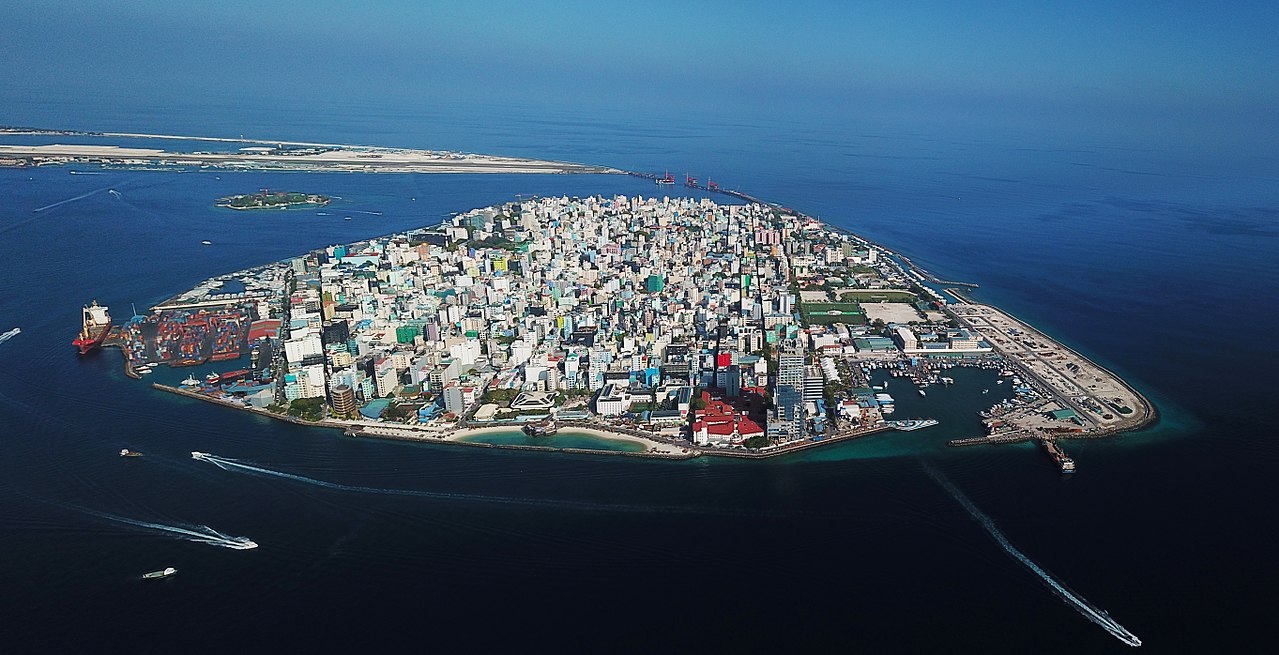
Male is one of the smallest capitals in the world by area and at the same time the main air gateway to the Maldivian archipelago. From here travellers transfer to seaplanes and speedboats to reach the resort islands with their villas over a turquoise lagoon, so the city itself is usually treated as a transit hub, although it deserves a couple of days of attention.
Geography and layout of the city
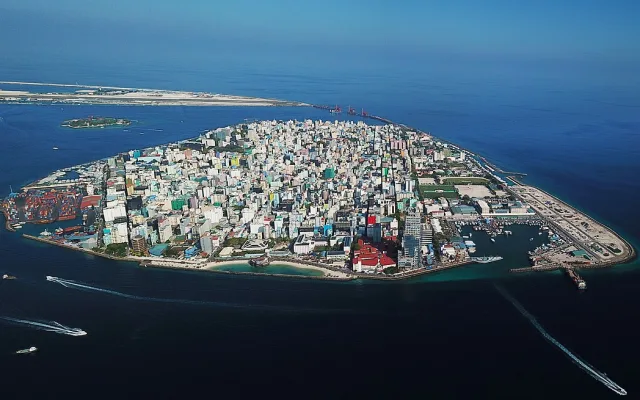
The capital occupies a tiny island of the same name in the south-eastern part of Kaafu (North Male) Atoll. The island itself covers less than two square kilometres and holds some 130,000 people; together with the annexed islands of Hulhule and Hulhumale the city extends to about 8.3 km², and with its suburbs it accounts for almost a third of the country's entire population. The density of building is among the highest on the planet: the streets are narrow, the houses pressed tightly together, and there is practically no free land left. That is why the authorities reclaimed the artificial island of Hulhumale alongside — a kind of "second storey" for the capital, with broad avenues, new residential quarters and room to grow. The Sinamale Bridge, the first structure of its kind in the country, links it with the main island and the airport (on the island of Hulhule).
What to see
Despite its compactness, the historic core of the city is full of sights that can easily be walked in a few hours.
- The Old Friday Mosque (Male Hukuru Miskiy) — built in 1658 from dressed coral blocks and decorated with carving and lacquer painting. One of the oldest and most valuable monuments of Islamic architecture in the archipelago.
- The Islamic Centre and the Grand Friday Mosque — the largest place of worship in the country, with a golden dome, holding thousands of worshippers; its silhouette is visible from almost anywhere on the waterfront.
- The Muliaage presidential palace and the government buildings near it set the unhurried colonial-tropical tone of the centre.
- The National Museum in Sultan Park holds thrones, weapons, everyday objects of the sultanate era and artefacts of the pre-Islamic past.
- The market and the waterfront — the heart of daily life. The fish market is at its most colourful early in the morning, when the fishermen unload fresh tuna; alongside it, coconuts, bananas, spices and dried seafood are traded.
The islands and the real point of the trip
The main reason to fly to the Maldives is not the capital but the resort and inhabited islands scattered across 26 natural atolls.
- Resort islands are given over to a single hotel each: privacy, villas on stilts over the water, house reefs for snorkelling. Among the premium names are Velaa, Gili Lankanfushi and Soneva Fushi.
- Local (inhabited) islands — Maafushi, Guraidhoo and others — are the affordable format, with guest houses. Muslim rules apply here: swimming in a bikini and drinking alcohol are possible only on designated "tourist beaches".
- Diving and snorkelling are among the best in the world. In the clear water you meet reef sharks, manta rays, sea turtles, barracuda and moray eels. PADI certification costs on average $350–500.
Food
Maldivian cooking is built on tuna, coconut and rice. The classic dishes are garudhiya (a rich fish broth), mas huni (shredded tuna with grated coconut and onion, the traditional breakfast served with roshi flatbread) and riha (a spiced fish curry). The small snacks known as "hedhikaa" are popular too: fried pastries with a fish filling. On the inhabited islands and in the cafes of the capital you can eat cheaply — a simple lunch costs from about $10, whereas dinner at a resort restaurant often runs to $100–300 a head. Tourist prices in the Maldives are quoted in US dollars, and are as of 2026.
Practicalities
- Transport. From Velana International Airport, travellers reach the resorts by seaplane (short, scenic flights), by speedboat, or, for the distant atolls, by domestic flight followed by a boat transfer. Within the island itself distances are short and everything is within walking reach.
- Money. The national currency is the rufiyaa, but US dollars are accepted everywhere, especially at the resorts.
- Rules and climate. The capital and the inhabited islands live by Islamic norms: covering clothing is appropriate in the streets. The weather is hot and humid all year; the drier season with less rainfall runs roughly from December to April.
- Planning a week. Seven days are enough to combine a day or two in Male and Hulhumale, seeing the mosques, the museum and the market, with the rest of the time on a resort or local island for the beach and diving.
Male is rarely a destination in itself, but it is through it that the road to the great landscapes of the Maldives opens — and a short stop in this densely populated tropical city helps you feel the real life of the country beyond the glossy lagoons.
Photos