New Orleans
United StatesDescription
America's jazz capital: the French Quarter, jambalaya and gumbo, Mardi Gras, and live music on Frenchmen Street until dawn.
Wiki
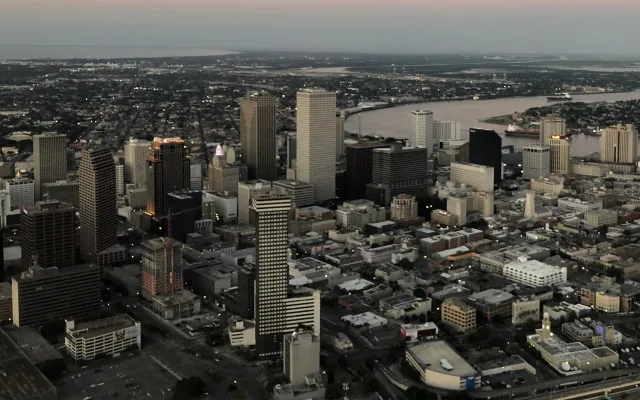
New Orleans is the largest city in Louisiana and one of the most distinctive places in the United States, where French, Spanish, African, and Caribbean heritage have fused into a singular Creole culture. Situated in a bend of the Mississippi River near the Gulf of Mexico, it goes by the nickname "the Big Easy" — for its unhurried pace of life, abundance of music, and the near-permanent street party that fills its neighbourhoods.
History and Character
The city was founded by the French in 1718 and named after Philippe II, Duke of Orléans, then regent of France. From 1763 it spent nearly four decades under Spanish rule before being purchased by the United States along with the rest of Louisiana in 1803. It was the Spanish who, after devastating fires at the end of the 18th century, rebuilt the French Quarter in the form that survives today — hence the characteristic interior patios and wrought-iron galleries more readily associated with Spain than with France.
Much of New Orleans lies below sea level and is protected by a levee system. That vulnerability was tragically exposed in 2005, when Hurricane Katrina and the failure of the flood defences inundated most of the city. Recovery took years, but the historic centre and tourist districts came back to life, and resilience has become part of the local identity.
Neighbourhoods and Architecture
- French Quarter (Vieux Carré) — the heart of the city: a compact street grid of two- and three-storey buildings from the 18th and 19th centuries, decorated with lacy ironwork balconies and shaded courtyards.
- Bourbon Street — the Quarter's loud, lively evening artery, lined with bars, restaurants, and live music and drawing large tourist crowds.
- Frenchmen Street — the strip in the Marigny neighbourhood where locals go for real jazz and blues; clubs including The Spotted Cat, d.b.a., and Three Muses are open nearly every evening.
- Garden District — a neighbourhood of grand Greek Revival and Victorian mansions set amid lush greenery, where the writer Anne Rice once lived. The historic St. Charles streetcar line is the most pleasant way to get there.
- Tremé — one of the oldest African-American neighbourhoods in the country and the cradle of brass-band and second-line traditions.
Sights
- Jackson Square — the Quarter's main plaza, centred on an equestrian statue of Andrew Jackson, with St. Louis Cathedral behind it — the oldest continuously operating Catholic cathedral in the United States.
- St. Louis Cemetery No. 1 — a necropolis dating to 1789, with above-ground brick tombs; among the most visited is the reputed tomb of Marie Laveau, the "Voodoo Queen."
- The National WWII Museum — one of the largest and most highly regarded museums in the country, with extensive exhibits and dedicated cinema theatres.
- Audubon Park and Audubon Zoo — a park shaded by century-old live oaks draped in Spanish moss, with a well-regarded zoo on the edge of the university district.
- Swamp Tours — boat and airboat excursions into the bayous outside the city, where alligators, herons, and turtles can be spotted at close range.
- Mississippi Riverfront — the waterfront promenade, served by sternwheel steamboats in 19th-century style.
Food
Gastronomy is a reason to visit in its own right. Local cooking divides into Creole (urban, with a French polish) and Cajun (rural, boldly spiced). Dishes not to miss:
- Gumbo — a thick stew built on a dark roux, with seafood or chicken and andouille sausage.
- Jambalaya — rice cooked with meat, shrimp, and spices; a distant cousin of paella.
- Étouffée — crawfish or shrimp braised in a butter sauce and served over rice.
- Po-boy — a sandwich on crisp French bread, filled with fried seafood or roast beef.
- Beignets — square, hole-free doughnuts buried under powdered sugar, the classic accompaniment to a morning cup of chicory coffee.
Festivals and Music
New Orleans is considered the birthplace of jazz: Louis Armstrong grew up here. Music is everywhere — from street brass bands to late-night clubs. The city's biggest annual event is Mardi Gras, the carnival before Lent, with parades, costumes, and the ritual throwing of beads. In spring, the New Orleans Jazz & Heritage Festival (Jazz Fest) draws musicians from across the country.
Planning Your Visit
Four days is enough to explore the French Quarter and Garden District, catch music on Frenchmen Street, spend a day at the National WWII Museum, and get out on a swamp tour. The compact centre is easily covered on foot; streetcars and the riverfront line help with outlying neighbourhoods. The best time to visit is October through May, when the punishing summer heat and humidity have eased. The climate is subtropical, and hurricane season runs from late summer into autumn.