Description
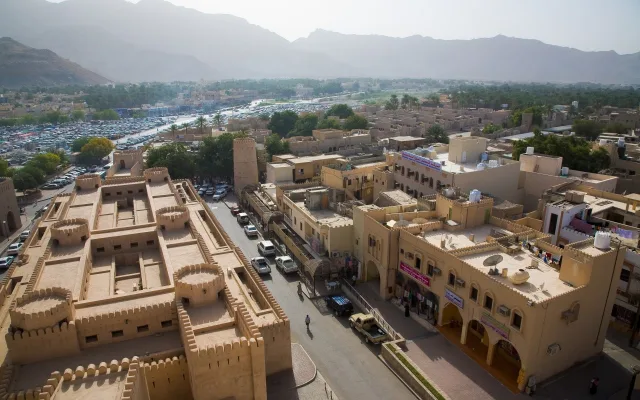
The historic capital of Oman's interior — the round tower of Nizwa Fort and the Friday livestock market.
Wiki
Oman without the gloss starts here. Nizwa is not the polished waterfront of Muscat but old Arabia, where goats change hands at dawn on Fridays and a round fortress tower rises over an oasis of date palms. It makes an ideal base for trips into the Hajar mountains and around the forts of central Oman.
Why come, and how long for
Two days is enough if you plan properly. The key detail: the main event, the Friday livestock market, happens on Friday only and early in the morning. The itinerary is built around that day.
A sensible plan:
- Day 1 — the fort, the souq, the silver shops, an evening in the old town.
- Day 2, ideally a Friday — dawn at the livestock market, then a day trip into the surroundings (Jabreen, Bahla or Misfat).
If your dates do not include a Friday it is no disaster: the ordinary souq and the fort are still worth the visit, just without the main show.
Getting there and around
Nizwa is around 165 km from Muscat, an hour and a half to two hours on good road. There is next to no convenient public transport for independent trips into the mountains, so the honest answer is this:
- A rental car is all but essential. Everything of interest — Jebel Shams, Misfat, the wadis, the forts — is scattered across the region, and without a car you are stuck in town. An ordinary saloon handles most destinations, but the climb to Jebel Shams and the mountain tracks need a 4×4.
- Intercity buses and shared minibuses run between Muscat and Nizwa, but on arrival you still face the question of local logistics.
- The centre of Nizwa itself is compact: fort, souq and mosque form a single walkable cluster, so you park once and go on foot.
What is actually worth seeing
Nizwa Fort (1668). Not just old walls: the point is the massive round tower, about 30 m high, which you climb by internal stairways. The top platform gives the best view in town, over the palm oasis and the mountains. Inside are museum rooms on daily life and defence. Allow an hour to an hour and a half.
Nizwa Souq. Restored but alive, right beside the fort: sections for dates — taste them, and haggle — as well as halwa, spices, pottery and, separately, silver.
Silver and the khanjar. Nizwa is the historic centre of the craft. The khanjar, the curved dagger, is Oman's national symbol. Genuine handwork is expensive and the souvenir versions are cheap; the difference shows in the chasing. Even if you are not buying, go and watch the smiths at work.
The Friday livestock market. The main thing. Early in the morning, roughly six to nine, Bedouin bring out goats, sheep and camels, walk the animals in a circle in front of the buyers and haggle in the old manner. This is not staged for tourists but a working market — keep to the edge of the circle, do not get in the way, and photograph respectfully. Arrive before light: by eight the best of it is winding down.
Day trips from Nizwa
These are the reason to keep the town as a base:
- Bahla (about 40 km) — a UNESCO-protected fort, one of the oldest in the country, with an imposing mudbrick wall around the oasis.
- Jabreen (about 50 km) — not a fortress so much as a palace of 1670, worth it for the painted wooden ceilings and well-preserved interiors.
- Misfat Al Abriyeen — a stone mountain village with a working falaj irrigation system running through palm terraces; the best slow walk in the area.
- Jebel Shams (3,028 m) — the highest point in Oman, the "Grand Canyon of Arabia", with a balcony path along the cliff edge. Needs a 4×4 and most of a day.
- Wadi Bani Khalid — a canyon with turquoise natural pools, but it lies well to the east; realistically a separate trip rather than an add-on to Nizwa.
Practicalities: rooms, money, season
Where to stay. Base yourself near the centre and the fort so that you can walk to the market at dawn without depending on a car. The choice is thinner than in Muscat, so book ahead for a Friday.
When to go. October to March is best, once the heat has eased. In summer, June to August, daytime temperatures push 40°C and above and walking round forts and mountains is punishing; only the highlands such as Jebel Shams, which are noticeably cooler, come out ahead.
Things to know.
- Oman is conservative and at the same time very safe. Covered shoulders and knees, especially at mosques and in the market, are the norm and a matter of respect.
- Friday here is the start of the weekend: some businesses keep different hours, while the market and the fort are the focus of the day.
- Car hire and fuel are the expensive part; food in simple local cafés — rice with chicken or fish, shawarma, fresh dates — is cheap. The savings are where the locals eat rather than at the tourist spots.
Common mistakes: turning up on a day that is not Friday and being surprised there is no goat market; oversleeping and reaching an empty market at nine; expecting to manage without a car; attempting Jebel Shams in a saloon. Avoid those and Nizwa gives you the most it can in two days.