Description
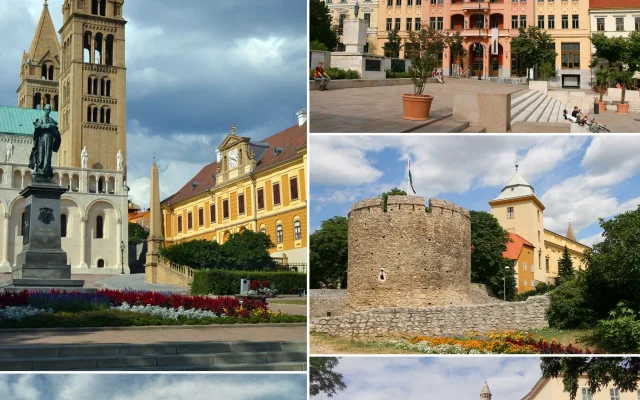
Pécs is a southern Hungarian city known for its late Roman catacombs, the Mosque of Gazi Kasim Pasha, and a lively student quarter.
Wiki
The fifth-largest city in Hungary and one of the most atmospheric small cities in Eastern Europe — around 145,000 people on the southern slopes of the Mecsek Hills. Its Early Christian Necropolis from the 4th century is a UNESCO World Heritage Site. Pécs was a European Capital of Culture in 2010. Founded by the Romans as Sopianae, it became a major ecclesiastical centre in the Middle Ages; the University of Pécs, established in 1367, is the oldest in Hungary. The architectural heritage spans Roman, Gothic, Ottoman, Baroque and Art Nouveau periods.
Main sights
- Early Christian Necropolis (Cella Septichora and Cella Trichora) — a UNESCO World Heritage Site: 4th-century Roman catacombs with frescoes, the largest complex of its kind north of the Alps.
- Mosque of Gazi Kasim Pasha (Gázi Kászim Pasha Dzsámi) — the city's landmark building on Széchenyi Square, a 16th-century Ottoman mosque now serving as the Inner City Parish Church.
- Mosque of Hassan Jakovali Pasha — another Ottoman mosque, well preserved and atmospheric.
- Cathedral of Saints Peter and Paul — the city's largest cathedral, with four towers, a neo-Romanesque facade and frescoes by Hungarian masters.
- Zsolnay Museum — the largest collection of the celebrated Hungarian Zsolnay ceramics, still manufactured in Pécs.
- Zsolnay Cultural Quarter — a restored factory complex transformed into a contemporary arts hub.
- Csontváry Museum — the principal museum dedicated to Hungarian Romantic painter Tivadar Csontváry Kosztka.
- Széchenyi Square (Széchenyi tér) — the city's main square, dominated by the mosque-church.
- Mecsek Hills — the ridge rising above Pécs, with a funicular, a TV tower and walking trails.
- Villány — southern Hungary's premier wine region, 30 km away, known especially for Cabernet Sauvignon.
- Siklós — a 14th-century castle 30 km from Pécs.
Food and prices
The cuisine is Hungarian: goulash, braised pork with dumplings, paprikash, lángos (deep-fried dough) and kürtőskalács. There is a strong Swabian and Serbian culinary heritage. Lunch at an étterem (restaurant) runs 8–15 EUR (about $9–17), dinner for two at a sit-down restaurant 18–35 EUR ($21–40). A glass of Villány Cabernet costs 4–6 EUR ($5–7). A litre of petrol is around 1.50 EUR ($2), a city taxi ride 5–12 EUR ($6–14), and a single public-transport fare about 1 EUR ($1). Prices are as of 2026.
Getting there and around
Pécs-Pogány Airport (PEV) is small and has infrequent service. It is more practical to fly into Budapest (BUD), 230 km away, then take the train — about 3 hours, 15–25 EUR ($17–29). From Zagreb the drive is around 4 hours. The city centre is compact and very walkable; local buses cover the rest.
When to go
April through October is the main season, with temperatures of 12–26 °C. May and June offer the best conditions; July and August are hot (28–32 °C). The Wine Festival in Villány takes place in September. Winter (December–March) brings 0–8 °C and occasional snow. Thanks to its southerly aspect, Pécs is one of the warmest cities in Hungary.