Description
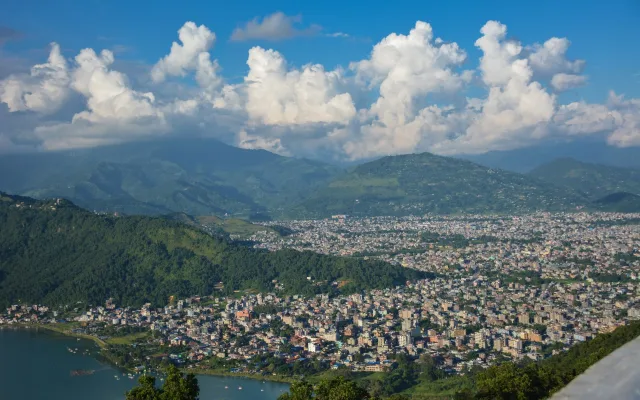
Nepal's trekking capital — Phewa Lake, the Annapurna skyline and the start of the great Himalayan routes.
Wiki
Pokhara is the gateway to the Annapurna region and Nepal's second tourist city. It stands on the shore of Phewa Lake at about 800 metres: to the north rises the wall of the seven- and eight-thousanders of Annapurna and Dhaulagiri, and to the south lie warm subtropical valleys. Almost every trek in the region starts here, and the town is also one of the best-known paragliding sites in the world.
Main sights
- Phewa Lake — the centre of town life, about 4.4 sq km. White wooden rowing boats work the water, and the Tal Barahi temple stands on an island in the middle.
- Sarangkot — a viewpoint hill at about 1,600 m above the town, the main place to meet the sunrise over Annapurna (8,091 m) and Machhapuchhre (6,993 m), the "Fishtail".
- The World Peace Pagoda (Shanti Stupa) — a white pagoda on the hill above the southern shore of Phewa, built by Japanese Buddhists. The easiest approach is by boat across the lake.
- Devi's Fall (Davis Falls) — a stream that vanishes into an underground cavity in the middle of the town.
- The Gupteshwor Mahadev cave — a cave temple of Shiva opposite the waterfall, into which the same water flows.
- The Mahendra and Bat caves — karst cavities on the northern edge of town.
- The International Mountain Museum — a large museum on the history of Himalayan mountaineering, the ascents of the eight-thousanders and the peoples of the mountains.
- The Gurkha Memorial Museum — on the Nepali soldiers of the British army.
- Begnas and Rupa lakes — east of town and noticeably quieter than Phewa.
- Lakeside (Baidam) — the main tourist street along the water: hotels, restaurants, rental shops and trekking gear.
Activities
- Paragliding from Sarangkot — a 30-45 minute flight over the town and the lake; tandems fly in the dry season, October to March.
- Bungee — a jump from a platform over a gorge half an hour out of town, near Hemja.
- Kayaking and boating on Phewa, and rafting on the Seti and Kali Gandaki rivers.
Treks from Pokhara
- Poon Hill (3-5 days) — the best short trek, with sunrise over Annapurna and Dhaulagiri.
- Annapurna Base Camp, ABC (7-12 days) — the classic of the region, with the camp at 4,130 m.
- Mardi Himal (5-7 days) — less walked, with close views of Machhapuchhre.
- The Annapurna Circuit (12-21 days) — the great loop over the Thorong La pass (5,416 m).
All of these need an ACAP permit and a TIMS card, issued in Pokhara or Kathmandu. A guide is not compulsory everywhere, but the high sections are not for walking alone.
Food and prices
The cooking is Nepali and Tibetan: dal bhat (rice with lentils and side dishes, with refills usually free), momos, thukpa and sel roti; Lakeside also has plenty of Indian and Western places. Lunch at a local canteen runs to 600-1,050 rupees ($4-7), and dinner at a tourist restaurant to 1,500-3,800 rupees ($10-25). An hour on the lake in a boat is around 1,200 rupees ($8), a taxi across town 750-1,800 rupees ($5-12), and a tandem paragliding flight 12,000-15,000 rupees ($80-100).
Transport
Pokhara International Airport (PKR) opened in 2023; Buddha Air and Yeti Airlines fly here from Kathmandu in about 25 minutes, with foreigner fares quoted in dollars at $100-150. The tourist bus from Kathmandu takes 6-8 hours and costs 2,300-3,800 rupees ($15-25). Around town there are taxis and motorcycle rickshaws; jeeps run to the trailheads.
When to go
October to December and March to May are the optimum for trekking: 12-25°C and clear views of the Himalaya. Winter nights are cold (0-5°C) but the skies are clear. The monsoon from June to September brings cloud and washes out the roads, making it the worst time for the mountains. The paragliding season runs from October to March.