Description
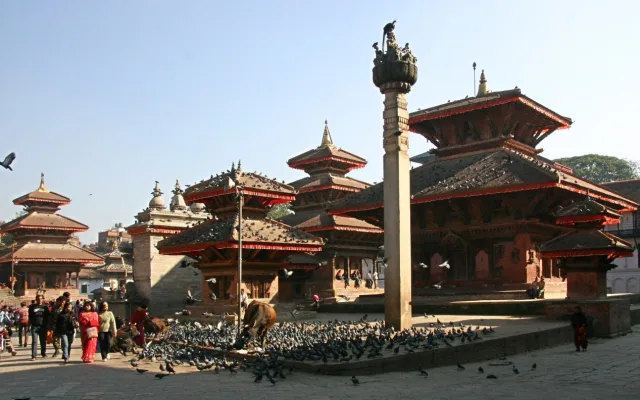
The capital of Nepal — Durbar Square, Pashupatinath, Boudhanath and the gateway to the Himalaya.
Wiki
Kathmandu is the capital and largest city of Nepal, set in the valley of the same name at about 1,400 metres among the foothills of the Himalaya. It is an ancient Newar centre where a distinctive urban culture took shape over centuries, and where Buddhist stupas stand alongside Hindu temples and crowded bazaar quarters.
The city and its atmosphere
More than a million people live in the Kathmandu valley, and together with neighbouring Patan and Bhaktapur the conurbation forms the historic and economic core of the country. The city sits at the crossing of the old trade routes between India and Tibet, which shaped its variegated character: Hindu, Buddhist and tantric traditions are so tightly interwoven here that the same shrines are often venerated by followers of different faiths.
The 2015 earthquake did serious damage to the architectural heritage — some temples and palaces collapsed, and restoration of a number of sites is still going on. Even so, the old quarters have kept their living rhythm: narrow lanes, carved wooden windows, the courtyard bahas, street shrines and morning rituals remain part of daily life. For most travellers Kathmandu is the starting point for the trekking routes of Everest, Annapurna and Langtang.
Main sights
- Kathmandu Durbar Square — the UNESCO-listed ensemble of the former royal residence, with the Hanuman Dhoka palace, temples of the Malla period, and the House of the Kumari, where a girl venerated as the incarnation of a goddess lives.
- The Durbar squares of Patan and Bhaktapur — two neighbouring historic cities in the valley, also UNESCO-protected; their squares count among the finest examples of medieval Newar architecture of the 15th to 17th centuries, with tiered pagodas and bronze casting.
- Swayambhunath — the ancient Buddhist stupa on its hill, nicknamed the Monkey Temple; the all-seeing eyes of the Buddha look out to the four directions, and the terrace gives a panorama of the valley.
- Boudhanath — one of the largest stupas in the world and the spiritual heart of Nepal's Tibetan community, ringed by monasteries and shops selling ritual goods.
- Pashupatinath — the country's most important temple of Shiva, on the bank of the Bagmati, where open-air cremations take place; only Hindus are admitted to the sanctuary itself, but the rites are visible from the opposite bank.
- Budhanilkantha — a monolithic statue of Vishnu reclining on serpents, carved probably in the early medieval period.
- Changu Narayan — one of the oldest working temples in Nepal, with valuable stone sculpture, standing on a hill east of the capital.
- Nagarkot — a village on the valley rim where people come to meet the sunrise over the chain of Himalayan peaks.
Districts and walks
The tourist centre is Thamel, a dense web of lanes with trekking gear shops, money changers, cafés, bars and the agencies that arrange permits. It is a convenient base for reaching the old city. Anyone after quiet should set aside time for Patan, with its museum in the royal palace, and for Bhaktapur, which has kept the feel of a medieval craft town — pottery squares, carving workshops and the local juju dhau yoghurt.
Food
The foundation of the Nepali table is dal bhat: boiled rice with lentil soup, vegetable curry and condiments, with refills served without limit in traditional places. Also popular are momos (steamed or fried dumplings), the noodle soup thukpa, and the ring-shaped sweet sel roti. Tibetan and Indian influence runs strong — thenthuk, thali and chow mein. Thamel also has international restaurants. A modest lunch at a local eating house costs little, dinner at a tourist restaurant noticeably more; bottled water and soft drinks are sold everywhere.
Practicalities
Allow about four days for the capital and the nearest towns of the valley: enough for the palace squares, the main stupas and one trip out to a viewpoint. The best seasons are spring (March to May) and autumn (October to November), when the sky is clearer and the mountain views sharper; summer brings the monsoon rains. Tribhuvan International Airport connects the city with Asia and the Gulf. Getting around is easiest on foot and by taxi; the traffic is dense and the air in the dry season can be dusty, so many travellers carry a mask. At temples it is customary to remove your shoes and dress modestly, and to photograph rituals with respect for worshippers.