Description
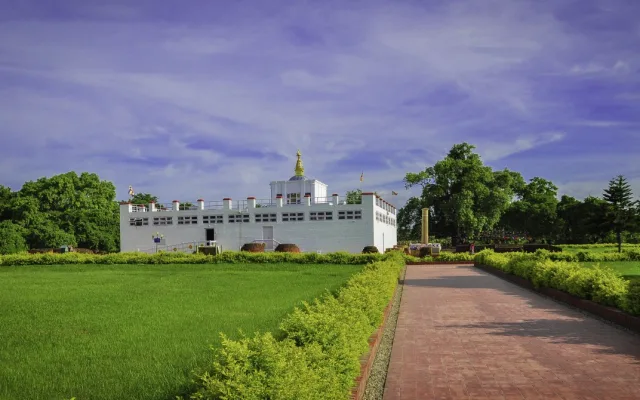
The birthplace of the Buddha and a UNESCO site — the sacred Maya Devi garden and monasteries built by countries worldwide.
Wiki
Lumbini is a quiet lowland village in southern Nepal where Siddhartha Gautama, who became the Buddha, was born. People come not for the scenery but for the atmosphere of one of the four great Buddhist pilgrimage sites in the world: the sacred Maya Devi garden and the monasteries of countries from across the globe, scattered through an enormous park, create a feeling you will not find anywhere else.
Is it worth going, and for how long
Honestly, Lumbini is slow and contemplative rather than eventful. If you are expecting a temple city on the scale of Kathmandu or Bagan you will be disappointed. But if you want a day or two of quiet, cycling between exotic monasteries, and a point on a Buddhist itinerary, it is worth it.
Two days is more than enough. The essential Maya Devi garden and a couple of the nearest monasteries take half a day. The second day is best given to an unhurried cycle around the monastic zone and a trip out to Tilaurakot. Many people allow a single night, and that works too if you are passing through.
Getting there
Lumbini lies on the Terai plain near the Indian border, away from the main mountain routes. The options:
- By bus. The transport hub is the town of Bhairahawa (also called Siddharthanagar), about 20 km away. Local buses, jeeps and taxis run from there to Lumbini. Long-distance buses come direct from Kathmandu and Pokhara; the journey from the capital is long, so allow most of a day.
- By air. Since Gautam Buddha International Airport opened near Bhairahawa in 2022 the journey has become easier, though there are still few international flights. Domestic flights connect the region with Kathmandu.
- From India. The nearest border crossing is Sunauli, a popular way in and out for anyone combining Nepal with Varanasi and Gorakhpur.
Getting around
The sacred park is a long rectangle laid out to a master plan by the Japanese architect Kenzo Tange: the Maya Devi garden in the south, a long canal down the middle, and the monasteries of the East and West zones along the sides. The distances are substantial, and walking it all is tiring and hot.
- A bicycle is the best way. Rentals are available at the entrances and at the guesthouses, cost very little, and let you cover everything in a couple of hours.
- Rickshaws and electric carts suit anyone who would rather not pedal in the heat.
- Within the Maya Devi garden itself you move on foot only, and barefoot in the inner precinct — bear in mind how hot the paving gets by midday.
What is genuinely worth seeing
The Maya Devi Temple with its marker stone, the Ashoka pillar and the sacred Puskarini pond with its bodhi tree form the historic core and the main reason to come; all of it stands close together. Beyond that it is a matter of taste: the monasteries of different countries vary sharply in style, and it is more interesting to pick contrasting ones than to tick off all forty — the golden Burmese Lokamani Pula pagoda, the austere Royal Thai Monastery, the minimalist Japanese buildings and the richly painted Chinese one. The World Peace Pagoda on the northern edge makes a good final stop.
Tilaurakot (ancient Kapilavastu), about 25 km away, is for those who want the context: the prince spent 29 years here before leaving to become an ascetic. It is worth the trip if you have a second day and an interest in archaeology; the site itself is modest.
When to go
The Terai is a hot lowland. The best time is October to March, the cool dry season. From April a punishing heat sets in, approaching 40°C, and summer brings the monsoon and humidity. In winter there is often thick morning fog, which affects flights.
Where to stay
Hotels cluster at the park entrances (the Bhairahawa road area) and in Lumbini village itself. One distinctive option is staying at one of the monasteries: simple rooms for a donation, with a daily routine and meditation sessions. There are plenty of budget guesthouses, and prices are low even by Nepali standards.
Food and money
The cooking is Nepali and Indian: filling dal bhat (rice with lentils and side dishes, often with free refills), momos, thukpa and chapati, with a great deal of vegetarian food given the pilgrimage character of the place. The choice of restaurants is modest — this is a village, not a food destination — and the best options are at the hotels. Prices are very low. Cash in Nepali rupees is essential: there are ATMs in Bhairahawa, but the village itself is poorly served.
Practical details
- The Maya Devi garden has a dress code and a rule of silence: cover shoulders and knees, and photography inside the temple is forbidden.
- Carry water and wear a hat: there is little shade in the open monastic zone.
- Mosquitoes are active on the plain, so repellent is worth having.
- Do not try to "do" Lumbini in a couple of hours between buses: half the point is the slowness.