Description
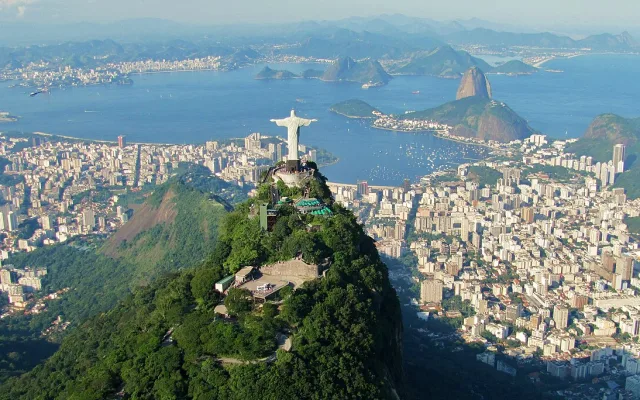
Rio de Janeiro is known for the famous districts of Copacabana and Ipanema, for the towering statue of Christ the Redeemer and for its dramatic mountains.
Wiki
Rio de Janeiro is the second-largest city in Brazil and the country's former capital, spread between granite mountains, tropical forest and the Atlantic. Founded by the Portuguese in 1565, today it is known as the "Cidade Maravilhosa", the Marvellous City, where beach culture, samba and majestic panoramas merge into a single image recognised the world over.
History and general character
The city took the name "river of January" from Portuguese navigators who mistook Guanabara Bay for a river mouth in January 1502. From 1763 to 1960 Rio was the capital — first of the colony, then of the Brazilian empire and the republic — until the role passed to Brasilia, built from scratch. The city divides into four zones: the North (industrial and residential), the Centre (the historic and business core), the West (fast-growing, with the Barra da Tijuca district) and the most visited South Zone, where the famous beaches and hills are concentrated. A characteristic feature of the city is the favelas, densely built quarters on the slopes, adjoining prestigious districts.
Main sights
- Christ the Redeemer — the 30-metre art deco statue on the summit of Corcovado (710 m), unveiled in 1931 and named one of the seven new wonders of the world. A scenic rack railway climbs to its foot through the Tijuca forest.
- Sugarloaf Mountain (Pao de Acucar) — the granite monolith 396 m high at the entrance to Guanabara Bay. The ascent goes in two stages by a cable car that has run since 1912; the viewing platforms give the best outlook over the bay and the beaches.
- Copacabana and Ipanema — the legendary beaches of the South Zone, with their wave-patterned mosaic promenade by the landscape architect Roberto Burle Marx. Ipanema was sung about in the bossa nova "The Girl from Ipanema"; the Rodrigo de Freitas lagoon and the fashionable Leblon quarter are here too.
- Tijuca National Park — one of the largest urban tropical forests on the planet, replanted by hand in the 19th century where coffee plantations had been cleared. Waterfalls, viewpoints (the Vista Chinesa), toucans and monkeys.
- Santa Teresa — a bohemian hill with cobbled streets, the old bondinho tram, artists' studios and the famous mosaic staircase, the Escadaria Selaron.
- The Maracana — one of the most famous football stadiums in the world, host of the World Cup finals of 1950 and 2014.
- The historic centre — Cinelandia square, the Municipal Theatre, the monastery of St Benedict, baroque churches and the futuristic Museum of Tomorrow in the redeveloped Porto Maravilha docklands.
Carnival and culture
The Rio Carnival, held 40 days before Easter (February–March), is the largest in the world. Its heart is the Sambadrome, designed by Oscar Niemeyer, where the elite samba schools compete in enormous night-time parades of costumes and floats. In parallel, free street processions — the blocos — take place across the city, drawing millions of people. Rio is the birthplace of samba and bossa nova; musical life bubbles in the bars of the Lapa district beneath the arches of the old Arcos da Lapa aqueduct.
Food
The cooking reflects Afro-Portuguese and Indigenous roots. The national dish is feijoada, a thick stew of black beans with pork, traditionally served on Wednesdays and Saturdays. Churrasco (grilled meat), pao de queijo (cheese balls), pastel turnovers, fresh juice and ice cream made from the acai berry, and beach snacks are all popular. The classic drink is the caipirinha, made from cachaca, lime and sugar. In rodizio restaurants (churrascarias), meat on skewers is served without limit.
Practicalities
- When to go: the peak season is the southern hemisphere summer (November–March), with the carnival and hot weather; April to October is cooler, cheaper and less crowded.
- Transport: the metro connects the centre with the South Zone beaches, backed up by buses, BRT express lines and the VLT tram in the port area. Taxi apps are usually more convenient and safer than hailing a car in the street.
- Airports: international Galeao (Tom Jobim) takes long-haul flights, and the city-centre Santos Dumont by the bay handles domestic ones.
- Safety: avoid displaying valuables, do not go into the favelas unaccompanied, and be attentive on the beaches and in crowds.
How much time to plan
It is best to set aside about 5 days: a day each for Corcovado with Christ the Redeemer, for Sugarloaf and the centre, for the beaches of Copacabana and Ipanema, for a walk through Santa Teresa and Lapa, and for an excursion into the Tijuca forest. That is enough to take in both the landscape and the rhythm of the city without rushing.
Photos