Description
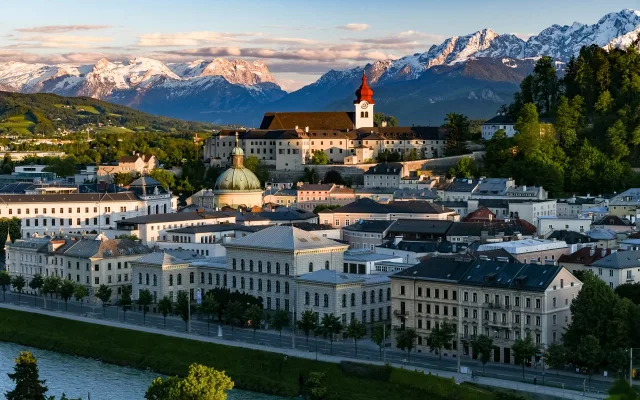
Salzburg is a compact baroque city, birthplace of Mozart, known for its historic architecture, the hilltop Hohensalzburg Fortress, and sweeping Alpine scenery.
Wiki
A compact baroque city of 155,000 people, wedged between two hills and the Salzach River — everything worth seeing is walkable, and the Alps begin almost at the city's edge. People come for two myths: Mozart and The Sound of Music. Both deliver, and two days is enough to cover both without rushing.
Getting There and Getting Around
The airport (W. A. Mozart) is 15 minutes from the centre. City buses (lines 2 and 10) run into town; tickets can be bought from the driver or at a machine. Taxis are pricey, but shared among 3–4 people they become more reasonable. Many travellers fly cheaper into Munich and take the train — roughly 1.5–2 hours and often cheaper on tickets overall.
The main railway station (Salzburg Hauptbahnhof) is about 20 minutes on foot from the old town, or a couple of bus stops. Direct trains connect Salzburg with Vienna, Innsbruck and Munich.
The key point about getting around: you largely won't need to. The historic centre, Mirabell, both Mozart houses and the fortress are all within a 20-minute walk of each other. Buses are useful for the airport, the station and trips to Hellbrunn. Don't bring a car into the centre — the old town is pedestrianised, parking is paid and expensive, and everything interesting is nearby. A hire car only makes sense for a trip to Berchtesgaden or a drive around the Salzkammergut lake district.
What to Do in 2 Days
Day 1 — old town and Mozart. Start on Getreidegasse with its ornate wrought-iron signs and stop into the Mozart Birthplace (Getreidegasse 9). Continue to the Cathedral, Residenzplatz, St Peter's Abbey with its cemetery carved into the cliff face and the oldest continuously operating restaurant in the city. In the evening, head up to Hohensalzburg Fortress: take the funicular or walk up in about 15 minutes — either way you get views over the whole city and the Alps. Aim to go near sunset.
Day 2 — right bank and the outdoors. Morning: Mirabell Palace and Gardens (the recognisable Sound of Music scenes; the gardens are free to enter), then Mozart's Residence on Makartplatz. Spend the afternoon at Hellbrunn — a 17th-century summer palace whose trick fountains still catch visitors off guard; buses run there in about 20 minutes.
If you have a third day, or are willing to drop part of the programme, Berchtesgaden and the Eagle's Nest lie 30 km away across the border in Germany: a mountain road, a historic retreat and sweeping panoramas. Easiest with a car or a guided tour.
The Salzburg Card: Do the Sums
The 24-hour card (around 30 EUR, about $37) covers all museum admissions, the fortress funicular, a boat ride and public transport. It pays off only if you are genuinely moving from one paid attraction to the next: fortress + both Mozart houses + Hellbrunn in a single day. If your style is to stroll, admire the architecture from outside and sit in cafés, skip the card and pay individually. Map out your day in advance and decide honestly.
Food and Prices
Austrian classics to try: Wiener Schnitzel, Tafelspitz (boiled beef), and Salzburger Nockerl (a light, sweet soufflé meant for sharing). You'll eat better and cheaper in a Beisl — an unpretentious local tavern where lunch runs 18–25 EUR ($22–$31) — than in the tourist restaurants around the Cathedral, where dinner easily reaches 35–65 EUR ($43–$80). A glass of Austrian Grüner Veltliner is 5–7 EUR ($6–$9). Prices are as of 2026.
To keep costs down:
- Have the Mittagsmenü (set lunch) — the same restaurant is noticeably cheaper at midday than in the evening.
- A sausage from a Würstelstand street stand fills the gap for a couple of euros.
- Mozartkugeln — the chocolate-and-marzipan confections — cost a fraction of what the old-town gift shops charge if you buy them at a supermarket.
- Drinking fountains in the centre provide free, clean tap water.
Salzburg is an expensive city by most standards — budget higher than you would for Eastern Europe.
Where to Stay
The old town is atmospheric but pricey and noisy with daytime tourist traffic. Staying on the right bank near Mirabell, or in the station district, is more practical: still walkable to the centre, a wider choice of accommodation and kinder prices. For budget options, look at guesthouses and hostels a little further out — public transport and easy walking distances make them workable.
When to Go and What to Watch Out For
- Summer — peak season: warm, but crowds and prices are at their highest, especially during the Salzburg Festival in July–August, when accommodation books up early and costs more.
- May–June and September — the sweet spot: greenery, comfortable weather and fewer visitors.
- December — Christmas markets, atmospheric, but cold and busy again.
Mountain foothills weather is unpredictable — rain is possible in any season, so bring a waterproof jacket and comfortable shoes: cobblestones and the climb to the fortress demand them. The city is safe; the usual awareness in crowds around major sights is all that's needed. And don't pack the itinerary too tightly — half the pleasure of Salzburg is simply walking slowly along the river with the fortress overhead.