Sarajevo
Bosnia and HerzegovinaDescription
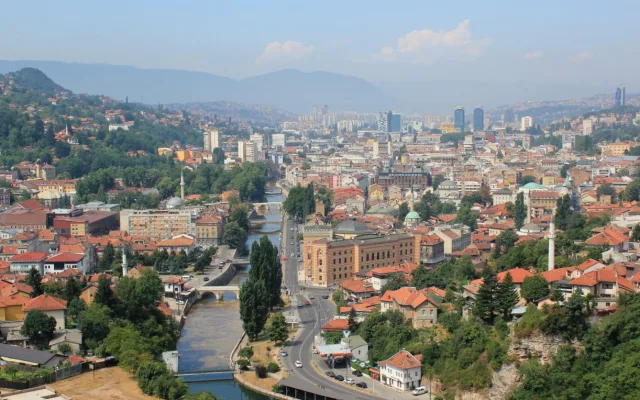
Sarajevo is the multicultural capital of Bosnia and Herzegovina, where mosques and Orthodox cathedrals stand side by side on the same street, representing a unique fusion of Eastern and Western traditions.
Wiki
The capital of Bosnia and Herzegovina and one of the most historically rich cities in Europe — around 280,000 residents in a valley surrounded by four mountains. Known as the "Jerusalem of Europe": it is the only city in Europe where a mosque, a synagogue, a Catholic cathedral and an Orthodox cathedral all stand within 200 metres of each other — a rare meeting of Islam, Judaism, Catholicism and Orthodoxy. This is where Gavrilo Princip assassinated Archduke Franz Ferdinand in 1914, triggering the First World War. It endured the longest siege in modern history (1992–1996, 1,425 days). It hosted the 1984 Winter Olympics.
Main sights
- Baščaršija — the old Ottoman bazaar dating from the 15th century, the city's main tourist district, with cobbled lanes, craft workshops and cafés.
- Sebilj — the drinking fountain at the heart of Baščaršija and the symbol of the city: the first stood here from 1753, while the present pseudo-Moorish wooden pavilion dates from 1891.
- Latin Bridge (Latinska Ćuprija) — the site where Archduke Franz Ferdinand was assassinated on 28 June 1914.
- Gazi Husrev-beg Mosque — the principal mosque of Bosnia (1531), an Ottoman masterpiece.
- Old Orthodox Church (Stara Crkva) — 16th century, located in Baščaršija.
- Ashkenazi Synagogue (1902) — the largest synagogue in Bosnia and Herzegovina and one of the few still in use in the Balkans.
- Sacred Heart Cathedral — the main Catholic cathedral of Bosnia.
- Olympic Bobsleigh Track — the abandoned 1984 Olympic bobsleigh run, now covered in street art.
- Tunnel of Hope (Tunel Spasa) — an 800-metre tunnel dug beneath the airport, the only link between Sarajevo and the outside world during the siege. A powerful memorial site.
- Vrelo Bosne — the source of the Bosna river in Ilidža, 12 km from the centre, a park with horses and carriages.
- Yellow Bastion (Žuta Tabija) — a hilltop viewpoint over the city, especially atmospheric during Ramadan when a cannon is fired at sunset.
- Bjelašnica and Igman — ski resorts from the 1984 Olympics, 30 minutes from the city.
- Museum of Crimes Against Humanity and Genocide 1992–1995 — a sobering account of the war.
- Markale Market — the site of two shellings, on 5 February 1994 and 28 August 1995, now a memorial listing the names of the dead.
Food and prices
Bosnian cuisine centres on ćevapi (grilled minced-meat sausages — the national dish), burek, sogan-dolma, pita zeljanica, and Bosnian coffee (served Turkish-style) with rahat lokum and baklava. Bosnian coffee is an institution not to be skipped. Lunch at a kafana from 8–15 EUR (about $9–17), dinner at a restaurant 15–30 EUR ($17–33). A glass of Herzegovinian wine 3–5 EUR ($3–6). A litre of petrol around 1.40 EUR ($2), public transport (GRAS) 1.20 EUR ($1), a metered taxi 5–12 EUR ($6–13). The country's currency is the convertible mark (BAM), pegged to the euro at about 1.96 KM to €1. Prices are as of 2026.
Getting around
Sarajevo International Airport (SJJ) is served by Turkish Airlines, flydubai, Wizz Air and Air Serbia. Bus 36 runs to the centre for 1.20 EUR ($1); a taxi costs 12–15 EUR ($13–17). From Dubrovnik: bus, about 4 hours across the border, 25–35 EUR ($28–39). From Zagreb: bus about 7 hours; a direct train does not always run, so check the timetable before travelling. Within the city: trams (the oldest tram network in the Balkans, operating since 1885), buses and taxis.
When to go
April to October sees temperatures of 10–25°C. May and September are the sweet spot. The Sarajevo Film Festival takes place in August and is the highlight of the year. Winter (December–March) is cold (−5 to +5°C), but ski season is in full swing at Bjelašnica and Jahorina. Ramadan is a special time to visit — the iftar meals at sunset are a memorable experience.