Description
The city-state — Gardens by the Bay, Marina Bay Sands, hawker centres and spotless streets.
Wiki
Singapore is a compact island state at the southern tip of the Malay Peninsula, separated from Malaysia by the narrow Johor Strait. In a little over 700 sq km it fits the skyscrapers of a business district, tropical gardens and a seaport of global importance, with a population of more than 5.5 million. It is one of the most prosperous, safe and orderly countries on the planet, where ultra-modern architecture sits alongside the historic quarters of three great cultures — Chinese, Malay and Indian.
History and general portrait
The modern city dates from 1819, when the Briton Stamford Raffles founded an East India Company trading post here. Its convenient position at a crossroads of sea routes quickly turned the port into one of the key hubs in Asia. After decades of colonial rule and Japanese occupation during the Second World War, Singapore gained independence, and in 1965 it left Malaysia and became a separate state. Within a few decades a poor port had turned into a financial and technological centre — a path often called the "Singapore miracle".
There are four official languages: English, Malay, Chinese (Mandarin) and Tamil. English is used in business, in education and on signage, so a visitor finds it easy to get around. The climate is equatorial: hot and humid all year, with temperatures holding around 27–31 °C, and rain possible in any month but especially frequent from November to January.
Main sights
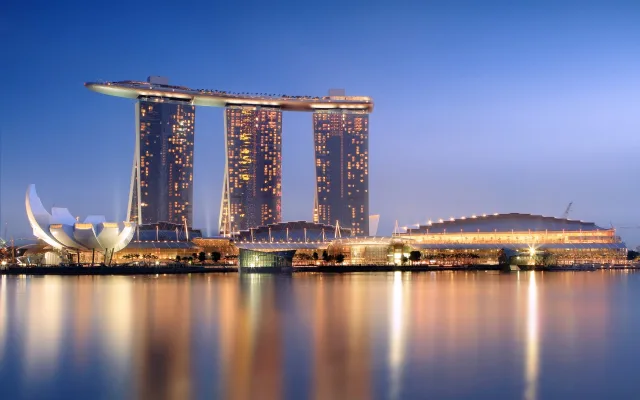
- Marina Bay Sands — the instantly recognisable complex of three towers crowned by a "ship" platform with a pool for hotel guests. The SkyPark observation deck opens a panorama of the bay and the skyscrapers of the business quarter.
- Gardens by the Bay — a futuristic park on reclaimed land. Its symbol is the artificial Supertree Grove, between which a light show is staged in the evening. Under glass domes are hidden the Flower Dome and Cloud Forest conservatories, the latter with a man-made waterfall.
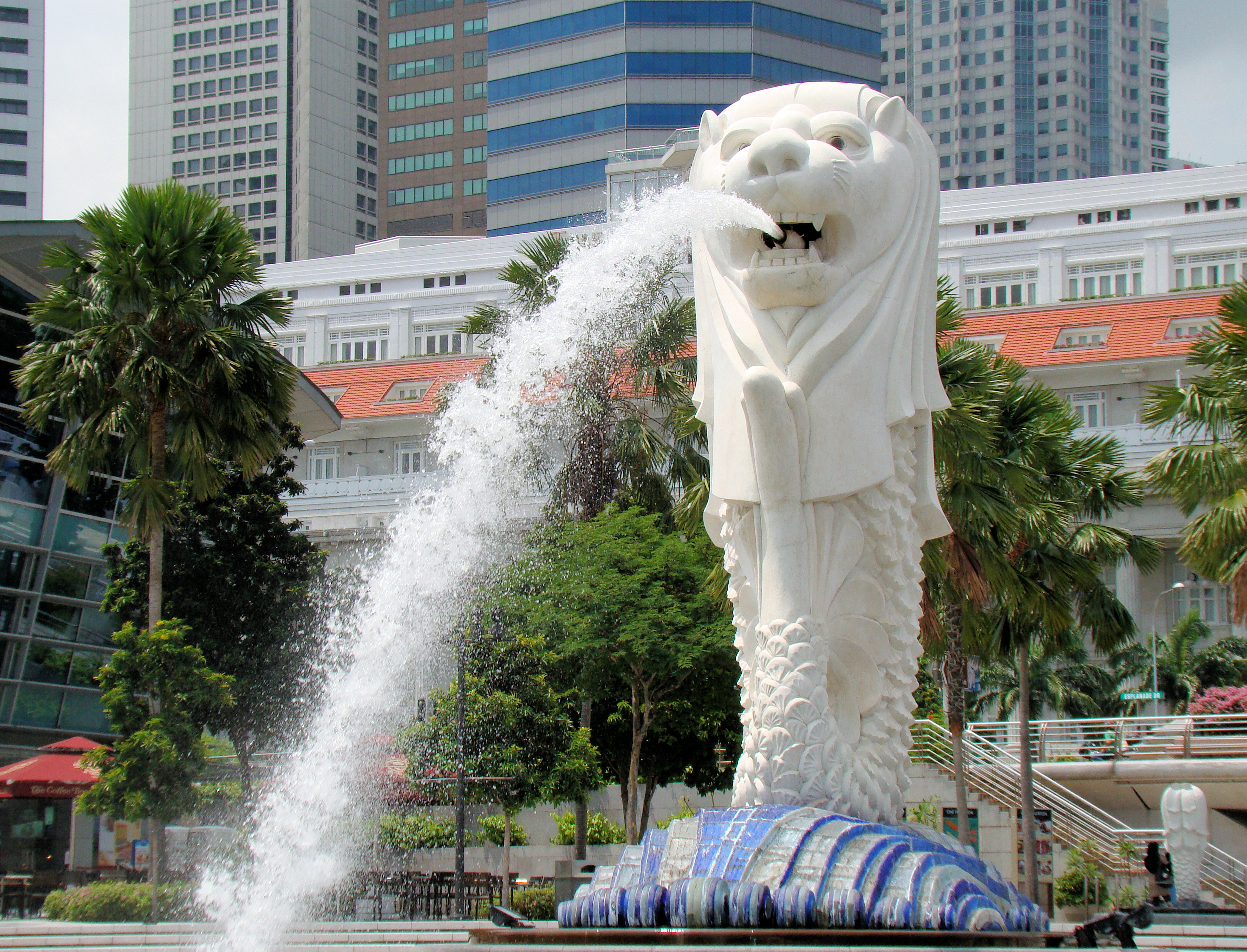
- The Merlion statue — a creature with the head of a lion and the body of a fish, the city's official symbol; the fountain faces the water opposite Marina Bay Sands.
- Sentosa — the island of entertainment, with Universal Studios, an aquarium, beaches, a cable car and the large Resorts World complex.
- The colonial core — the district around the Singapore River, with the parliament building, the cathedral, the Raffles hotel and the Boat Quay and Clarke Quay waterfronts.
- The Singapore Botanic Gardens — a UNESCO World Heritage site with the famous National Orchid Garden.
Districts and quarters
Walking through the ethnic quarters is a pleasure in itself. Chinatown combines temples, herbal shops and street food; the Buddha Tooth Relic Temple stands here. Little India is bright with garlands, spices and the colourful Hindu temple of Sri Veeramakaliamman. Kampong Glam is the historic Malay-Arab quarter, with the golden domes of the Sultan Mosque and fashionable little shops on Haji Lane. The business centre around Raffles Place shows off its glass towers, while Orchard Road is the main shopping artery, lined with malls.
Food and hawker centres
Singapore's gastronomy is a fusion of Asian traditions. The heart of local eating is the hawker centre, a covered space with dozens of inexpensive stalls: Maxwell Food Centre, Lau Pa Sat, Newton, Old Airport Road. Some of these street cooks have been listed in the Michelin guide — a rare thing for street food.
It is essential to try Hainanese chicken rice (the unofficial national dish), spicy chilli crab, laksa noodles, fried char kway teow, roti prata and a shaved-ice dessert with beans. The mixing of kitchens has produced a distinct Peranakan (Nyonya) style, joining Chinese and Malay recipes.
Transport
The MRT metro is considered one of the cleanest and most punctual in the world and connects practically every point a visitor wants. Fares on the metro and buses are easily paid with a contactless EZ-Link or bank card. Taxis and Grab work reliably but cost more than public transport. Changi airport, with its green Jewel terminal and indoor waterfall, is a sight in itself.
Practical advice
Singapore is famous for strict rules and heavy fines: littering, smoking in the wrong places, and the import and sale of chewing gum are all prohibited. That observance of order explains the city's exceptional cleanliness. Tap water is drinkable, crime is extremely low, and foreigners are treated with courtesy.
Allow about four days for a visit: a day for Marina Bay and Gardens by the Bay, a day for the ethnic quarters and the colonial centre, a day for Sentosa and one more for the gardens, the museums and unhurried walking. Dress light, but carry a cover for a sudden downpour and a light top — the air conditioning indoors is powerful.
Photos