Description
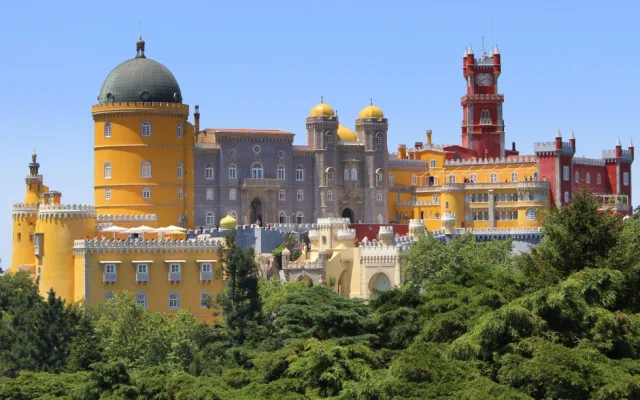
Fairytale palaces in the misty mountains of the Serra de Sintra — a romantic UNESCO World Heritage site half an hour from Lisbon.
Wiki
The heartland of "Portuguese magic" and the favourite summer residence of kings and aristocrats since the 15th century — around 380,000 people live in the wider municipality and 30,000 in the historic core. A UNESCO World Heritage Site (listed as the "Cultural Landscape of Sintra"), it sits in the Serra de Sintra mountains 30 km from Lisbon. The microclimate is unique: mist, high humidity and cool air even in summer. The "Sintra style" is an eclectic blend of Moorish, Gothic and 19th-century Romantic architecture, full of turrets, gargoyles and mystical symbols.
Main sights
- Pena Palace (Palácio Nacional da Pena) — Sintra's defining landmark: a multicoloured (yellow, red and blue) Romantic palace built 1842–54, and a UNESCO-listed monument. Timed-entry slots must be booked in advance.
- Pena Park (Parque da Pena) — 200 hectares of grounds surrounding the palace, planted with exotic trees from around the world.
- Quinta da Regaleira — a mystical 19th-century estate steeped in the symbolism of Freemasonry, the Knights Templar and alchemy. Its centrepiece is the Initiation Well, a 27-metre spiral shaft. The single most popular attraction in Sintra.
- Moorish Castle (Castelo dos Mouros) — an 8th–12th-century hilltop fortress with sweeping views over Sintra.
- Sintra National Palace (Palácio Nacional de Sintra) — the main royal palace in the town centre, recognisable by its two white conical chimneys. A royal residence from the 15th to the 19th century.
- Monserrate Palace (Palácio de Monserrate) — an Indo-Gothic 19th-century mansion set in exotic gardens.
- Seteais Palace (Palácio de Seteais) — a neoclassical 18th-century palace, now a hotel.
- Capuchos Convent (Convento dos Capuchos) — a 16th-century hermit monastery lined with cork.
- Cabo da Roca — the westernmost point of continental Europe: cliffs 140 m above the Atlantic, 18 km from Sintra.
- Cascais & Estoril — Lisbon's coastal resort towns, 25 km from Sintra.
- Praia da Adraga and Praia Grande — the finest beaches along this stretch of coast.
Food and prices
The local cooking is Portuguese and Sintran: travesseiros (puff-pastry pillows filled with almond cream — the signature Sintra treat), queijadas (small cheese tartlets), pastel de nata, bacalhau and grilled sardines. A café lunch costs 14–22 EUR (about $16–25), dinner at a restaurant 25–50 EUR ($29–58). A glass of vinho verde or Douro wine is 4–6 EUR ($5–7). A litre of petrol runs to 1.70 EUR ($2), a local bus ticket 2.50 EUR ($3), a taxi 12–20 EUR ($14–23), and entry to Pena Palace 14 EUR ($16). Prices are as of 2026.
Getting there and around
From Lisbon, take a CP train to Sintra (40 minutes, 4.50 EUR / about $6 return). Around town, Bus 434 runs the tourist circuit — Pena Palace, Moorish Castle and the town centre. A day pass covering routes 434 and 435 costs 13.50 EUR ($16); a single return ride is about 7 EUR ($8). Alternatives include the Lisboa Card, taxis or Uber, or walking (practical only within the historic centre).
When to go
April–October brings temperatures of 12–25 °C. Summer (July–August) is warmest at 22–28 °C but very busy. May–June and September are the sweet spot. Winter is mild (8–15 °C) though often rainy and misty — which only adds to the atmosphere. Sintra makes an essential day trip from Lisbon.