Description
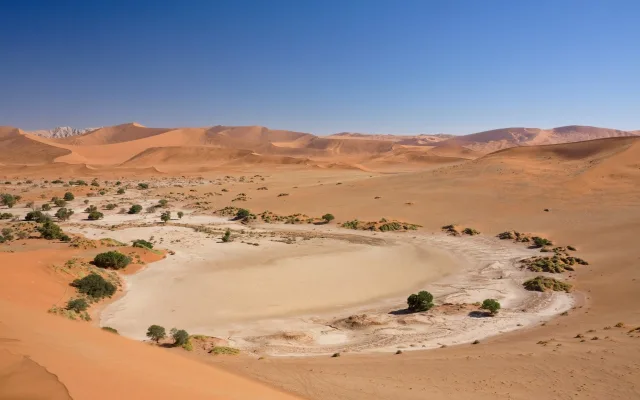
Rust-red dunes and Dune 45, the blinding white clay pan of Deadvlei, and dead trees against a burning sunrise.
Wiki
Sossusvlei is a clay and salt pan in the heart of the Namib, ringed by vast dunes the colour of rust. It is Namibia's calling card and one of the most recognisable places in Africa, and travellers cross the continent for it.
Geography and nature
Sossusvlei lies in the southern part of Namib-Naukluft National Park, the largest reserve in the country and one of the largest in Africa. The Namib is considered the oldest desert on the planet, its age estimated at 55-80 million years. The dunes here reach record heights of up to 380 metres, among the tallest in the world.
The characteristic orange-red of the sand comes from the oxidation of iron: the older the dune, the deeper its colour. At dawn and dusk the slopes catch every shade of ochre, crimson and gold, and the lines of the crests draw sharp contrasts of light and shadow. The name Sossusvlei comes from a mixture of Nama and Afrikaans and means roughly "the dead end where the water gathers": the seasonal Tsauchab river loses itself among the dunes, only rarely filling the pan after heavy rain.
Main sights
- Dune 45 — the most photographed dune on earth, about 80 metres high, named for its distance from the park gate. It stands on the way to the main pan, and its silhouette with a lone acacia in the foreground has become a classic of landscape photography. The climb takes 20-40 minutes.
- Deadvlei ("the dead marsh") — the most famous view in Namibia: a blinding white clay platform scattered with the blackened trunks of camel thorn trees, 700-900 years old. They died when the river changed course, but in the dry climate they did not rot; they dried and charred in the sun. Against the red dunes and blue sky the scene looks almost unreal.
- Big Daddy and Big Mama — the giant dunes framing Deadvlei. Climbing Big Daddy (about 325 m) takes an hour and a half to two hours, though the descent down the steep face straight into the pan is a matter of minutes.
- Sossusvlei pan — the final basin, where the road ends. After the rare downpour a shallow mirror lake appears here, drawing flamingos and other birds.
- Hidden Vlei — a secluded pan away from the tourist paths, reached by few.
- Sesriem Canyon — a narrow gorge up to 30 metres deep, cut by the river through sedimentary rock right by the park gate. A good place to walk in the heat of the day.
- Elim Dune — a dune by the entrance, accessible at any time; a good option if you cannot get deeper into the park.
How a visit works
The main gate is the settlement of Sesriem at the park entrance. It is about 350 km from Windhoek, and the same from coastal Swakopmund; the road is mostly gravel, so allow several hours. The last 5 km from the car park to Deadvlei is deep sand, passable only in a 4×4 or on the local shuttle.
The key piece of advice is to enter the park at dawn. The outer gate at Sesriem opens with the first light, and only guests of Sossus Dune Lodge, the only hotel inside the reserve, reach the dunes earlier. The morning light is softer, the air cooler, and there is time to climb and photograph before the midday heat turns the sand fierce.
Climate and when to go
A desert climate means sharp swings: daytime temperatures often exceed 30-40°C, while on winter nights (June to August) they drop close to freezing. The best time to visit is the cool dry season from May to September. Water, a hat, sunscreen and footwear for sand are essential.
The night sky
Neighbouring NamibRand holds the status of an International Dark Sky Reserve. The absence of city light and the dry, clear air make this one of the best places in the world for stargazing: the Milky Way is visible to the naked eye in full glory.
Nearby
To the east rise the Naukluft mountains, a harsh massif of gorges and springs, popular with multi-day trekkers. Two days are usually enough to catch sunrise at Deadvlei, climb Dune 45, walk Sesriem Canyon and spend an evening under the desert sky.