Description
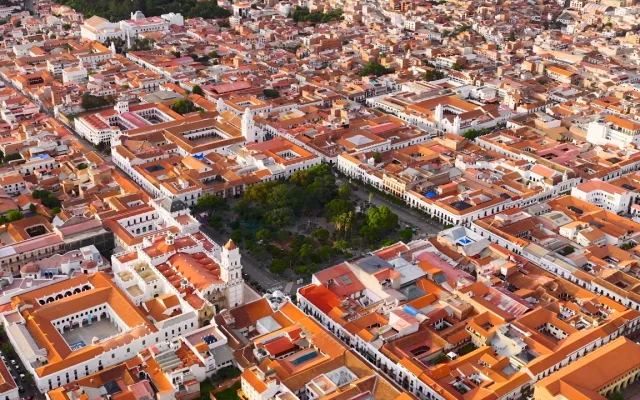
Whitewashed constitutional capital of Bolivia, with colonial cathedrals, dinosaur footprints pressed into limestone, and a pleasant climate at 2,800 m.
Wiki
The constitutional capital of Bolivia (the government sits in La Paz) and one of the most elegant colonial cities in South America — around 270,000 people at 2,810 m in the Andes. UNESCO World Heritage Site (since 1991). The "White City" — all buildings in the centre are required by law to be painted white. Founded by the Spanish in 1538 as La Plata, it was renamed Sucre in 1839 in honour of Marshal Antonio José de Sucre, Bolívar's lieutenant. The main historic heart of Bolivia: the Declaration of Independence was signed here in 1825.
Main sights
- Plaza 25 de Mayo — the central square, with the cathedral, Casa de la Libertad, and the municipality building.
- Sucre Cathedral — 16th–17th century, the country's principal church.
- Casa de la Libertad — the most important historic site in Bolivia, where the Declaration of Independence was signed on 6 August 1825. Now a museum.
- Iglesia y Convento de San Felipe Neri — the best panoramic viewpoint over the city, reached via the monastery rooftop.
- Iglesia de San Francisco — the oldest church in the city (1540).
- Museo de Arte Indígena ASUR — considered the finest museum of textile art in Latin America.
- Museum of Indigenous Peoples (MUSEF) — Andean ethnography.
- Museo de la Recoleta — at the foot of Recoleta Hill, a former Franciscan monastery.
- Cementerio General — the main 19th-century cemetery, with neoclassical mausoleums.
- Mercado Campesino — the main market, especially lively on Wednesdays and Saturdays.
- Maragua Crater — a vast geological crater 8 km across, 50 km from the city; trekking routes pass through Jalq'a villages.
- Cal Orcko — the world's largest dinosaur tracksite, with 5,050 footprints dating back 80 million years, 5 km from the centre.
- Tarabuco — a village 65 km away, home to the main Sunday artisan market of the Jalq'a people.
- Potosí — a UNESCO World Heritage Site 165 km away, built around the former silver mine of Cerro Rico.
Food and prices
The cooking is Bolivian and local: chorizo chuquisaqueño (the city's signature dish), salteñas (the essential breakfast), pique macho, anticuchos, api con buñuelos. Lunch at a local spot costs 28–49 BOB (about $4–7), dinner at a restaurant 83–174 BOB ($12–25). Prices are as of 2026. A litre of petrol is around $0.70, a taxi within the city 7–21 BOB ($1–3, fixed by zone), a minibus 2 BOB ($0.30).
Getting there and around
Juan Méndez Airport (SRE) handles domestic flights from La Paz, Cochabamba, and Santa Cruz. From La Paz: 45 minutes by air ($60–120) or 12–14 hours by bus ($15–25). Within the city, the compact centre is easily walkable; taxis and auto-rickshaws cover the rest. The altitude of 2,810 m is relatively manageable, but take it easy on your first day.
When to go
April to October is the dry season, with temperatures of 5–22 °C (the altitude keeps things cool and nights can be cold). September is the sweet spot: warm days, no rain. The rainy season (December–February) brings short, heavy downpours. Key events: Carnival — two days before Lent; Fiesta de la Virgen de Guadalupe — 8 September.