Tunis
Description
The capital of Tunisia — the UNESCO medina, the Bardo Museum's mosaics and Carthage next door.
Wiki
Tunis is the capital and largest city of the country of the same name, on the shore of the Gulf of Tunis on the Mediterranean, beside the wide El Bahira lagoon. About 640,000 people live in the city proper and some 2.7 million in the metropolitan area, making it the political, economic and cultural heart of the Maghreb.
History and character
The urban history reaches back to antiquity: Phoenician and later Roman Carthage lay alongside, while the settlement on the site of the present capital gained importance under the Arabs. Its heyday came with the Hafsids (13th to 16th centuries), when Tunis became the capital of a powerful dynasty. Later it joined the Ottoman Empire, and from 1881 to 1956 it was under a French protectorate. That inheritance reads clearly in the double plan: the eastern medieval medina sits beside the regular "European" quarter of the colonial period. The city is today considered one of the most open and secular in North Africa.
Main sights
- The Medina of Tunis — on the UNESCO World Heritage list since 1979. One of the most completely preserved medieval Islamic cities in the region: more than seven hundred monuments — mosques, madrasas, mausoleums, palaces, fountains and caravanserais — hidden in a maze of narrow lanes.
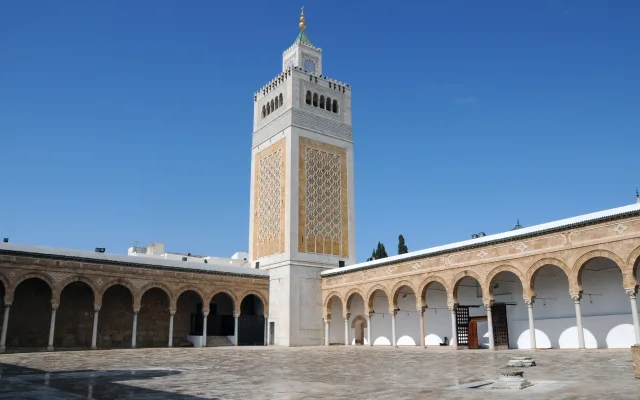
- The Zitouna Mosque (the Mosque of the Olive) — the spiritual centre of the capital, founded at the end of the 7th century. For a long time it housed one of the oldest institutions of learning in the Muslim world.
- The Bardo National Museum — the largest art collection in North Africa, housed in a former beylical palace. Its worldwide fame rests on the collection of ancient mosaic, covering thousands of square metres and unmatched in its completeness.
- Carthage — the UNESCO archaeological complex about 12 km away. The Baths of Antoninus survive on the shore, along with the Tophet sanctuary and the ruins of the Roman amphitheatre and circus, while the Byrsa hill holds the Punic residential quarter and the museum and looks out over the gulf.
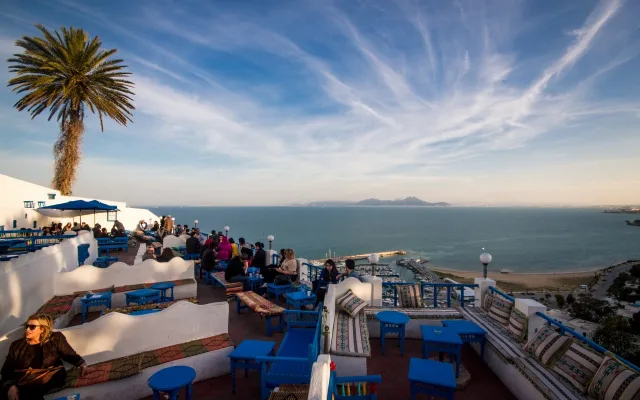
- Sidi Bou Said — a picturesque village on a cliff along the gulf, famous for its blue-and-white houses, wrought-iron grilles and views over the sea.
- Avenue Habib Bourguiba — the ceremonial artery of the French quarter, lined with trees, with the theatre, cafés and the clock tower; it is often compared to the boulevards of Paris.
- The Cathedral of St Vincent de Paul — a late 19th-century Catholic church in a neo-Byzantine spirit, facing the main avenue.
- Dar Hussein and the other palaces of the medina — examples of 18th-century Ottoman town architecture with inner courtyards and tilework.
Outside the city it is worth setting aside time for the more distant sites: the ruins of Utica an hour away, and the superbly preserved Roman town of Dougga (UNESCO) about two and a half hours off, with its capitol, theatre and triumphal arch.
Food
The local cooking combines Berber, Arab, Mediterranean and French traditions. Its calling card is brik, a thin crisp pastry parcel with egg, tuna and herbs. Couscous with lamb, fish or vegetables is made everywhere, along with the thick soup chorba. The fiery paste harissa goes into almost every dish. On the coast fresh fish and seafood are prized, and meals end with honey and date pastries and strong mint tea with pine nuts.
Practical information
- Getting there. Tunis-Carthage International Airport is a few kilometres from the centre and connects the capital with Europe and the Middle East.
- Transport. The light metro (tram) and taxis are convenient around the city. The TGM suburban railway line runs along the coast to Carthage and Sidi Bou Said.
- Season. The best time to visit is spring and autumn, without the summer heat. Summer is hot; winter is mild and rainy.
- Shopping. The souks of the medina sell carpets, ceramics, leather and copperwork; haggling is part of the tradition.
A three-day itinerary
Day 1 for the medina: the Zitouna Mosque, the palaces and the souks, then out onto Avenue Bourguiba and the European quarter. Day 2 for the Bardo and its mosaics, and for archaeological Carthage by the sea. Day 3 in Sidi Bou Said looking out over the gulf, and if you have the energy and the time, a run out to the distant Roman ruins of Dougga or Utica.
Updated