Description
Gateway to the world's largest salt flat — the Salar de Uyuni: an endless mirror plain, flamingos, and pink lagoons on the Bolivian altiplano.
Wiki
Uyuni is a small city in southwestern Bolivia, the administrative centre of the Antonio Quijarro Province in the Potosí Department. Sitting at around 3,670 metres above sea level, it is the main jumping-off point for the Salar de Uyuni — the largest salt flat on Earth — and is known to travellers far beyond Bolivia's borders, even though the town itself remains a quiet provincial settlement on the harsh altiplano.
History and general character
Uyuni grew up in the late 19th century as a railway junction on the line connecting Bolivia's mines to Chile's Pacific ports. Silver, tin and other metals extracted from the mountains around Potosí all passed through the station. When mining declined in the mid-20th century the railway lost much of its importance, and the abandoned locomotives left behind became one of the area's landmark sights. Today the town's economy rests on tourism, salt extraction, and lithium: beneath the crust of the salt flat lie some of the world's largest known reserves of the metal.
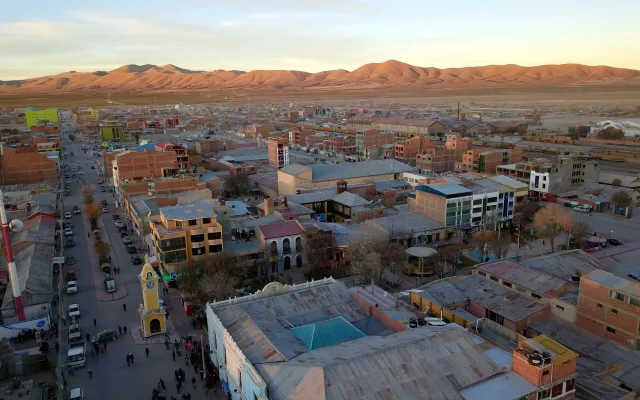
Uyuni's layout is straightforward — a grid of straight streets, low brick and adobe houses, a central plaza with a clock tower, and a market. Because of the altitude, nights are cold year-round and the air is thin; new arrivals should budget a day or two for acclimatisation.
What to see
Although the most striking experiences lie outside the town limits, Uyuni has its own points of interest.
- Train Cemetery (Cementerio de Trenes) — a couple of kilometres southwest of the centre, dozens of rusting early-20th-century locomotives and carriages sit stranded on the desert plain. The surreal scene has become the symbol of the town.
- Salar de Uyuni — a salt plain covering more than 10,000 km². During the rainy season a shallow layer of water turns it into a vast mirror reflecting clouds and the horizon; in the dry months the surface is covered by a dense white crust marked by the characteristic hexagonal patterns. Out on the flat you'll find rocky "salt islands," hotels built entirely from salt blocks, and the famous perspective photographs where all sense of scale disappears.
- Isla Incahuasi (Incahuasi Island) — a rocky hill rising from the white sea, covered in giant cacti several metres tall; from its summit there is a panoramic view across the entire plain.
- Coloured lagoons of the southwest — Laguna Colorada, its water reddened by algae and minerals, and the emerald-green Laguna Verde at the foot of the Licancabur volcano cone on the border with Chile. Nearby are the Sol de Mañana geyser field and hot springs.
- Flamingo colonies — three species of flamingo, including the rare Andean flamingo, nest on the shallow high-altitude lakes.
Food and culture
Local food reflects the harsh altiplano climate: the staples are many varieties of potato, quinoa, maize, and llama and alpaca meat. Hearty soups, stewed meat, and chuño — potato freeze-dried by the cold and storable for years — are all common. The most widespread drink is coca-leaf tea (mate de coca), which helps the body cope with the altitude. The population is predominantly Quechua and Aymara, and traditional crafts, weaving, and festivals remain part of everyday life.
Getting there
The small Joya Andina airport receives flights from La Paz — the fastest option. Budget travellers more often take overnight buses from La Paz, Oruro, or Potosí. Rail connections still exist: trains link Uyuni with Oruro to the north and with the Chilean border to the west. Almost all tourists explore the salt flat and the lagoons on organised jeep tours that depart directly from town; the classic itinerary runs three to four days with nights in basic lodges.
When to go
The season you choose shapes the whole trip. The rainy season (December–April) produces the mirror effect, but some tracks across the flat can flood and become impassable. The dry season (May–November) makes travel easier across the full expanse of the salar and out to the distant lagoons, but the mirror surface is gone and overnight temperatures drop well below freezing. A stay of around three days is enough to take in the Salar de Uyuni, the coloured lakes, and the volcanic landscapes of the southwest.
Practical tips
- Bring warm layers, sunscreen, and sunglasses — the sun at altitude and the glare off the salt are intense.
- Withdraw Bolivian bolivianos before you arrive: ATMs are scarce in town and non-existent deep on the altiplano.
- Give your body time to adjust to the altitude, drink plenty of water, and avoid strenuous activity in the first 24 hours.