Description
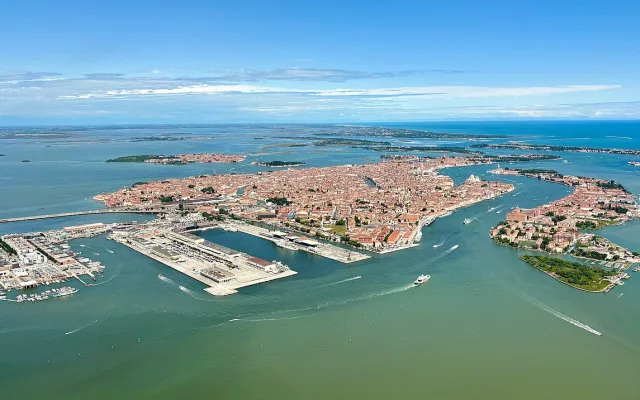
Venice is famous for its canals and gondolas. It is home to St Mark's Square and to the celebrated carnival.
Wiki
Venice is not so much a city as a labyrinth of water and stone, where there is not a single car and it is almost impossible not to get lost. Come prepared to walk a great deal, to pay a little more than usual, and to know a couple of tricks in advance so as not to overpay threefold.
What is genuinely worth seeing
The main ensemble is St Mark's Square, with the basilica (entry to the church itself is free, but the climb to the balcony with the golden horses and the treasury are charged separately), the Doge's Palace (around €25, about $29) and the Campanile bell tower (around €10, about $12, with a lift to the top). There is always a queue for the basilica; either arrive at opening time or book a slot online in advance — that saves an hour or more of standing.
The Grand Canal is not seen on foot but from the water. The most honest "sightseeing cruise" is not a tourist boat but the scheduled vaporetto no. 1 (€9.50, about $11, for a single ticket): it goes slowly, calls at every stop, and passes every palazzo. Sit at the bow or the stern, where the deck is open.
The Rialto Bridge and the market beside it are best caught in the morning — the fish stalls pack up after midday. A gondola is pure romance: the official rate is €90 (about $104) for 30 minutes by day and €110 (about $127) in the evening, charged per boat for up to five passengers rather than per person. Real savings come from the traghetto, the gondola ferry across the Grand Canal for a couple of euros: ride standing up, like the locals.
Do not shut yourself into St Mark's. The real Venice is in the quarters of Dorsoduro and Cannaregio: quiet canals, washing strung out to dry, courtyards without a single tourist. That is where you understand why you came.
The islands of the lagoon
On the second day it makes sense to set aside half a day for the lagoon. The vaporetto from Fondamente Nove runs to Murano (glass, blowing demonstrations), then Burano (brightly coloured fishermen's houses — the most photogenic place in the area, plus lace) and Torcello, an almost deserted islet of the 7th century with an ancient basilica and mosaics. The order Murano → Burano → Torcello works well: you get back to the city by evening.
Getting there and getting around
Marco Polo airport is connected to the city by water and by land. By water, the Alilaguna boat runs straight to St Mark's or the Rialto (slower, but spectacular and with no changes while dragging a suitcase). By land, a bus goes to Piazzale Roma, and from there you continue on foot or by vaporetto. The second airport, Treviso, is further out and serves the low-cost carriers; a shuttle bus runs from it.
Inside the city there are only two ways of getting about — your feet and the vaporetto. There are no cars, mopeds or bicycles at all. Distances are short, but the route constantly winds through bridges and dead ends, so GPS lies and the signs (verso San Marco / verso Rialto / verso Ferrovia) help more than a map. Download an offline map in advance.
If you plan to travel a lot by water and out to the islands, get a 24-hour vaporetto pass (about €25, roughly $29); at five or six journeys it has already paid for itself. For one or two trips, single tickets are better value.
Where to stay and how many days
Two days are enough to see the essentials without rushing: one day for the historic centre, one for the lagoon and the quieter quarters. It is better to sleep on the islands themselves rather than in Mestre on the mainland — yes, Mestre is cheaper, but you lose Venice in the evening and early morning, when the crowds have drained away and the city belongs to you. Look for a room in Dorsoduro, Cannaregio or Santa Croce — quieter and cheaper than right beside St Mark's, but everything is still within walking distance.
Food and money
Venice is expensive, but overpaying usually comes from not knowing the ropes. A few simple rules:
- Do not sit down to eat on St Mark's or by the Rialto — that is exactly where you find €6–10 (about $7–12) coffee and the "tourist menu".
- Drink your coffee standing at the bar (al banco) — about €1.30 (roughly $1.50) against three times as much at a table.
- Look for osterie and bacari in Dorsoduro and Cannaregio. The local format is cicchetti: one-bite snacks with a glass of wine (an ombra). You can eat well and cheaply going from bar to bar instead of sitting down in restaurants.
- The local speciality is not pasta but seafood and rice: sarde in saor, risotto, fritto misto.
- Watch for the coperto (the cover charge for the table) on the bill — it is normal, but check the amount.
A cheap lunch really can be kept to €12–15 (about $14–17) if you stick to the back lanes rather than the waterfronts. Prices are as of 2026.
When to go and what to expect
The optimum is April–May and September: warm, without the summer furnace and without the dense crowds. Summer means stifling air, the smell of the canals in the heat and queues everywhere. The Carnival (February, two weeks before Lent) is spectacular but expensive and crowded, and rooms are booked months ahead.
From autumn to the end of winter there is acqua alta, the seasonal flooding when water comes up onto St Mark's. It is not a disaster: wooden walkways are put out, rubber overshoes are sold, and the level is announced in advance. Just bring waterproof shoes and keep an eye on the forecast.
Typical mistakes
- Trying to "cover everything" by map — it is quicker to give in and allow yourself to get lost, since the best views are found by accident.
- Eating dinner next to the main sights.
- Saving money on a bed in Mestre at the cost of Venice in the morning and the evening.
- Forgetting the access fee. In 2026 the charge on day visitors applied on 60 days between 3 April and 26 July, from 8.30 to 16.00: €5 if booked at least four days ahead, €10 if paid late. Anyone staying overnight is exempt, as are the lagoon islands; the calendar is published in advance, so check it before you travel.
- Dragging a big wheeled suitcase along — there are dozens of bridges, and you will have to lift it over every one.