Description
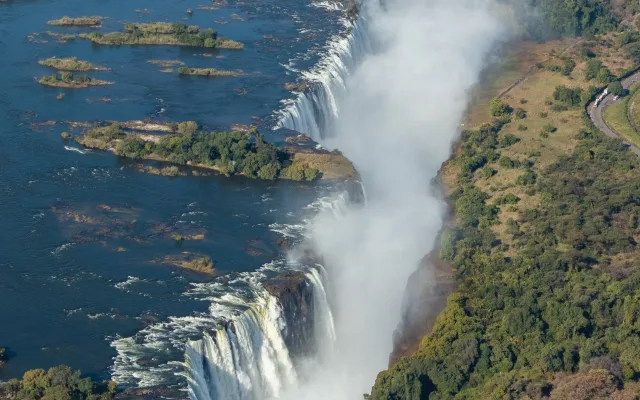
Victoria Falls is the town beside one of the widest waterfalls in the world, a UNESCO site. Here you can see the bridge over the Zambezi and set off on safari.
Wiki
Victoria Falls is a small resort town in north-western Zimbabwe, grown up around one of the most tremendous waterfalls on the planet, on the Zambezi River. It is the main gateway to a natural wonder known locally as Mosi-oa-Tunya, "the thundering smoke": the column of spray and the roar of falling water can be seen and heard for many kilometres.
The setting
The town lies on the border of Zimbabwe and Zambia, where the Zambezi drops into a narrow basalt gorge. The curtain of water reaches 1,708 metres across and falls up to 108 metres, making this the largest sheet of falling water in the world. The site is on the UNESCO World Heritage list and counted among the seven natural wonders. The falls are best watched from the Zimbabwean side, which offers around three quarters of the panorama. The alternative base is Livingstone in Zambia, a little further from the edge.
The region sits at the heart of the transboundary KAZA conservation area, which links protected land across five southern African countries. From here it is easy to reach Botswana's national parks and the wetlands of the Okavango Delta.
Main sights
- The falls and Mosi-oa-Tunya park — a network of paths with sixteen viewpoints runs along the edge of the gorge. In high-water season the flow disappears into a cloud of spray, so a raincoat, or a hired one, is welcome; in the dry season the rock structure is exposed and the long views open up.
- The Victoria Falls Bridge — a steel arch across the Zambezi gorge, built in 1905 as part of Cecil Rhodes's imperial scheme. The border runs across it today, and trains, cars and pedestrians all pass; the bold jump from it on a 111-metre bungee.
- Devil's Pool — a natural rock bath at the very lip of the drop, which you can get into during the dry season from the Livingstone Island side; the water is held back at the brink by a natural barrier of stone.
- The helicopter flight — the so-called Flight of Angels lasts about 12-25 minutes and takes in the zigzag of the gorges and the full width of the arc of water from above.
- A Zambezi cruise — an unhurried trip at sunset along the upper river, where hippos, crocodiles and elephants come to the banks to drink.
- Rafting — the stretch below the falls is considered among the strongest in the world, with grade V rapids; it runs mainly in low water.
History and culture
Long before the Europeans arrived, these lands were home to the Tonga and Lozi peoples, for whom the thundering water held sacred meaning. In 1855 the Scottish explorer David Livingstone reached the falls and gave them Queen Victoria's name. The colonial railway and tourism followed.
Local culture today shows itself in the craft markets of wood and stone carving, in drumming and in dance performances. The evening Boma Dinner and Drum show combines a traditional meal, live music and a chance for guests to take up the drums themselves.
Food
The staple is sadza, a stiff maize porridge served with stewed meat, vegetables or a relish. Barbecue over coals (braai) is popular, along with dried biltong, and for the adventurous, fried mopane worms, valued as a source of protein. The town's cafés also serve familiar international food without difficulty.
Practical information
- Getting there. The nearest airports are Victoria Falls (VFA) in Zimbabwe and Livingstone (LVI) in Zambia. Regional and major airlines both fly in, and taxis run from the terminal to the centre.
- Borders and visas. Moving between the two countries is easy on foot or by car across the bridge. The single KAZA UniVisa, valid in both Zambia and Zimbabwe, suits many travellers; check entry conditions in advance, as they change from time to time.
- Money. Zimbabwe uses US dollars, and it is best to carry cash. Markets and souvenirs are open to haggling.
When to go
The best time depends on what you want. February to May is high water after the rains: the flow is at its fullest and most spectacular, though the spray sometimes hides the view. August to December is low water: the rock is exposed, the structure of the falls is clearer, and the extreme activities open up, from swimming at the brink to rafting. Mornings give soft light and fewer visitors, and a rainbow often stands over the gorge towards evening.
Suggested itinerary
Three days are enough to walk the viewing paths without hurrying, give a day to a safari or a cruise, and keep time for adventure activities or a crossing to the Zambian side for the other perspective.