 Города и дороги
Description
An ancient town on the road from Moscow to Smolensk: the Spasskaya Tower left from its fortress, the Trinity Cathedral, and monuments to two wars, 1812 and the Second World War.
Wiki
Vyazma is a town in Smolensk Region at roughly the 212th kilometer of the M-1 highway from Moscow and 175 km from Smolensk, with about fifty thousand residents. It stands on the road by which every western army entered Russia and left it again, and its whole biography is about that: the 17th century, 1812, and 1941. In 2009 Vyazma was given the title of City of Military Glory.
The Spasskaya Tower and Cathedral Hill
A stone fortress was built here in 1632 under Mikhail Fyodorovich: six square towers covering the western approach after the Time of Troubles.
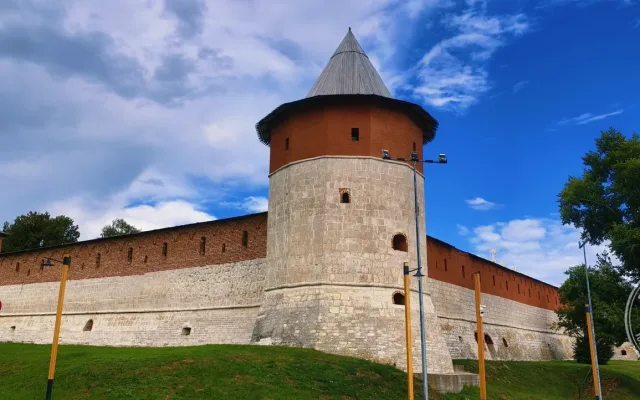
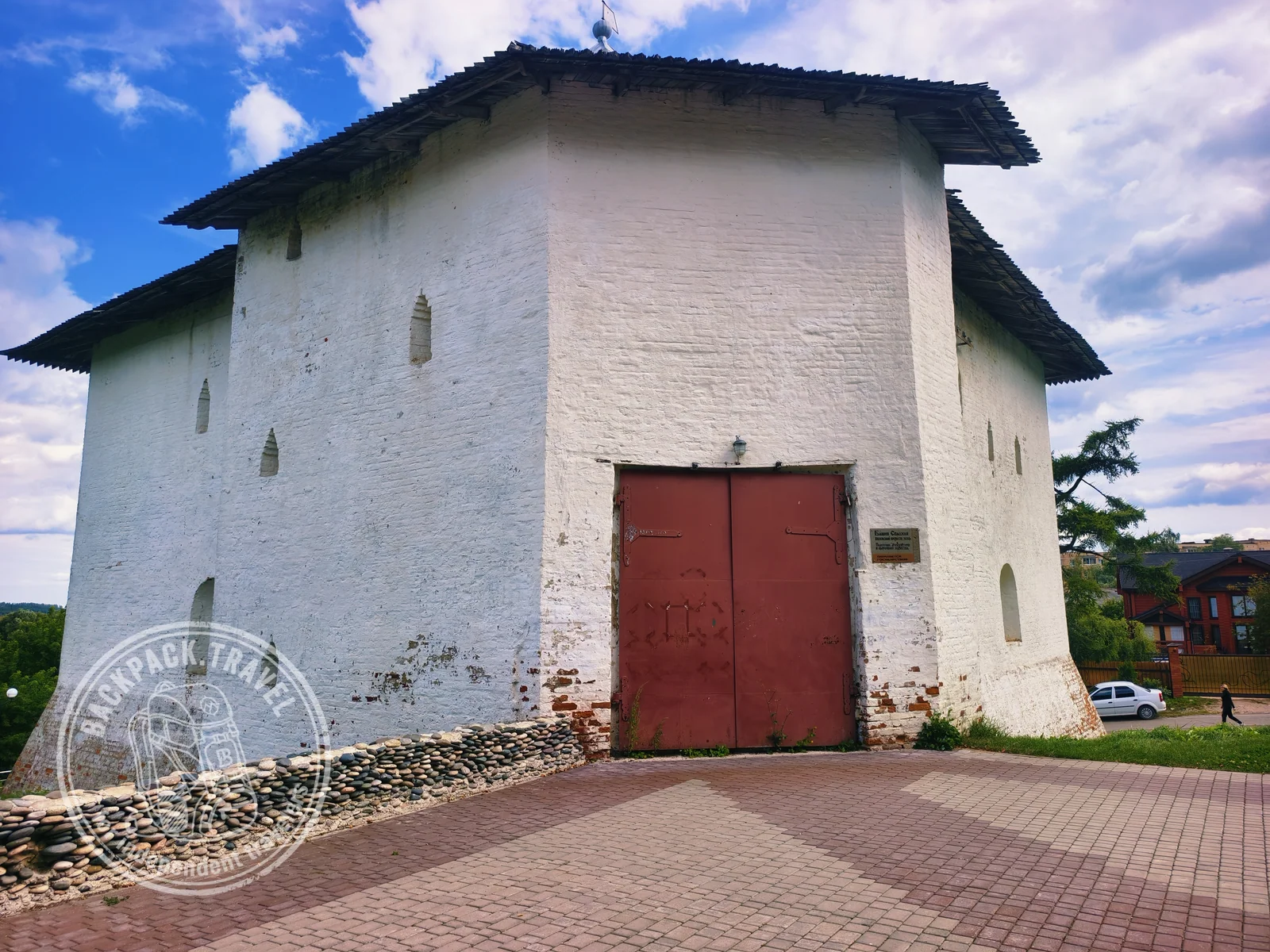
- The Spasskaya Tower is the only one of the six to survive. It is laid in oversized brick with a white-stone facing at the base, and the walls at the foot are very massive. It survived largely because it ended up inside monastery grounds, and it came through 1812 and an attempt to blow it up during the German retreat before being restored in the 1970s. This is the oldest structure in town.
- The Holy Trinity Cathedral on Cathedral Hill dates from 1674–1676 and was built under Tsar Alexei Mikhailovich on the site of earlier wooden churches. The four-tier bell tower was added in 1850. The cathedral is active and serves as the see church, and it is also the main landmark, visible on the approach to town.
- The Monastery of St John the Baptist, founded in the 1530s and 1540s by Gerasim of Boldino. Its Church of the Hodegetria (1630–1638) has three tented roofs, and there are only a handful of such churches in Russia, since after tented construction was banned nothing like it was built again. Next to it is the Ascension gate church of the mid-17th century.
The year 1812
Near Vyazma on 22 October (3 November in the new style) 1812 the vanguard of Miloradovich and Platov's Cossacks attacked the corps of Davout, Ney, Beauharnais and Poniatowski as they stretched out on the march. The French fought them off and withdrew, but by the figures of the time they lost around four thousand killed and wounded and up to three thousand taken prisoner. It is held that it was after Vyazma that the retreat of the Grande Armée ceased to be organized. The town itself burned down in the process.
The memory of this is the monument "To Valiant Ancestors" beside the Spasskaya Tower, put up for the centenary of the war and usually dated to 1912. A double-headed eagle tears at a fallen French banner, and the second head is turned to the west, where the enemy came from. Not far away stands a column with an eagle in honor of the grenadiers of the Pernov Regiment, who were first into the town.
The Vyazma pocket and General Yefremov
At the start of Operation Typhoon, between 2 and 13 October 1941, four Soviet armies were encircled west of Vyazma — the 19th, 20th, 24th and 32nd — with part of the forces caught in neighboring pockets. The estimates differ widely: German reports for the Vyazma and Bryansk pockets together gave more than 600 thousand prisoners, while researchers put the figure anywhere from half a million to almost 690 thousand. The encircled troops fought on until 13 October, and that bought time to deploy the Mozhaysk defense line, so that the defense of Moscow was effectively paid for with those armies.
The sequel came in the spring of 1942. The strike group of the 33rd Army under Lieutenant General Mikhail Yefremov broke through to Vyazma and was itself cut off. A plane was sent for the commander, but he refused to fly out and sent the regimental banners and the wounded in his place. On 19 April 1942, badly wounded during the breakout, Yefremov shot himself rather than be taken prisoner. According to the widespread account, the Germans buried him with military honors. He was made a Hero of Russia posthumously, in 1996.
The monument to Yefremov in the center was unveiled on 5 November 1946, the work of the sculptor Yevgeny Vuchetich and the architect Yakov Belopolsky, and one of the first postwar monuments on this scale in the country: a mortally wounded general with his men around him, a composition pointedly free of triumph. An eternal flame burns beside it. Vyazma was liberated on 12 March 1943.
The local history museum occupies the old Church of the Mother of God. About 12 km away, by the village of Bogoroditskoye, there is a memorial on the site of the attempted breakout from the encirclement. On the edible side there is the Vyazma gingerbread, a beaten honey cake, dense and hard.
How much time to allow
The transit minimum on the Moscow to Smolensk road is two or three hours, covering the Spasskaya Tower, the monuments of 1812, the Trinity Cathedral and the monument to Yefremov. Half a day is needed if you add the Monastery of St John the Baptist and the museum. A full day makes sense for the sake of the Bogoroditskoye field and the Khmelita estate, the ancestral home of the Griboyedov family about 35 kilometers to the north.
The town sits on the M-1 and on the Moscow to Smolensk and Brest railway, with express trains among those that stop here, some three hours from Moscow. The logical chain is Smolensk further west or Rzhev to the north if you are making a loop around the Rzhev-Vyazma salient.
Who won't enjoy it
Vyazma is an ordinary working district town with unremarkable postwar building: it burned in 1812 and was almost completely destroyed between 1941 and 1943, so hardly any old fabric is left and the monuments stand as islands among prefabricated blocks and shopping centers. There is not much of anywhere to walk, no food scene, and empty streets in the evening. If you are interested in neither old Russian architecture nor the war, the trip will come down to half an hour by the tower and the question of whether that is all. The opposite is equally true: for anyone coming after specific subjects, whether the triple-tented church, the year 1812 or October 1941, Vyazma offers a rare density on a small patch of ground.
Updated