Description
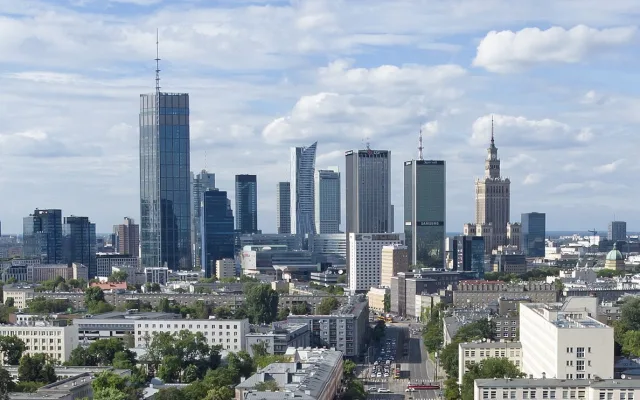
A capital reborn — the Old Town, the Royal Castle, the Uprising Museum and excellent street food.
Wiki
The reborn capital of Poland rightly bears the name of a phoenix city: after the Second World War Warsaw lay in ruins, but its historic centre was recreated from pre-war drawings, the paintings of Canaletto (Bernardo Bellotto) and the survey measurements taken by architecture students. Today it is the largest economic and cultural centre in the country, where old facades stand beside the glass skyscrapers of the business district.
History and appearance of the city
The first mentions of a settlement on the left bank of the Vistula date from the 13th century. Warsaw gained capital status at the end of the 16th century, when King Sigismund III Vasa moved his court here from Krakow — his column still greets visitors at the entrance to the Old Town. Flowering and tragedy alternated in the city's fate: the partitions of the Polish-Lithuanian Commonwealth, the Napoleonic campaigns, the uprisings against the Russian Empire. The culmination came in the autumn of 1944, when, after the suppression of the Warsaw Uprising, the Nazis methodically levelled the city. The post-war rebuilding was an unprecedented reconstruction project, and it is precisely as an example of that revival that the historic centre is on the UNESCO list.
What to see
Along with the Old Town, the Royal Castle, the Uprising Museum, the Palace of Culture and Lazienki Park, other places deserve attention:
- Krakowskie Przedmiescie and Nowy Swiat — the ceremonial axis of the city, a run of palaces, churches and coffee houses leading from Castle Square to the Square of the Three Crosses.
- Wilanow Palace — the baroque country residence of King Jan III Sobieski, a "Polish Versailles" with well-tended gardens.
- The Church of the Holy Cross — the urn walled up here holds the heart of Frederic Chopin, returned to the composer's homeland.
- The POLIN Museum of the History of Polish Jews — set on the territory of the former ghetto, and internationally awarded for its display.
- The Powazki cemeteries — the Catholic, Jewish, Orthodox and Muslim burial grounds side by side — and the Saxon Garden, the oldest public park in the city.
Districts
The centre (Srodmiescie) concentrates the business life and the main monuments. Praga on the right bank came through the war almost unscathed, keeping its pre-war buildings; former factories here have been turned into art spaces, among which the old Koneser vodka works stands out. The young quarters around Plac Zbawiciela are known for their cafes and evening life. The Vistula embankments, landscaped over the past decade, become a place for walking and open-air concerts in summer, and the river itself, with its wild right bank, is a rarity for a European capital.
Food and the table
The food scene combines tradition and modernity. Besides pierogi, zurek and bigos, it is worth trying placki (potato pancakes), flaki, and for something sweet paczki doughnuts and Polish-style cheesecake. A legacy of the communist era is the milk bar, where a filling lunch costs a handful of zloty. The street food of the food halls, the craft breweries and the third-wave coffee houses also deserve attention, and there are especially many of them in Srodmiescie and in Praga.
Transport and practicalities
The city network is convenient and inexpensive: two metro lines and extensive tram and bus routes work on a single ticket. Chopin Airport is linked to the centre by suburban train and buses, and there is also the more distant Modlin airport, used by low-cost carriers. The centre is comfortable to cover on foot, and a city bike hire scheme operates.
When to go
The best time to travel is late spring and early autumn, when it is warm and the flow of visitors is gentler than the summer peak. In summer there are free piano concerts in Lazienki and city festivals; winter brings Christmas markets and the illumination of the Old Town. Three days are enough to see the historic centre, visit the key museums, walk through Praga and the parks and, if you wish, get out to Wilanow.
Warsaw surprises with its contrasts: recreated antiquity, a stark memory of war, modern high-rises and a living creative scene add up to a capital that rewards unhurried discovery.
Photos