Description
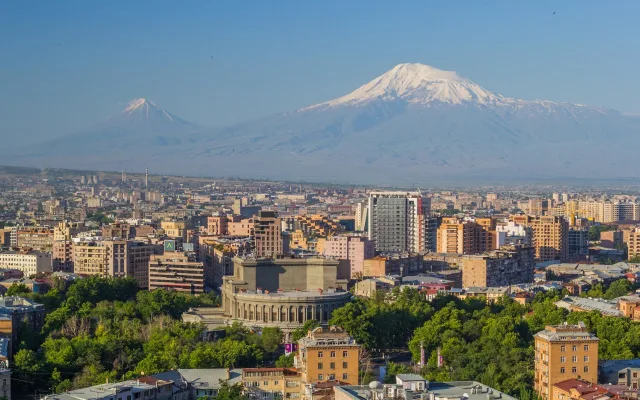
Yerevan is the capital of Armenia, known for landmarks such as the Cascade complex and the colourful Vernissage market. The city is famous for its pink tuff and its view of Mount Ararat.
Wiki
Yerevan is the capital and largest city of Armenia, spread across the Ararat plain on the banks of the Hrazdan river at the foot of the great mountain itself. It is one of the oldest continuously inhabited cities on earth, founded in 782 BC as the Urartian fortress of Erebuni — twenty-nine years before Rome. Around 1.1 million people live here today, roughly a third of the country's entire population.
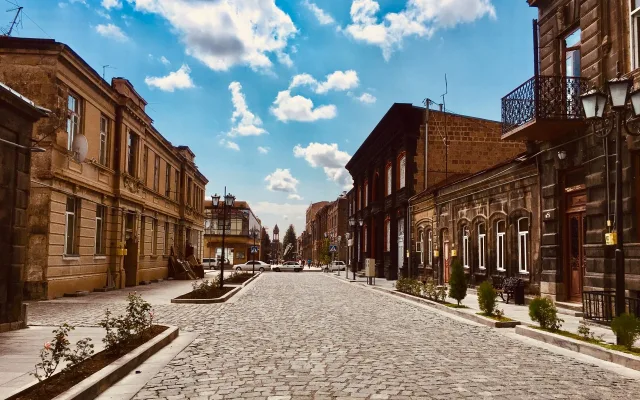
The look of the city is shaped above all by the local volcanic stone: the pink and apricot tuff of the central facades. That warm palette is why Yerevan is often called the "pink city". The symmetrical radial-and-ring centre was designed in the 1920s by the architect Alexander Tamanian, who gave the Armenian capital a coherent neoclassical ensemble with national motifs.
History and identity
Yerevan's long history runs through the crossroads of empires — Persian, Ottoman and Russian. A particular place in the self-understanding of its citizens belongs to the memory of the Armenian genocide of 1915 and the loss of Western Armenia: it was then that Mount Ararat, the sacred national symbol, ended up on the far side of the border, in Turkey. The mountain is visible from almost anywhere in the city and remains out of reach — a paradox that goes a long way towards explaining the melancholy and the endurance of Armenian culture. Yerevan also gave the world some recognisable names of its era: Armenian brandy, the joke-telling "Armenian Radio", and generous Caucasian hospitality.
Main sights
- Republic Square — the formal heart of the city, ringed by tuff buildings; in the evening the "singing fountains" put on a music and light show.
- The Cascade — a giant stepped stairway with terraces, gardens and the open-air Cafesjian Center for the Arts; from the upper levels a panorama of the city and Ararat opens up.
- The Matenadaran — the Mesrop Mashtots institute and repository of ancient manuscripts, holding more than 17,000 items, among them unique medieval codices.
- Tsitsernakaberd — the genocide memorial complex, with an eternal flame, a stele and a museum on the hill above the city.
- The Opera and Ballet Theatre and Freedom Square — the centre of cultural life, surrounded by cafés and Swan Lake.
- The Ararat brandy factory — an enterprise with nearly a century of history, offering tours of the cellars and tastings of aged brandy.
- Erebuni Fortress — an archaeological site of the Urartian era and a museum at the origin point of the city.
Around Yerevan
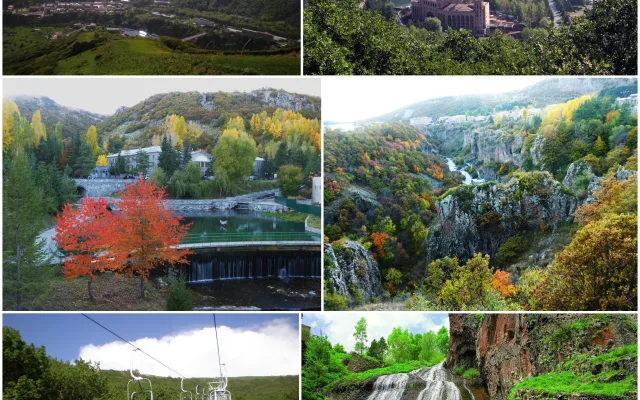
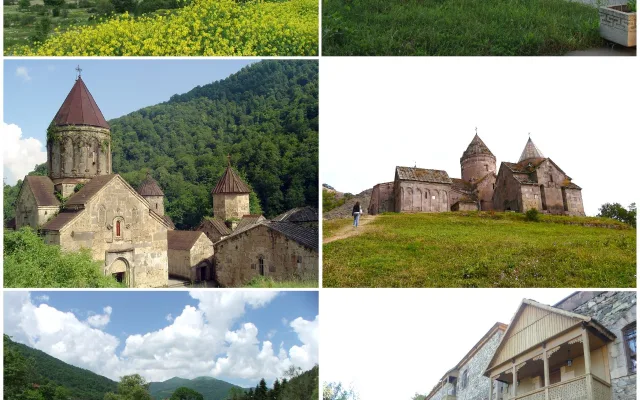
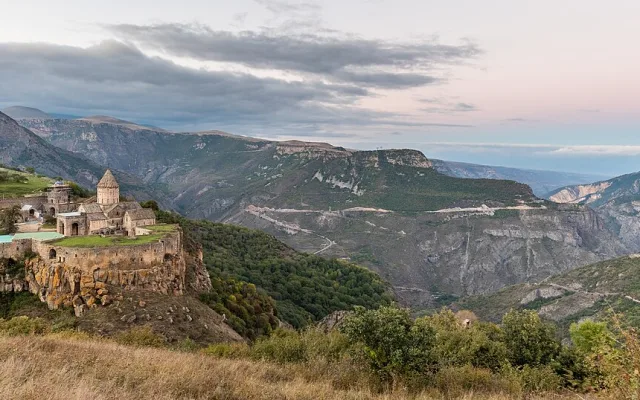
Many of the key sanctuaries lie within an hour or two. Khor Virap is a monastery right by the Turkish border, giving the best view of the twin peaks of Ararat. Garni is the country's only surviving Hellenistic-style pagan temple (1st century), standing above a picturesque gorge with its "symphony of stones". Nearby is Geghard, a monastery cut into the rock and a UNESCO World Heritage Site. In the south of the country stands the 9th-century Tatev Monastery, reached by the Wings of Tatev, one of the longest passenger cable cars in the world (about 5.7 km). Lake Sevan, with the Sevanavank monastery, is also worth a day.
Food
Armenian cooking means dolma in vine leaves, rich khash, festive harissa, cured basturma and, of course, thin lavash bread, inscribed on the UNESCO intangible heritage list. Dessert brings baklava, gata and dried fruit, along with coffee brewed in the eastern style. Popular drinks include pomegranate and apricot wine, dry red made from the areni grape, and aged brandy. For culinary finds, head to the GUM market and the stalls selling spices, cheeses and dried fruit.
Shopping and local colour
The emblem of Yerevan shopping is the Vernissage, a huge open-air fair that runs at weekends. It sells carpets, obsidian work, silver, paintings, antiques and handmade souvenirs. Nearby are the Pak Shuka market and the shopping streets of the centre.
Practicalities
Allow three days for the city and its immediate surroundings: the first for the centre, the Cascade and Republic Square; the second for Garni, Geghard and Tsitsernakaberd; the third for Khor Virap and the vineyards. Public transport means buses, minibuses and a single metro line; taxis booked through apps are convenient and cheap. The best times to visit are spring and autumn, when the summer heat has gone. The language barrier is slight: Armenian is the state language, Russian is widely spoken, and English is common in the centre, particularly among younger people.