 Города и дороги
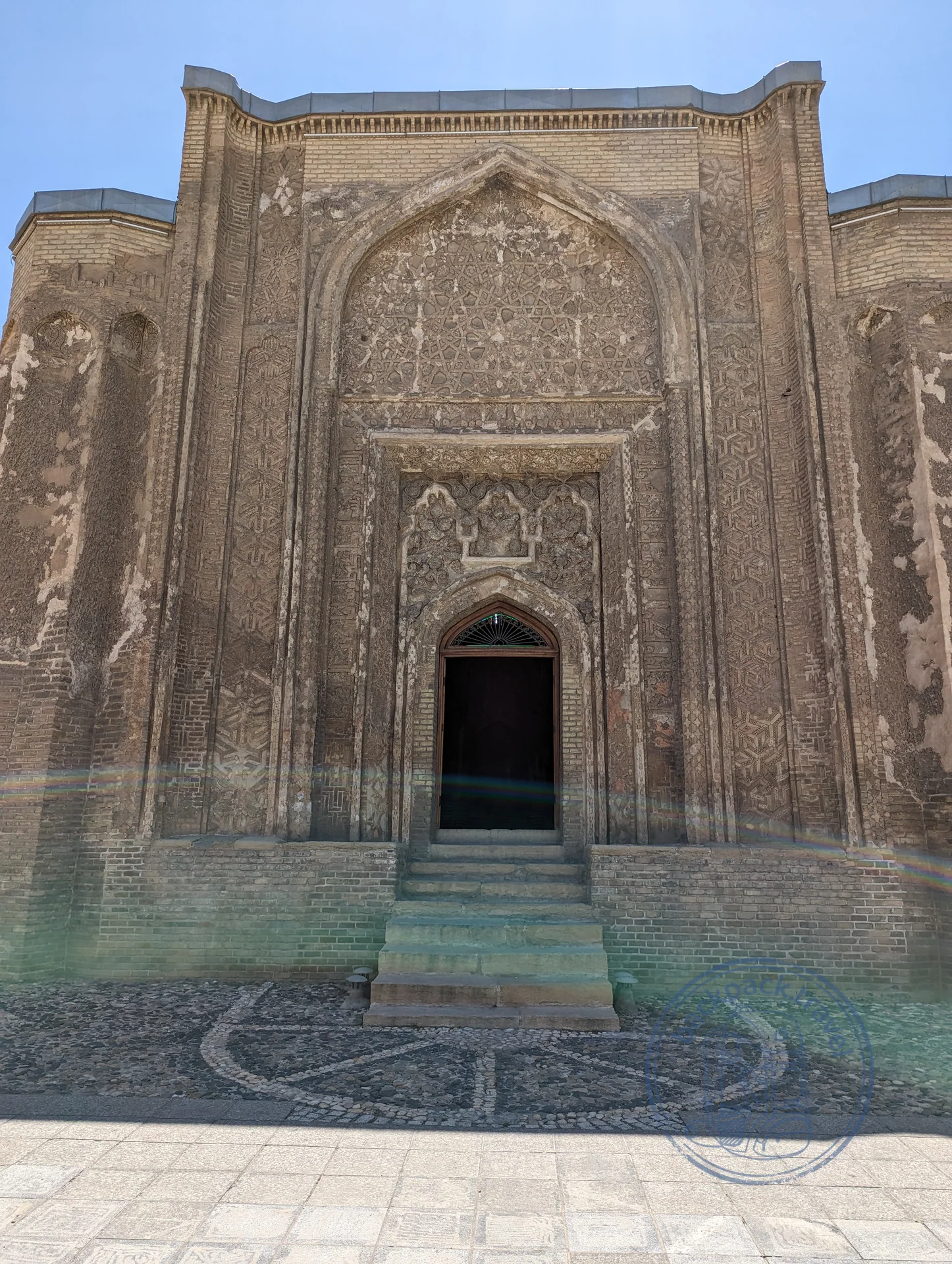
Gonbad-e Alavian is the mausoleum of the noble Hamadan family of the Alavids, built in the twelfth century, at the end of the Seljuk period. It is a square brick building with almost no windows; the dome that gave it its name has not survived, and the structure is now flat on top. Its value lies in the decoration: the facade and the interior walls are covered with deep carving in alabaster stucco, where interlacing plant scrolls, rosettes and Kufic inscriptions are laid out in several layers, so that the pattern reads like a lattice casting its own shadow. Stucco carving of this volume and quality is a rarity in the Seljuk architecture of Iran. The brickwork of the facade is laid so that the masonry itself forms a geometric pattern, while the alabaster fills only the inset panels. Inside there is a mihrab, likewise carved throughout, and beneath the floor lies a crypt with two burials, reached by a narrow staircase. The building stands away from the centre of Hamadan, among ordinary houses, and from the outside it looks modest until you come right up to the portal.
From the outside the building looks plain — everything here is for the interior, for the alabaster carving, which is worth approaching closely; entry is charged. It stands away from the centre among ordinary buildings, so navigate by GPS. Cash only.
- Address
- جلالی, Hamedan
On the map
Reviews (0)
No reviews yet. Be the first!
Updated